
Your backstage pass to the universe and how NASA studies it. Exoplanets, black holes, dark energy, and more!
- Tweets12.6K
- Following80
- Followers1.1M
- Likes327


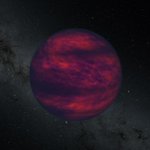


ALT Artist’s concept of a brown dwarf floating in space. A large sphere with swirling crimson and orange clouds against a dark purple atmosphere dominates the center. Behind it, scattered stars and a hazy band of the Milky Way cross the black background diagonally from upper left to lower right. The image is watermarked “Artist’s concept” and “Credit: NASA/JPL-Caltech.”


ALT A chaotic, dust-shrouded system of merging galaxies forming stars at a furious rate. Chandra X-ray data (magenta) pinpoint powerful black hole activity and hot gas, while Hubble optical (blue and white) and Webb infrared (red and grey) data illuminate vast stellar nurseries hidden behind interstellar dust. Credit: X-ray: NASA/CXC/SAO; Optical: NASA/ESA/STScI; Infrared: NASA/ESA/CSA/STScI; Image Processing: NASA/CXC/SAO/L. Frattare and J. Major


ALT Composite image of the Treble Clef, a giant radio structure in space. Bright pink filaments resembling a musical treble clef stretch through a diffuse blue cloud, surrounded by scattered stars against a black background.

ALT A spiral galaxy with two distinct arms forming a backwards "S" shape is in the foreground, against a background of many other much smaller, more distant galaxies. In the right lower corner, a gravitational lens can be seen, with a large, distinctive arc to the upper left.

ALT A nebula made of clouds of gas and dust with stars forming within. In the center and out to the left it is filled with thin, wispy blue gas that forms delicate layers. Around this are thicker orange clouds with dark ridges. Thin red filaments of gas cross the center of the nebula. Glowing bubbles in the gas contain dense, very bright clusters of stars. In the edges, distant stars are visible as bright points on a dark background.

ALT This composite shows a wide view of supernova remnant G306.3–0.9, placing it in context with star-formation regions in southern Centaurus. Chandra X-ray observations (blue), Spitzer infrared data (red, cyan), and radio observations (purple) from the Australia Telescope Compact Array are merged in this composite. The image is one degree across, which corresponds to 450 light-years at the remnant's estimated distance. Credit: X-ray: NASA/CXC/Univ. of Michigan/M. Reynolds et al; Infrared: NASA/JPL-Caltech; Radio: CSIRO/ATNF/ATCA


ALT In a darkened clean room, a technician clad in white coveralls, hood, mask, and blue gloves inspects a prototype telescope set within a black frame. At center, the telescope’s translucent, tan-colored structure glows as the technician shines a flashlight behind it. Other suited people partially appear in the background at right, while at top and left ceiling lights from areas beyond the clean room can be seen through windows. The image is watermarked “Credit: NASA/Dennis Henry.”


ALT The shimmering colors visible in this NASA/ESA Hubble Space Telescope image show off the remarkable complexity of the Twin Jet Nebula. Lobes of material, in teal, orange and blue hues, stretch outward like elongated orbs from a central star system that shines bright white. Streams of gas jet outward from the center. Stars are visible in the background, dotting the black of space in yellow and white. Credit: NASA/ESA/Judy Schmidt


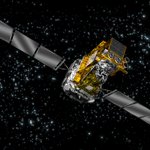
ALT NASA’s Neil Gehrels Swift Observatory orbits above Earth in this artist’s concept. Image Credit: NASA’s Goddard Space Flight Center Conceptual Image Lab

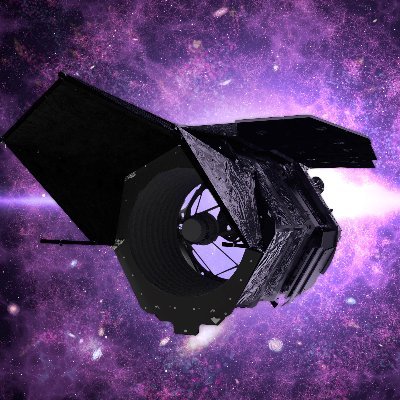
ALT An artist concept of the Nancy Grace Roman Space Telescope against a purple and black background. The telescope is a silver cylinder, with a panel of solar panels along the back like wings on an insect. A hood along the front is open to reveal a mirror, reflecting purple.

ALT A dark brown dust structure swathes across the center of a vista of glowing red gas, interspersed with bright stars.


ALT A spiral galaxy viewed from its side, featuring a giant halo of hot gas blowing out of its stellar disk. X-rays from Chandra and ESA’s XMM-Newton (purple and royal blue) trace hot gas driven out by supernovas and black holes and neutron stars pulling gas from their companions, while optical light (light blue, gold and white) from ground-based observer R. Jay GaBany showcases dense dust lanes. Edge-on views of galaxies allow astronomers to study how flat their stellar disks are and provide the clearest views of material located above or below the disk. Image Credit: X-ray: NASA/CXC/SAO; Optical: ©2011-2015 by R Jay GaBany, Cosmotography.com; Image Processing: NASA/CXC/SAO/L. Frattare

ALT An edge-on spiral galaxy. Its rusty-brown dust lanes bisect the galaxy lengthwise. Bright-blue points dot the galaxy and seem to be more dense on its left side. A bright foreground star shines just to the left of the galaxy's center. The background is black and dotted with distant galaxies and a smattering of foreground stars, which are easily identified by their diffraction spikes.


ALT Several galaxies shine against black space, with a large cluster near center-left.

ALT On an abstract purple space-inspired background, illustrations of 11 space telescopes form the shape of a heart around another. Each telescope is shaded in a monochrome blue palette, and they have a variety of different shapes and features. These spacecraft are not depicted to scale. Credit: NASA