

The Policy Division of @MSM_NCPC. All tweets are sole responsibility of authors.
- Tweets2.2K
- Following253
- Followers295
- Likes446









ALT Today is National Center for Primary Care Day. Image of proclamation. At NCPC's Grand Opening, both the City of Atlanta and Fulton County proclaimed Nov. 2, 2002 as the Morehouse School of Medicine National Center for Primary Care Day.

ALT NCCHCA Annual Primary Care Conference and Board Meeting. Transformation: Embracing a New Tomorrow on June 7-9, 2023 at Washington Duke Inn and Golf Club in Durham, North Carolina.

ALT NCPC in DC: The National Center for Primary Care at Morehouse School of Medicine was excited to join the Consumer Technology Association and our partners at the CTA Innovation House on April 27th to discuss the findings from our Digital Health Tools Study. This enlightening conversation is part of our work to advance health equity.

ALT Panel discussion with five people at the CTA Innovation House in Washington, D.C.

ALT This session will discuss the history and value of practice-based research networks (PBRNs)and describe how patient and clinician engagement is foundational to the work of PBRNS. Dr. Gaglioti will discuss why it is imperative to have the lived wisdom of front-line primary care practice and community members generating research and evidence to ensure that research is translatable to the primary care setting and relevant to communities and practitioners. A learning series brought to you by The Network for Community-Engaged Primary Care Research (NCPCR) Objectives: Understand the history and value of practice-based research networks; Understand how patients can contribute to improving the health of their communities via research engagement; Learn about the history of patient engagement in research in the US

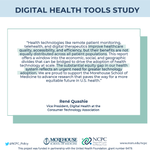
ALT Quote from Rene Quashie, Vice President of Digital Health at the Consumer Technology Association: “Health technologies like remote patient monitoring, telehealth, and digital therapeutics improve healthcare quality, accessibility, and efficiency, but their benefits are not equally distributed across all patient populations. This report offers a window into the economic, social, and geographic divides that can be bridged to drive the adoption of health technology at scale. The substantial equity gap in our health system reflects an urgent need for greater technology adoption. We are proud to support the Morehouse School of Medicine to advance research that paves the way for a more equitable future in U.S. health.”

ALT Advancing Health Equity and the Role of Health Technology presented by Consumer Technology Association and Morehouse School of Medicine. Panelists: Megan Hauck, Senior Program Manager of Diversity Initiatives at Consumer Technology Association. Dominic Mack, MD, MBA, Director of the National Center for Primary Care and Professor of Family Medicine at the Morehouse School of Medicine.

ALT Advancing Health Equity and the Role of Health Technology presented by Consumer Technology Association and Morehouse School of Medicine. Panelists: Bryan O. Buckley, DrPH, MPH, MBA, Director of Health Equity Initiatives at the National Committee for Quality Assurance (NCQA). Lisa Fitzpatrick, MD, MPH, MPA, CEO and Founder of Grapevine Health. David Hunt, MD, Medical Director of Patient Safety & Health IT Adoption at the Office of the National Coordinator for Health IT (ONC). Saranya Loehrer, MD, MPH. Chief Health Equity Officer at Teladoc Health.

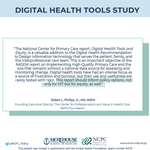
ALT Quote from Robert L. Phillips, Jr., MD, MSPH, Founding Executive Director and The Center for Professionalism and Value in Health Care, ABFM Foundation: The National Center for Primary Care report, Digital Health Tools and Equity, is a valuable addition to the Digital Health Recommendation to Design information technology that serves the patient, family, and the interprofessional care team. This is an important objective of the NASEM report on Implementing High-Quality Primary Care and the one that remains without a national data source for assessing and monitoring change. Digital health tools have had an intense focus as a source of frustration and burnout, but their use and usefulness are rarely tested with rigor. This report should inform policy options, not only for HIT but for equity, as well.”

ALT Advancing Health Equity and the Role of Health Technology. Thursday, April 27, 2023 from 9:30 am to noon eastern time at the CTA Innovation House.

ALT Quote From Dr. Adrienne Mims, Chief Medical Officer for Rainmakers Strategic Solutions: “The timing of the DHTS is invaluable in demonstrating the impact that the pandemic has had on the increased access to health care services for underserved through the use of telemedicine. As the national healthcare system moves forward with population health through value based care, the identified barriers of broadband and smartphone access, lack of integration into clinical workflows and interoperability need to be prioritized to prevent further inequalities in healthcare.”

ALT Advancing Health Equity and the Role of Health Technology. Thursday, April 27, 2023 from 9:30 am to noon eastern time at the CTA Innovation House.

ALT Key Policy and practice changes to support digital health tool use from the Digital Health Tools Study: 1) prioritizing equity in health care transformation efforts; 2) improving the interoperability of digital health tools; 3) improving access to telehealth; 4) increasing accessibility to culturally and linguistically tailored patient centered DHTs; 5) increasing support for both patients and health care professionals in the use of DHTs.

ALT Advancing Health Equity and the Role of Health Technology. Thursday April 27, 2023 from 9:30 am to noon eastern time at the CTA Innovation House. Register today

ALT Key Findings from the Digital Health Tools Study. Clinicians participating in quality reporting programs were more likely to use telemedicine, health information exchanges, and electronic health records than other digital health tools. Top barriers to adopting digital health tools: 53% time, 51% cost, 40% limited workflow integration

ALT Save The Date: The National Center for Primary Care at Morehouse School of Medicine, in partnership with the Consumer Technology Association is hosting a Congressional Briefing. Location: CTA Innovation House at 21 D St SE in Washington, DC. Date: Thursday, April 27 9:20 am to 12 pm. Register at bit.ly/PolicyBrief

ALT Key Findings from the Digital Health Tools Study. 99% of respondents had used at least one DHT in the past five years. 52% of respondents who used telehealth because of COVID-19 reported in was their first time. Top factors for supporting digital health tool adoption: 58% ease of workflow integration, 55% meets patients need, and 50% improves patient health.


ALT Digital Health Tool Study Data Highlight, Southeast: Reasons for Using digital health tools during COVID-10: Training (38.5%), treatment of COVID-19 positive patients (62.6%), treatment of COVID-10 negative patients (66.2%), and other (9.8%)
