

The AI Trading Platform. Build. Backtest. Deploy. AI Agents • Trading Map • Automation CA: 0x97F68328cF8Ad42eDC771355bdEDAc657f4949b9
Joined April 2025
- Tweets619
- Following11
- Followers1.3K
- Likes11.7K


Pinned Tweet
$NEUT has been live for two days. Now, the real building begins.
Today, we’re sharing the first in-depth look at the NEUTON product.
First up: Backtesting.
See how users can build a strategy, define conditions, run a backtest, and review the results—all within the NEUTON platform.
More is coming.
$NEUT #NEUTON #AITrading
An incorrect AI result can come from different failures.
In trading, inaccurate market data, flawed strategy logic, or insufficient backtesting can lead to unreliable decisions.
NEUTON integrates AI-powered market analysis, backtesting, strategy optimization, and automated execution into a unified trading workflow.
By identifying weaknesses at each stage, traders can refine their strategies before deploying them in live markets.
Analyze. Validate. Optimize. Execute.
$NEUT #NEUTON #AITrading

10
12
63
A chart insight may pass through several steps before reaching a user: raw exchange data, cleaning, aggregation, calculations, and AI interpretation.
If a result looks suspicious, can those steps be traced backward? Data lineage connects the final claim to the transformations and sources that produced it.
That makes corrections more precise and reviews more transparent.
Trust improves when evidence has a readable history.
$NEUT #NEUTON #HumanAI

23
25
189
Before relying on an AI assistant for recurring research tasks, give it cases with known facts and expected behavior.
Can it identify a missing input? Does it refuse to invent a price? Can it distinguish a hypothetical result from a live one?
Evaluate the response against clear criteria, then document the failures. Testing known cases is different from asking the AI to criticize its own opinion.
It measures behavior against a defined standard.
$NEUT #NEUTON #HumanAI

9
7
54
Two AI systems may both say “wait” while relying on entirely different observations.
One may focus on volatility; another may detect weak liquidity. Agreement on the final action does not mean agreement on the reasoning.
Compare the evidence paths before interpreting consensus as stronger support.
The value of multiple perspectives comes from understanding their differences, not simply counting identical answers.
$NEUT #NEUTON #HumanAI

2
48
A model can produce a plausible explanation for a market move without proving that explanation is true.
A narrative about buyers, news, or liquidity needs supporting observations that can be checked independently. Treat AI-generated reasoning as a hypothesis until the relevant evidence is identified.
Good explanations help people ask better questions; they do not replace the work of verification.
A convincing story is not automatically a verified cause.
$NEUT #NEUTON #HumanAI

18
An AI answer can sound certain and still be wrong.
Fluent language, a precise percentage, or a decisive recommendation does not prove the underlying claim. Where confidence scores exist, they need to be evaluated against actual outcomes rather than read as guarantees.
For market research, separate how strongly a system states a conclusion from how well that conclusion is supported.
Conviction in the wording is not evidence of correctness.
$NEUT #NEUTON #HumanAI

25
A performance chart can look strong when it begins after a difficult period and weak when it includes that same period.
Neither image is necessarily fabricated; the selected window changes the story. Compare consistent start and end dates when evaluating alternatives, and note what market conditions the window includes.
A return figure without its measurement period is missing essential context.
The calendar is part of the evidence.
$NEUT #NEUTON #TradingPerformance

22
A marketplace may display many active strategies while failed or retired systems are harder to find.
Studying only the survivors can make the ecosystem look stronger than the full history would suggest. Ask whether inactive, discontinued, or delisted BOTs are represented in the dataset being analyzed.
The missing cases matter when evaluating a category of strategies.
What remains visible is not necessarily everything that existed.
$NEUT #NEUTON #TradingPerformance

23
A marketplace may display many active strategies while failed or retired systems are harder to find.
Studying only the survivors can make the ecosystem look stronger than the full history would suggest. Ask whether inactive, discontinued, or delisted BOTs are represented in the dataset being analyzed.
The missing cases matter when evaluating a category of strategies.
What remains visible is not necessarily everything that existed.
$NEUT #NEUTON #TradingPerformance

19
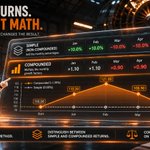
A sequence of percentage gains can produce different headline figures depending on whether returns are compounded.
Adding monthly percentages is not the same as multiplying the monthly growth factors. For example, a gain followed by an equal-sized percentage loss does not return capital to its starting point.
Check the calculation method before comparing BOT performance summaries.
Similar-looking return figures may describe different mathematics.
$NEUT #NEUTON #TradingPerformance

22
A reported average return is an estimate drawn from observed trades.
It is not a perfectly known property of the strategy. Confidence intervals can communicate how uncertain that estimate is under stated statistical assumptions.
A wide interval signals that the evidence allows a broad range of plausible values. Rather than treating one decimal number as a promise, examine the uncertainty surrounding it.
Precision on the screen is not certainty in the market.
$NEUT #NEUTON #TradingPerformance

17
A 10% drawdown does not tell you how long an account stayed below its previous high.
One strategy may recover quickly; another may spend months underwater. That difference matters for capital planning and the patience required to operate the system.
Measure time to recovery alongside drawdown depth. Risk has a duration as well as a size.
The calendar can reveal what a percentage cannot.
$NEUT #NEUTON #TradingPerformance

15
A long winning streak makes an attractive screenshot.
But the order of wins and losses is only one part of performance. A strategy can have a memorable streak and still show unstable results across months or market conditions.
Look beyond the longest run of green trades and examine the broader sequence.
A streak describes what happened consecutively; stability asks how dependable the process appears over time.
$NEUT #NEUTON #TradingPerformance

2
2
20
Two strategies can lose the same total amount in very different ways.
One may experience frequent small losses; another may remain quiet before suffering a rare, severe decline. Total loss alone hides that difference.
Review how often losses occur and how large they become, including the tail of the distribution.
Understanding the shape of losses helps explain the experience of operating a system, not just its final score.
$NEUT #NEUTON #TradingPerformance

28
Imagine nine modest trades and one exceptionally large winner.
The average result may look impressive even though the typical trade is much smaller. Compare the mean with the median to see how much a few extremes influence the headline figure.
Neither statistic tells the entire story, but together they reveal more than one number alone.
Ask what a normal outcome looks like, not only what the arithmetic average says.
$NEUT #NEUTON #TradingPerformance

19
An account balance can rise because the strategy earned money or because the owner deposited more funds.
Those events should not be mixed when evaluating returns. Record external cash flows separately and use an appropriate performance method for the question being asked.
A growing account is not automatically a winning strategy.
Performance analysis begins by separating trading results from capital movements.
$NEUT #NEUTON #TradingPerformance

26
A dashboard can show a growing profit while the position remains open.
That number is unrealized P&L, not the same as a completed trading result. Market movement, fees, and closing conditions can change what is ultimately realized.
When reading BOT performance, separate open-position valuation from closed-trade outcomes. Both matter, but they answer different questions.
A displayed gain is not always money already secured.
$NEUT #NEUTON #TradingPerformance

23
A valid API credential can still be used in an unexpected way.
Sudden request bursts, unfamiliar locations where available, or actions outside normal operating patterns may warrant investigation. Define what ordinary access looks like and what should trigger review.
Detection is different from permission management: it asks whether an authorized connection is behaving as expected.
Security improves when unusual activity becomes visible early.
$NEUT #NEUTON #TradingSecurity

22
Saving a configuration file is useful, but it does not prove a system can be restored.
A backup may be incomplete, incompatible with a newer version, or missing a dependency. Test the recovery procedure in a safe environment and document the steps required to return to operation.
The meaningful question is not whether a copy exists.
It is whether that copy can rebuild the system when needed.
$NEUT #NEUTON #TradingSecurity

24
After a connection failure, the application may have an incomplete picture of what the exchange actually executed.
An order marked pending locally might already be filled, canceled, or partially filled remotely. Before resuming automation, compare exchange-side orders and positions with internal records.
Resolve mismatches instead of assuming the local screen is correct.
Recovery begins with the real account state, not with restarting the software.
$NEUT #NEUTON #TradingSecurity

20