

#WEARE the Natural Language Processing Lab at Penn State :)
State College, PA
Joined June 2017
- Tweets196
- Following100
- Followers158
- Likes243



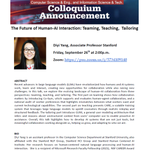






We are pleased to announce the upcoming NLP Colloquium, which will take place on Friday November 21, from 2 pm to 3 pm (ET). Please join us on zoom(psu.zoom.us/j/92438180581) if you are interested.
We are looking forward to your participation!

We are pleased to announce the upcoming NLP Colloquium, which will take place on Friday November 14, from 2 pm to 3 pm (ET). Please join us on zoom(psu.zoom.us/j/98595718475) if you are interested.
We are looking forward to your participation!

We are pleased to announce the upcoming NLP Colloquium, which will take place on Friday October 24, from 2 pm to 3 pm (ET). Please join us either in-person or zoom(psu.zoom.us/j/93456668909) if you are interested. We are looking forward to your participation!

We are pleased to announce the upcoming NLP Colloquium, which will take place on Friday September 26 (today), from 2 pm to 3 pm (ET).Please join us via Zoom if you are interested (psu.zoom.us/j/5734109140).We are looking forward to your participation!

2
82


PSU NLP LAB retweeted

📢 New paper!
FoVer enhances PRMs for step-level verification of LLM reasoning w/o human annotation 🚀
We synthesize training data using formal verification tools and improve LLMs at step-level verification of LLM responses on MATH, AIME, MMLU, BBH, etc.
arxiv.org/abs/2505.15960


PSU NLP LAB retweeted

Excited to share our latest work!
The development of process reward models (PRMs) is limited by manual labeling of step-level reasoning correctness. In this new paper led by @RyoKamoi, we use formal verification tools — formal logic and theorem proving — to automatically synthesize high-quality examples for training LLM-based reasoning verifier. We found this improves LLM-based PRMs with generalization across a wide range reasoning tasks!

📢 New paper!
FoVer enhances PRMs for step-level verification of LLM reasoning w/o human annotation 🚀
We synthesize training data using formal verification tools and improve LLMs at step-level verification of LLM responses on MATH, AIME, MMLU, BBH, etc.
arxiv.org/abs/2505.15960
PSU NLP LAB retweeted

TIL: "Artificial Intelligence" was coined in 1956 by Dartmouth College😮
John McCarthy was then a mathematics professor.

PSU NLP LAB retweeted
Poster is ready for #NAACL. If you are attending and interested in evaluation, responsible ai, post training..let’s chat
☕️ is on me!


PSU NLP LAB retweeted

In this era of vibe coding fueled by LLMs, our #CHI2025 paper, led by amazing @StevenHe918, asked a simple question:
Can we really get away with *not* using gold labels?
Paper: arxiv.org/abs/2502.11267 1/n

PSU NLP LAB retweeted
Excited to be part of this amazing work led by @ShayneRedford where we find that data distribution across all modalities is very skewed in favor of some countries!

Thrilled our global data ecosystem audit was accepted to #ICLR2025!
Empirically, we find:
1⃣ Soaring synthetic text data: ~10M tokens (pre-2018) to 100B+ (2024).
2⃣ YouTube is now 70%+ of speech/video data but could block third-party collection.
3⃣ <0.2% of data from Africa/South America.
1/

PSU NLP LAB retweeted
Ever wondered how much you can trust a benchmark?
We did too - so we built SMART to make them smarter!
I will be presenting our work at NAACL along with my coauthors @megnung @DavidPantoja__
See you all in New Mexico!
PSU NLP LAB retweeted
Excited to share SiReRAG! Our #ICLR2025 paper on improving RAG indexing for multihop reasoning.
🔍 SiReRAG combines similarity (semantic closeness) and relatedness (entity-based connections) to better organize and retrieve information from large corpora for comprehensive knowledge synthesis.
📈 SReRAG delivers consistent gains over state-of-the-art methods with +1.9% avg F1 on multihop QA benchmarks including MuSiQue, 2WikiMultiHopQA, and HotpotQA.
📄 Paper: arxiv.org/abs/2412.06206
🛠️ Code: github.com/SalesforceAIResea…
This work is led by my excellent PhD student @NanZhangNLP during his internship at Salesforce, collaborated with Prafulla Kumar Choubey, @alexfabbri4 , Gabriel Bernadett-Shapiro, Prasenjit Mitra, @CaimingXiong , and @jasonwu0731. Nan is currently on the job market, please consider hiring him!


📢 Happy to introduce SiReRAG: our #ICLR2025 paper on RAG indexing!
Facilitating comprehensive knowledge synthesis on multihop reasoning, SiReRAG models both similarity and relatedness signals of a corpus.
Code: github.com/SalesforceAIResea…
Paper: arxiv.org/abs/2412.06206
(1/N)🧵

PSU NLP LAB retweeted
🚀If you're looking for inference-time techniques to max out the reasoning ability of your local LLMs, check our #ICLR2025 paper GreaTer for gradient-based prompt optimization! We generate fluent & strategic prompts outperforming APO/APE/PE2/TextGrad on multiple reasoning benchmarks across BBH, GSM8k, and FOLIO! 📊🔥
🔑Three key takeaways
1️⃣Gradient can better guide prompt refinement than text-based feedback, unlocking stronger reasoning in small, local LLMs without relying on expensive proprietary models.
2️⃣Incorporate CoT reasoning — not just final answers — leads to smarter, more context-aware prompts.
3️⃣Use perplexity to constrain the search space to generate fluent and readable prompts.
We make it extremely easy to use GreaTer as a Python library with GUI interfaces:
📝Paper: arxiv.org/abs/2412.09722
🔗Python Library: github.com/psunlpgroup/Great…
Led by @sarkarssdas. Collaboration with @RyoKamoi @bo_pang0 @YusenZhangNLP @CaimingXiong

🚨 New #ICLR2025 Paper & Library Alert!
Tired of hand-crafting prompts or relying on massive LLMs for optimization?
Meet GReaTer — a gradient-based method that leverages gradients over reasoning chains to optimize prompts and help small models reason better.
Even better? Check out GReaTerPrompt, a fully open-source library that wraps GReaTer and other prompt optimization techniques into a unified API — plus an easy-to-use Web UI for non-experts.
📝 GReaTer (ICLR’25): arxiv.org/abs/2412.09722
@RyoKamoi @bo_pang0 @YusenZhangNLP @CaimingXiong @ruizhang_nlp
🛠️ GReaTerPrompt: arxiv.org/abs/2504.03975
Wenliang Zheng, @YusenZhangNLP , @ruizhang_nlp
📦 PyPI: pypi.org/project/greaterprom…
🔗 GitHub: github.com/psunlpgroup/GreaT…, github.com/psunlpgroup/Great…
(1/N)

ALT Workflow of GReaTer, where we leverage gradient over reasoning to calculate optimal prompt for the task.

ALT GReaTerPrompt library offers a unified API with an easy-to-use web-UI for prompt optimization
PSU NLP LAB retweeted
Thrilled to see DeepSeek-GRM evaluated on our ReaLMistake dataset 😍
ReaLMistake continues to be a challenging benchmark for error detection in LLM responses.
📄ReaLMistake paper: arxiv.org/abs/2404.03602
🔍ReaLMistake dataset: huggingface.co/datasets/ryok…

Checkout this interesting reasoning focused prompt optimization work from our group!
🚨 New #ICLR2025 Paper & Library Alert!
Tired of hand-crafting prompts or relying on massive LLMs for optimization?
Meet GReaTer — a gradient-based method that leverages gradients over reasoning chains to optimize prompts and help small models reason better.
Even better? Check out GReaTerPrompt, a fully open-source library that wraps GReaTer and other prompt optimization techniques into a unified API — plus an easy-to-use Web UI for non-experts.
📝 GReaTer (ICLR’25): arxiv.org/abs/2412.09722
@RyoKamoi @bo_pang0 @YusenZhangNLP @CaimingXiong @ruizhang_nlp
🛠️ GReaTerPrompt: arxiv.org/abs/2504.03975
Wenliang Zheng, @YusenZhangNLP , @ruizhang_nlp
📦 PyPI: pypi.org/project/greaterprom…
🔗 GitHub: github.com/psunlpgroup/GreaT…, github.com/psunlpgroup/Great…
(1/N)
ALT Workflow of GReaTer, where we leverage gradient over reasoning to calculate optimal prompt for the task.
ALT GReaTerPrompt library offers a unified API with an easy-to-use web-UI for prompt optimization
4
138
PSU NLP LAB retweeted
I will be visiting @jhuclsp on Friday to talk about data annotation, crowdsourcing, and LLMs.
Come say hi. :)
More:
clsp.jhu.edu/events/ting-hao… – at State College, PA
