

Mostly intelligible rambles.
NY
Joined May 2022
- Tweets15.6K
- Following538
- Followers7K
- Likes64.8K




Pinned Tweet
Article’s out! Memoirs and travelogues as genres should be revived, so as my own contribution, I wanted to write on my recent travels and my discovery of «home»—here’s the outcome. LMK what y’all think. traversingtradition.com/2025…

One thing I’ll never regret is having my own study and all the money I’ve dropped on it. If you can, invest in physical books and take other PDFs offline and store them in your HDDs/SSDs. Take your LLMs offline as well. Internet unfreedom will only increase from here, so prepare.


All the romanticization you see of American life occurred in those eras. Education had meaning. Mortgages cost only a fraction of your income—after all expenses, you’d have saved up comfortably. Institutional and social trust were high. The transition to technology was viewed with hope. You will never have this again.


Liked this idea, so decided to expand it to include the whole world rather than just London. I also added in a feature where you can (1) check the reviews of the restaurant, and (2) whether it’s on the BDS list. Take a look: food.nafalis.com

back in London for a month, so here’s my contribution to the city.
introducing the London Food Money Matrix: a map of ~600 London restaurants, cafés and pubs and who owns them, whether that’s private equity, big corporates, or independent. look up a place before you go, and if it’s PE-owned it’ll show you an indie spot nearby.
why: went to Harry’s yesterday and the staff broke into Bella Ciao mid-dinner. since when is Harry’s a tourist trap?
so me and my friends looked it up - it was sold this year in a £1.4bn deal to an Abu Dhabi investment group.
london-food-money-matrix.ver…


There is no greater gift than passing on hope and knowledge. When you see a child, teach him of the incoming civilizational collapse, the Second Great Depression, the famine to overtake us all, the New World that will make humanity obsolete, and the fires to ensue from all ends.
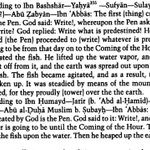
See for example how medieval Islamicate thought was. Travis Zadeh’s study on the ‘Aaj’ib is great, and Kitab al-Bulhan is well-known to anyone interested in the topic. But there’s a point to be made on Tafsir as well and how fantastical ideas make their way into interpretations.


We moderns understand physical realities better than the ancients and medievals, but unlike them our thinking is restricted and rigid (see Mortimer on medieval England). Society was violent, and thus violence was humorous—something we can’t imagine as readily today.
Society was also more in touch with the supernatural, seemingly, hence the fascination, because these predate modernity’s disenchantment by long. How many experiences did they have that became narrations, as narrations became histories, and histories became legends, and legends became myths?
When you read into the Occult in particular, this shows well—or even in myths. Human imagination is vast, but there’s always a basis to all these occurrences. We aren’t a people divorced from those who preceded us, but a people who grew into their legacies.
There are several reports al-Tabari presents that convey fantastical ideas about the world, for example. You check al-Idrisi’s map, and you also find a place where he “locates” Ya’juj and Ma’juj. Surrounding the circle are the icy mountains of Qaf—terrains where there reside different races of Jinn. (See Travis Zadeh’s work for more details on the last point.)


Read Borges, C.S. Lewis, Tolkien, and their fascination with the medieval mind and its products (myths, folklores, and way of thinking), and disillusionment with the modern world. It becomes clear why it all feels connected and fascinating.

Serious question yeah… how does one person sit down, invent an entirely fictional world, give it centuries of history, languages, politics, bloodlines, magical laws, ancient prophecies and interconnected characters, then somehow make every little detail feel like it existed long before we ever opened the first book?
We moderns understand physical realities better than the ancients and medievals, but unlike them our thinking is restricted and rigid (see Mortimer on medieval England). Society was violent, and thus violence was humorous—something we can’t imagine as readily today.
Society was also more in touch with the supernatural, seemingly, hence the fascination, because these predate modernity’s disenchantment by long. How many experiences did they have that became narrations, as narrations became histories, and histories became legends, and legends became myths?
When you read into the Occult in particular, this shows well—or even in myths. Human imagination is vast, but there’s always a basis to all these occurrences. We aren’t a people divorced from those who preceded us, but a people who grew into their legacies.
People raising this point forget that the reason they cheat is the “thrill” associated with it and to seek pleasure from someone more youthful. You hear stories from Muslim circles all around where converts are preyed on and divorced after sex. No number of marriages fixes this.


Be militant about your time, anon.
A thing to emphasize—that I don’t do nearly enough of myself—is to be absolutely militant about your time, how you spend it, where, and why. Be eager for what benefits, and do not give in to incapacity or entertain thoughts that there’s time. There is none. The world will burn.
12
605


