

Helping agency owners turn financial chaos into profitable growth. Founder & EA @ Basta & Croop 📊 Profitability • Cash Flow • Agency Finance
Free Profitability Review Call
Joined June 2026
- Tweets479
- Following164
- Followers33
- Likes278





Pinned Tweet
Hi, I'm Neil.
Father of 3. Christian, faith is the foundation everything else is built on.
I've been in business 15+ years. I'm deaf. It shaped how I listen, how I read people, and how I run a firm.
I train BJJ. It's the closest thing to running a business: stay calm, solve the problem in front of you, tap and reset when you're wrong.
Here's what I've noticed:
The typical agency owner I talk to has a CPA, a bookkeeper, payroll handled. Maybe even a financial advisor.
And they still lose sleep over money.
Why? Every one of those people looks backward. Nobody is answering "can I afford this hire" or "when do I raise prices."
Compliance is not clarity. You need both.
That's what I do. I help agency owners bring clarity to their numbers so they can scale profitably.
Glad you found me. Let's get to know each other.
Took my @cybertruck in for service at North Charlotte @Tesla and found a lot full of Cybercabs.
Up close the gold finish has a fine sparkle to it. This one even had a steering wheel installed.
Would you ride in one?


I keep my referral list short on purpose: three law firms that work with agencies.
I know each firm well, so when I send an owner over, I know how they'll be treated.
I hold myself to the same standard. Anyone referred to me hears back the same day or the next.
"Revenue went up and I'm taking home less."
I hear this a lot from growing agencies. Three numbers usually explain it, all measured against AGI: revenue minus pass-through costs like media and freelancers.
1. People. Wages, taxes, benefits and your market-rate salary. Keep it at 55% or less.
2. Overhead. Rent, software, insurance and everything else. Keep it at 25% or less.
3. Profit. What's left. Protect 20%.
If you want to run these on your own agency, send me a DM.
If you don't track hours, at least know what each retainer costs to serve.
One owner I talked with keeps it simple: weekly team hours on the account, plus vendor costs for that client.
Check it against the retainer monthly. Rising cost with a flat invoice is scope creep.
The fourth-quarter estimate isn't due until January 15. Don't wait that long to learn what you owe.
Every October we run a tax plan for clients: a short questionnaire on what changed, then a projected number.
If it's higher than expected, you still have ten weeks to plan.
"I just let QuickBooks do its thing."
An agency owner told me that recently. Transactions get categorized and nobody reviews them.
That works until you need the numbers for a hire, a loan, or a tax return. Then it's a clean-up project, which costs more than monthly upkeep.
An agency owner I spoke with tried performance-only deals. No retainer, just a percent of the sales they drove.
Two problems showed up.
1. Those clients averaged about a third of the revenue of a retainer client.
2. With less at stake, they were slower to respond, and the work stalled waiting on them.
He stopped offering them. Now he's replacing them with larger retainer clients.
Before you take a deal like that, put its expected revenue next to what it costs you to serve. Both numbers, every month.
About 15 years ago I started my practice and took almost any client.
Marketing and creative agencies kept showing up, so I focused on them.
The biggest change was the language. Retainers, utilization, pass-through media, scope creep. Owners don't have to explain them.
Save this for the first Monday of the month.
30 minutes, no exceptions:
1. Pull last month's numbers and fill in your 8 KPIs.
2. Which KPI improved?
3. Which one got worse?
4. What is the one thing you'll do differently this month?
The next first Monday is November 2.
Talent being affordable doesn't mean your agency can afford the talent.
True Labor counts wages, payroll taxes, benefits, subcontractors, and your own pay and distributions.
Add the new hire to that total. Then check it against your Labor Budget before you post the job.
An owner I talked with moved new clients from end-of-month net 30 billing to billing on the 1st.
That cut about 60 days of waiting on revenue.
Same clients and same work, with the cash two months sooner.
Cash tight while revenue grows? Check when you bill before you hire.
Several years ago I started working with agencies. I stayed because I enjoy the industry and the need is real.
I kept meeting owners who were growing but couldn't tell if the business was healthy.
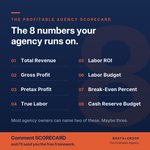
I read a lot of books on service businesses. Eight numbers worked best for agencies. That became the Profitable Agency Scorecard.
Before hiring to fix a stretched team, check two numbers.
Utilization: 75-85% of a contractor's time should go to work that makes you money.
Labor ROI: Gross Profit ÷ True Labor. Under 1.5 is risk, 1.5 to 2.0 tight, 2.0+ healthy.
Reply SCORECARD and I'll send you all 8 KPIs.
A founder I work with has two kinds of revenue: monthly retainers with brands, and a lower-priced subscription product.
When one brand cut its retainer sharply, it moved everything around. That client was a big share of his monthly income.
When a few subscription customers canceled, it barely mattered.
So he's leaning into the subscription side. Low delivery cost, steadier revenue.
If one client is a big share of your monthly income, check your Break-Even Percent before that client calls:
(Pretax Profit minus Owner Distributions) ÷ Gross Profit
That's your cushion after you pay yourself. Under 15% is life support. 20% is healthy.
Cash Reserve Budget: months of operating expenses your cash covers.
Under 3 months is low. 3 to 6 is healthy. 6 or more is strong.
Three months buys time to replace a client calmly. Below that, you take clients you shouldn't and avoid conversations you need to have.
My own industry pushes back on this one:
Marked-up freelancers don't belong in COGS.
Put them there and Labor ROI counts that labor twice.
In my numbers, all labor stays below the line, freelancers included. COGS is direct non-labor delivery cost only.
The line I find missing most often when agency books reach me: owner pay.
Wages, contractors, software. All there. The owner's pay and distributions never show up on the P&L.
So the agency looks more profitable than it is, and the owner can't figure out why cash is short.
October 15 is one week away.
If you filed an extension, the IRS gave you more time to file. Not more time to pay.
Most agency owners I talk to won't know what they owe until the return is done.
That's the real problem. Not the deadline.
Neil Basta | Profitability Advisor retweeted
"I already have a bookkeeper."
I hear this from agency owners all the time.
Your bookkeeper tells you where your money went last month. They cannot tell you if you can afford to hire next month.
Bookkeeping exists for tax compliance and historical tracking. It organizes categorized expenses so your CPA can file your returns at the end of the year.
What it does not do is give you forward operational visibility.
When an agency owner looks at a clean P&L, they see total dollars spent. They do not see True Labor or whether delivery margins are quietly compressing. They do not know their Labor ROI, so deciding to hire another account manager turns into pure guesswork.
You do not need a custom spreadsheet or an expensive ongoing advisory retainer to solve this.
It takes a 30-minute diagnostic with 8 core KPIs. We put the entire framework into an interactive Scorecard so you can see your real numbers without building models from scratch.
Most agency owners hire based on top-line revenue.
Revenue is up, so you add headcount. Revenue dips, and you freeze.
That is guessing, not budgeting.
Your Labor Budget has a hard ceiling:
(Gross Profit × 0.80) − (Total Operating Expenses − Payroll Labor)
True Labor must stay below that line. If you don't know that number before posting a job listing, you're just hoping delivery margins hold up.
Reply SCORECARD