

Solving policy challenges with legislative expertise, strategic communications, and coalition building. Former U.S. House staffer. Senior Fellow @aftfuture
SoCal | DC
Joined October 2014
- Tweets544
- Following546
- Followers575
- Likes321





Another reason @JoinFAI is such a fun and effective organization: it takes the time to explore ideas like using ocean waves to power AI workloads.
Great piece by @SohamThoughts on @_panthalassa and the possibilities of offshore data centers.
thefai.org/posts/ocean-futur…

This is great and will be a must-read for me (it should be for everyone else interested in what an experienced Washington DC pro has to say)!

Bringing back something I did for years on Capitol Hill — sharing a few things I’m watching around Washington.
Congress, political spending, what’s happening around @S2RPubAffairs, the Browns, and Blessed Fulton Sheen.
My latest here: linkedin.com/pulse/few-thing…
Thank you @andashleysays for having me join @PaulSteidler and @KevinTFrazier on today’s webinar panel @CmteForJustice on all things AI!
One of the best teams working on tech policy in Washington DC. Don't miss this opportunity (and their events are righteous as well).


.@LEHogg and @JoshuaTLevine have been at the forefront of studying and explaining the importance of submarine cables for a while.
The internet is nearly 1.2 million miles of fiber optic cable running across the ocean floor, carrying the global economy, national security and the future of AI.
A remarkable piece on the physical infrastructure that makes the digital world possible, and why America must keep building it. 👇

The world’s most consequential infrastructure is a bundle of glass fibers under miles of water, doing its work so quietly that we only remember it exists when it breaks.
@JoshuaTLevine and I unpack the complex world of submarine cables.
New in @arenamag:

.@RyanFedasiuk writing on AI is always must read. This piece is no exception. Share this and bookmark it. Some of the best analysis on Kimi K3 is right here: “Kimi K3 is not exactly downloadable to your laptop. In fact, very few organizations on Earth will be able to host it locally—and understanding this fact reveals a deeper, important trend in the direction of the Sino-American contest to deploy AI services.”

We can’t ignore what just happened. The American moat in AI software is not as strong as many of us had hoped.
It’s time to recognize the AI race for what it really is: an industrial systems competition to build and install compute.
My latest for @AEI:
aei.org/foreign-and-defense-…

Neil Siefring retweeted

Tomorrow at 3:30 PM: The Fall of Humphrey’s Executor: Trump v. Slaughter and the Future of the FTC
Join us (@CmteForJustice) for a discussion with former FTC Commissioner Joshua Wright (@JoshWright1977) and Ilya Shapiro (@ishapiro) of @ManhattanInst.
Register: bit.ly/HumphreysSlaughtered
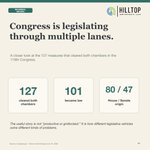
I reviewed the 127 measures that cleared both chambers of Congress this session through June 16 and a clear pattern emerges: Congress is legislating through several distinct channels, each with its own pathway to completion.
Here is what the bicameral record reveals. 🧵
Much of the work that crosses the finish line is built in committee around clearly defined, jurisdiction-specific problems. Specificity creates a workable path: a clear objective, an identifiable constituency, and a legislative vehicle designed to finish.

Congratulations are in order. I worked for an appropriator, and I appreciate how difficult it is to move these complex bills. Advancing them through regular order is a significant accomplishment and a testament to a well run committee.


This is the future being built and operated right now.

no cab. no driver. no problem. @bonsai_robotics is out here spraying straw beds by itself in Salinas.
they're building a stack of jobs and form factors and pricing it so you don't have to farm 5,000 acres to run them.
real transformer agtech. @niday_tyler
Great points about technology and music.
Here is one of my own: AI will democratize music.
More people will have more tool to express themselves musically than ever before. We will all benefit from this increased access to technology.

When the microphone arrived, many musicians said it wasn't authentic.
That it wasn't real.
It wasn't human.
Duke Ellington saw something different.
He wrote "Mood Indigo" specifically to take advantage of the microphone's unique capabilities—and helped change music forever.
🎧 Listen to the story on Everyday Abundance with @johnachardin @vpostrel @CharlesCMann
Really important essay from Satya Nadella.
The AI future is not just about which frontier model is best. It is about where value gets created, and how workers, companies, and institutions use AI to build on their own knowledge, judgment, and expertise.
This is a fresh and important way of looking at the AI stack.

One of the unexpected joys of the World Cup has been watching fans visit America and share their experiences online.
The food, the landscapes, the cities, the hospitality.
As we approach our 250th birthday, it is a welcome reminder of how much there is to appreciate about this country, and of the generosity and wonderful character of the American people.
Check out @andashleysays latest on EU regulation of tech: "Unsurprisingly, since the DMA took effect, the European Commission has investigated only U.S. companies for alleged violations of the law."

My latest op-ed in @thecentersquare on EU efforts to regulate (i.e. quash) our largest companies, and what America should do about it:
Read this piece from @jrhuddles @CatoInstitute for great analysis and a brilliant distillation of the stakes in the AI debate: "It is important that any policy framework consider not only technology as it exists in 2026 but also what a better future might be prevented by an overly prescriptive approach. Presuming to know everywhere AI is headed in 2026 is like presuming to know everywhere the internet was headed in 1996."

The Obernolte-Trahan bill is significant for the debate on AI policy. While I and my team are still analyzing the specifics some thoughts on what this proposal means and what principles we should look for when it comes to AI policy
My latest blog
cato.org/blog/there-finally-…