








Sammy retweeted
I’m setting up a Substack focused primarily on sex differences, sexuality and gender, alongside wider neuroscience.
I’ll have two columns, one specifically on sex differences ect, and another more about wider neuroscience fields (such as those from my own field)
The plan is to publish:
- A weekly breakdown of a scientific paper (including papers recommended by readers).
- Overviews of important research topics.
- In-depth analyses and deep dives on specific topics.
- Critical appraisals of individual studies, highlighting both methodological weaknesses and genuinely good science.
Most content will be free to start, with optional paid subscriptions to support the research and writing, and potentially some additional subscriber-only content down the line.
Would people be interested in something like this?
Sammy retweeted
Not in high regard.
While there are indeed studies “supporting” this theory, the issue is that this only stands true when taking the authors conclusions at face value. Any ounce of critical analysis applied, and the theory falls apart.
But why?
The vast majority of these studies are HEAVILY confounded by other variables known to promote the same outcome (i.e., co-occurring homosexuality and/or the administration of cross-sex hormones). Many studies have inadequate controls, and some (such as Kurth et al., 2022) have faulty methodology and statistics which consistently biases the results in favour of the stated hypothesis.
It’s not a good literature and is plagued with issues. Those telling you otherwise haven’t (or cannot) work out the issues, and I guarantee will take authors conclusions as gospel, rather than critically analysing the data within the original papers and coming up with their OWN understanding.


"SOLID" is a bit of a stretch... The literature is known to be of low-quality with failed replications, inadequate statistics/methodologies, small samples, and heavy confounds.
If this is deemed "SOLID" to you, then I don't want to see what you believe bad evidence to look like...

Finding neurological differences in transgender people does NOT establish that there is some innate “gender identity” that we all possess.
Look at depression. We could hypothetically identify specific changes in neural circuitry associated with depression, but this doesn’t mean we’ve identified some dedicated “depression circuit” that everyone possesses. Instead, these differences may reflect alterations in systems involved in a wide range of other functions.
Why should we interpret neurological differences in transgender populations any differently?
Even if we identified consistent neurological differences, these could reflect variation in neural systems involved in numerous other functions, rather than evidence of a dedicated “gender identity” mechanism that everyone possesses.
Finding neural correlates of a phenomenon does not establish that it represents a distinct, universal psychological characteristic.

What regulates "neurological gender identity" during embryonic development? What structures are involved???

“Breaking news” - Natal males should be in spaces for natal males for medical purposes…

Trans people should use hospital spaces according to biological sex, NHS England says bbc.in/4dJfdkS

Wired in what way? What causes the sex difference in this wiring anyways? Does it replicate? Controlled for brain-size? Hormones? Sexual orientation? Where is this specific “gender wiring”?
What are the effect sizes? Uncertainty? Variance?
How confident are we?
Think about the data properly!!

Sammy retweeted
I don't usually post studies from my actual research field, but this paper is cool.
We typically think of phosphorylated tau (p-tau205) as a biomarker of Alzheimer's disease pathology in blood and cerebrospinal fluid (CSF), but an interesting new study suggests it also plays an important physiological role in memory.
In mice, tau phosphorylation at T205 (p-tau205) increases during the initial encoding of a memory, helping to selectively recruit neurons into a precise memory-associated ensemble (engram).
Interestingly, preventing this phosphorylation does not impair initial learning or immediate recall, but disrupts the precise reactivation of memory-associated neurons and impairs long-term recall weeks/months later.
This suggests that p-tau205 may help establish the neural circuitry required for memories to remain accessible long after they are formed.
For the Alzheimer's field, this raises an interesting possibility: could the pathological dysregulation of tau phosphorylation disrupt its normal physiological role in memory formation and persistence? Rather than viewing phosphorylated tau solely as a marker of pathology, we may also need to consider what happens when its normal functions are altered during disease progression:
Paper: Tau T205 phosphorylation modulates engram cell recruitment and remote memory in mice - PubMed

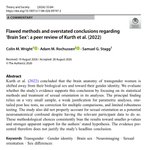
This study has been publicly criticised for several major methodological and statistical flaws, many of which systematically bias the results and undermine the conclusions being drawn.
See here:
link.springer.com/article/10…
This quoted post is unavailable.