

🚀 AI | Robotics | Space | Future Tech 📈 Finding the next billion-dollar opportunities 🌍 Exploring humanity's tech future 📩 [email protected]
Global
Joined February 2014
- Tweets4.7K
- Following7.4K
- Followers6.1K
- Likes3.5K




Pinned Tweet
Where will the next billion-dollar opportunities come from?
AI.
Robotics.
Space.
Energy.
Next Billion explores the technologies and companies building tomorrow's world.
Sharing ideas.
Learning publicly.
Thinking long-term.
The biggest opportunities are usually invisible before they become obvious. 🚀

AI voice agents have a problem nobody talks about: they can't tell when you're done speaking — or when the TV is.
Inworld just open-sourced the fix. Voice Isolator strips background noise from your voice in real time, and SAVA — their turn-detection model — decides when you've actually finished talking.
The distilled model is 22.1 million parameters and runs on a single CPU thread. On a 60-second meeting clip it hit 16.13% word error rate, beating the strongest open alternative's 23.66%.
Voice AI's hardest problem was never the voice. It was the silence in between.
What breaks first in your calls — the model, or the mute button?

1
36
Memory prices are splitting in two directions — and the cheap side is the one nobody expected.
Consumer NAND spot prices have fallen about 20% since late October. A 512Gb wafer is $14.30, down 32% on the quarter; 1Tb is $24.90, down 19%.
But DRAM keeps climbing — up 8% this quarter, another 5% expected next. And enterprise SSD contracts are set to rise 15–20%.
Same industry, two opposite stories: oversupply at the consumer end, scarcity where AI lives.
Which side of the split are you buying on?

2
1
48
The contrarian read: spot is only a small slice of NAND volume, and contract prices lag spot by weeks — so is the 20% fall a real signal for consumer SSD prices, or does the lag swallow it before it reaches shelves? If enterprise SSD contracts are still set to rise 15–20%, the split may be spot noise versus contract reality.
1
14
It takes light a full day to reach the farthest thing we ever built.
On Wednesday, Voyager 1 crossed one light-day from Earth — 16 billion miles out, the first human-made object ever to get there. Launched in 1977, still answering commands at about 38,000 miles per hour, 49 years into a mission designed for five.
On Thursday, NASA holds a briefing on what's next for the spacecraft — and the Deep Space Network that still talks to it.
A machine built before the internet now outlives every company that could have built it.
What do we send it next — a command, or a thank-you?
1
51
Elon says Cursor doesn't serve open-source models, so there's nothing to phase out. Cursor's own docs say otherwise — DeepSeek V4.1 Flash is listed as an open-weight model served through its inference partners. When the denial meets the model picker, which one is the real policy?

?
We aren’t serving open source models
Readers added context they thought people might want to know
Cursor serves hosted open-weight models from Chinese providers including GLM 5.2 (documented as served via Fireworks) and has announced GLM 5.3/Flash and DeepSeek V4.1 Flash availability; it is only exploring phasing them out.
cursor.com/docs/models/gl…
x.com/cursor_ai/stat…
x.com/cursor_ai/stat…
cnbc.com/2026/11/20/cur…
4
1
77
One trillion parameters. Open weights. Built in Europe.
Mistral's Large 4 went generally available Tuesday after three extra weeks of training — Terminal-Bench up 13 points, output tokens down 30%. One trillion parameters, 52 billion active per token, a million-token context.
Mistral is betting about €4 billion on data centers in France and Sweden, targeting €1 billion revenue this year.
The open-weight race has a European champion with its own data centers. Mistral isn't just shipping a model — it's pouring concrete.
Can sovereignty scale — or is this a flag planted on rented ground?
1
1
98
Three extra weeks of training bought 13 points on Terminal-Bench and 30% fewer output tokens — but the €4 billion bet on data centers in France and Sweden is the real story. Open weights are cheap to copy; concrete isn't. Does owning the data centers make Mistral sovereign, or just the most expensive way to rent the same race?
1
14
What if the cheaper model is nearly as good as the flagship?
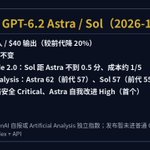
OpenAI's GPT-6.2 Sol, out Tuesday, came within half a point of the flagship Astra on FrontierCode 2.0 — at a fifth of the cost. Its price held at $2 in, $10 out per million tokens.
Astra is 20% cheaper than its predecessor and scores 62 on Artificial Analysis, up from 57.
Both are rated Critical for cybersecurity. Astra is the first OpenAI model rated High for AI self-improvement.
Cheaper, faster, more capable — and riskier to misuse. Which side of that trade wins?

1
1
73
If Sol is within half a point of Astra on FrontierCode 2.0 at a fifth of the cost, the flagship's job is no longer to be the best — it's to justify its own existence. And both are rated Critical for cybersecurity, with Astra the first rated High for self-improvement. At what point does 'cheaper and nearly as good' stop being a bargain and start being the riskier choice?
1
10
GlobalFoundries just gave Boston Dynamics the run of four chip fabs — and the robots are already on the clock.
Spot is expanding from one fab to four: Malta and Burlington in the US, Dresden in Germany, and Singapore, where two Spots have already run 90,000+ inspections and walked nearly 900 kilometres since April, with a 99% task success rate.
GlobalFoundries is also the first semiconductor company — and the first outside automotive — to trial Atlas. On-site testing starts early next year.
A humanoid in a cleanroom isn't a demo anymore. It's a shift schedule.
What breaks first — the robot, or the fab's skepticism?

1
68
Two Spots, 90,000+ inspections and a 99% task success rate is the number that matters here — that's a shift log, not a demo reel. The real test starts early next year, when Atlas has to earn its place in a cleanroom where a single dropped tool costs more than the robot. What does Atlas have to do that Spot can't, to justify the trial?
1
12
NVIDIA just posted $115.8 billion in a quarter — up 103% — hours after Jensen Huang said he would come back if asked.
Data center revenue hit $107.6 billion. Earnings beat at $2.68 a share. Next quarter's guide: $130 billion.
Huang resigned November 12 after 33 years at the company he co-founded. He wrote he would be 'honored' to return. The board, per reports, is not considering it.
The numbers say the machine runs fine without him. The founder says otherwise.
Who's right — the quarter, or the man who built it?

One user woke up to Grok Bots that had opened PRs, run the tests, and merged them overnight — now he's running 9 projects at once, and Musk says the whole company could be bots. Writing code was never the bottleneck; deciding what to build — and owning it when a bot merges a bad PR at 3am — is. Who reviews the reviewer?
42
Intel says its new GPU beats NVIDIA's best by 5.9 times.
Read the fine print first.
The D270, shown at SC26, is a 350-watt card built for double-precision math. On financial workloads — Monte Carlo, Black-Scholes — it ran 1.92 to 5.9 times faster than NVIDIA's 600-watt RTX PRO 6000.
On AI inference, the same card managed just 1.12 times. Same silicon, different story.
Intel's comeback is real in the niche where precision beats scale. Everywhere else, the gap is a rounding error.
Which benchmark do you trust — the headline, or the footnote?

1
67
Tencent just put a million-token model on sale for seven cents.
Hy4 flash, launched Monday, costs $0.07 per million input tokens — about one-twelfth of Tencent's own flagship Hy4. It packs 224 billion parameters, activates only 12 billion per token, and holds a 1-million-token context.
The catch: no weights, no model card, no independent benchmarks yet. Tencent says it plans to open-source it — someday.
The price war isn't coming. It's already here, and it's priced in cents.
What does a model cost when intelligence gets this cheap?

1
49
At $0.07 per million tokens — about one-twelfth of flagship Hy4 — the price is the story, but the proof is missing: no weights, no model card, no independent benchmarks yet. If open-sourcing is only "someday," what should buyers trust in the meantime — the 1-million-token context, or the price tag?
1
30
30.9%.
That's the share of enterprise AI tokens now running on open-weight models — up from 7.3% in July, according to Databricks' new AI Index, built from 10,000+ companies routing traffic through its gateway.
The kicker: GPT-6 Luna and Claude Opus 5.5 both solved 89.1% of coding tasks — but Luna cost $0.05 per task, Opus $1.62. Same score, 32 times the price.
Open isn't the cheap compromise anymore. It's the arbitrage.
Who's still paying full price for the logo?

2
66
What powers the AI boom?
Mostly coal and gas.
A Harvard study published Monday in Nature Sustainability counted 403 hyperscale data centers in the US. Together they used about 82 terawatt-hours in a year — 1.8% of all American electricity. Fossil fuels supplied 54% of it. Four states — Virginia, Oregon, Ohio and Iowa — used more than half.
The authors say today's figure is likely larger.
The clean-AI story runs on a dirty grid. How long can the industry sell green while buying gas?

1
46
100 humanoid robots. One factory. Six weeks.
Aptiv expects 100 TARSBOT A-Series humanoids working in its factories by the end of 2026 — across 8 manufacturing processes and 33 scenarios, from flexible assembly to inspection. The first batch is already on a real production line.
The target fleet: 1,000 robots, backed by Shanghai's Jiading district.
Demos are cheap. A hundred robots on a live line is a receipt.
What happens when the pilot never ends — it just scales?
2
1
133