




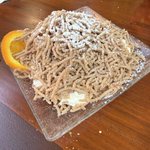


Here’s a simple, beginner-friendly method that works for all five no-churn ice creams :
Shared steps (for every flavor) :
1. Chill your tools
Put your mixing bowl and beaters (or whisk) in the freezer for 10–15 minutes. Cold tools help the cream whip better.
2. Whip the cream
Pour 2 cups cold heavy whipping cream into the chilled bowl. Beat on medium-high speed until stiff peaks form (the cream holds its shape when you lift the beaters). This takes about 3–5 minutes. Do not overbeat.
3. Mix the base
In a separate bowl, stir together the 1 can (14 oz) sweetened condensed milk, vanilla extract, and pinch of salt. Add any flavor ingredients now (see notes below).
4. Combine
Gently fold the condensed milk mixture into the whipped cream with a spatula. Use light, sweeping motions until fully combined and no streaks remain. Do not stir hard or the cream will deflate.
5. Freeze
Pour into a loaf pan or freezer-safe container. Smooth the top. Cover tightly and freeze for 6–8 hours (or overnight) until firm.
6. Serve
Let it sit at room temperature for 5–10 minutes so it softens enough to scoop easily.
Flavor notes :
• Vanilla : Use 2 tsp vanilla extract. No other additions.
• Chocolate: Sift in 1/4 cup unsweetened cocoa powder with the condensed milk. Use 1 tsp vanilla.
• Cookies & Cream : Use 1 tsp vanilla. Fold in 1 cup chopped chocolate sandwich cookies at the end of step 4 (after combining the cream and condensed milk).
• Coffee : Dissolve 1 tbsp instant coffee granules in 1 tbsp hot water. Let it cool completely, then stir it into the condensed milk mixture. Use 1 tsp vanilla.
• Caramel Pecan: Use 1 tsp vanilla. After combining in step 4, gently swirl in 1/3 cup thick caramel sauce and fold in 1/3 cup chopped toasted pecans (cooled).
Tips for success :
• Everything must be cold except the dissolved coffee.
• Stiff peaks are key - the cream should stand up firmly.
• Fold gently to keep the volume.
• These keep well in the freezer for up to 2 weeks. Let them soften slightly before scooping.
That’s the full process, Same method for all five, just different mix-ins.


💯🙌🏼

Estoy en esa edad en la que, si como azúcar, me sube la diabetes; si como sal, me sube la presión; si tomo agua, tengo que ir al baño cada cinco minutos y, si no la tomo, me deshidrato.
Si como, engordo; si no como, me desmayo. Si no como sano, me sube el colesterol; si como sano, me falta calcio. Si hago ejercicio, al día siguiente no puedo moverme del dolor en los huesos; si no hago ejercicio, pierdo movilidad.
Si duermo mucho, me duele la espalda. Si duermo poco, ando como un zombi. Si tomo café, me acelero; si no tomo café, no arranco. Si descanso, me siento culpable; si no descanso, ando de arrastro.
Estoy en una edad en la que hasta cuidarse es peligroso.
Una edad en la que por las mañanas ya no me despierto... resucito. Sólo quiero decirles que: tenemos que tomarnos la vejez con calma, hay gente que se está volviendo realmente loca al estar encerrada y sola.
Justo se lo estaba comentando hace un rato al microondas y la tostadora mientras nos tomabamos el café, y los tres estábamos de acuerdo.
A la lavadora ya no le cuento nada porque a todo le da vueltas y a la nevera la noto muy fría y distante.
Ahh se me olvidaba, he dejado de intentar hablar con la plancha y el horno, porque se calientan por nada.
Seamos felices la vida es muy corta ; y no olviden sonreír cada día. *Un oncólogo brasileño dijo:*
1. La *mediana edad* comienza a los 50 y termina a los 70.
2. La *edad dorada* comienza a los 70 y termina a los 80.
3. La *vejez* comienza a los 80 y termina a los 90.
4. La *longevidad* comienza a los 90 y termina con la muerte.

😍

El pan de muerto es un pan dulce de trigo, aromatizado con naranja y cubierto de azúcar, que en México se hornea entre octubre y el 2 de noviembre y se coloca en las ofrendas del Día de Muertos.
Yo hace varios años que armo mi altar el 31 de octubre y hoy hice esta receta para poner de ofrenda.
En la simbología del pan de muerto nada está ahí por casualidad.
El círculo superior representa el cráneo.
Las canillas cruzadas, los huesos.
El aroma de azahar, la memoria de los difuntos.
El pan, el cuerpo.
El azúcar, la dulzura del recuerdo.
Todo está pensado para recordar que la muerte no se oculta: se integra. Asi que yo elegí creer y colocar mi pan junto a velas, fotografías de quienes ya no están. No para llorarlos, sino para celebrarlos , recordarlos y sentirlos más cerca nuestro ese día.


🍒Nicole🍒 retweeted

When Barbra Streisand learned she was pregnant in 1966, she turned down a Las Vegas engagement worth a million dollars.
The press instantly labeled the unborn child “The Million Dollar Baby.” That child was Jason Gould.
He was born to two of the era’s biggest stars—Streisand and Elliott Gould—so fame was never something he had to chase. It was already waiting.
Photographers followed him as a child. Headlines analyzed him before he could form his own sense of self. He later described the experience as feeling like an attack.
His first on-screen appearance came early, as a toddler in his mother’s film Up the Sandbox. After that, he largely stayed on the margins of the industry.
When he returned to acting as an adult, including a role in Say Anything, it was driven more by curiosity than ambition.
In 1991 he appeared alongside his mother in The Prince of Tides.
What should have been a professional milestone was overshadowed by something else: a tabloid outed him without his consent, publishing false details and turning a private part of his life into public spectacle.
He had already shared that part of himself on his own terms. This was not truth; it was intrusion. Roles narrowed. He was no longer simply an actor. He was a category.
He stepped away—not in defeat, but in refusal. He refused to be reduced to someone else’s narrative.
In 1997 he told the story himself with Inside Out, a short film about a celebrity child outed by the media.
It was an act of reclamation. After that came quieter years. He withdrew from the machinery of fame, faced personal struggles, and worked through addiction away from the spotlight.
Streisand did not push. She watched and waited.
Once, when he was a teenager, she heard him singing behind a closed door. When she mentioned it, he shut her out—not out of rejection, but out of fear. Fear of comparison. Fear of expectation.
Years later that fear loosened. In 2012 she invited him to join her on tour. He had never performed live before. He stepped onto the stage unsure whether his voice would hold, then sang anyway.
He later called it “a very private moment… that just happened to be in front of 18,000 people.”
Two years later they recorded “How Deep Is the Ocean” together. He continued releasing music, including Dangerous Man, shaped by experience rather than the pursuit of fame.
This is not a story about inheritance. It is a story about distance—about choosing when to step forward and when to step away. Born into a life defined by other people, he waited until the noise quieted and the voice was his own.
The cameras tried to capture him. The headlines tried to define him. He chose to speak when he was ready. And when he did, he sang anyway. ❤️

🍒Nicole🍒 retweeted

🧠 En el marco del Día Mundial de la Enfermedad Cerebrovascular, en @PacificaSalud realizaremos la jornada Stroke 360°, un espacio para compartir distintas perspectivas y estrategias que nos permitan mejorar la atención de nuestros pacientes con ECV.
⏰👉🏻🧠
#DíaMundialdelaECV



😍😍
Ya les conté esta historia, pero en estos momentos con tanta gente abrumada por deudas, falta de trabajo y preocupaciones les recuerdo que una vez escuché al Papa Francisco contar que cada que se sentía abrumado o con algo que no podía resolver lo escribía y lo dejaba debajo de su San José dormido para que al otro día , con su intercesión lo ayudara a resolverlo.
Yo me compré en San Cayetano mi San José dormido y me tomé la costumbre de hacerlo.
Representa la confianza absoluta en la providencia divina y la escucha de la voluntad de Dios. Se utiliza para pedir la intercesión en situaciones difíciles, "confiando al santo" los problemas imposibles.
Por qué se lo representa dormido? Porque en cuatro oportunidades en sueños José recibe instrucciones de Dios para proteger a María y a Jesús.
Es una imagen de descanso activo, que invita a los fieles a confiar sus problemas a la intercesión de San José, sabiendo que él actúa en el silencio.

🍒Nicole🍒 retweeted

Lamentablemente no llegamos a la meta de medicamentos para realizar la gira de mañana. Y es importante para nosotros no solamente ir con médicos, sino con tratamiento también. Así que hemos movido la visita para el domingo, si nos ayudan a compartir y donar estaremos agradecidos.

Ayúdenme a compartir esta información: Mañana tenemos gira médica a La Patriota en el Sur de Soná. Los informes nos hablan de brotes de diarrea y vómitos, asma en niños menores de 5 años. Abuelitos hipertensos y con diabetes sin tratamientos. Vean Instagram @ypusonrisa lo que estamos haciendo y en qué se gasta cada dólar. El 100% de lo recaudado es gastado inmediatamente en insumos y medicamentos.
Donar:
Directorio de Yappy: yopintounasonrisa
ACH: Banco General
A nombre de: Fundación Yo Pinto Una Sonrisa
Cuenta de ahorros número: 04-10-99-871618-0
Donaciones fuera de Panamá:
gofundme.com/f/PanamaEarthqu…


Aprovechen en Megapolis @gloriamelania @emalek1985 @kastillopulus @IsaacLarrier @JJGB1 @robertvanhoorde @ing_cjmr @rubenchenwong


🍒Nicole🍒 retweeted

I am a member of the Norwegian Nobel Committee.
There are five of us. Five people, appointed by a parliament most of the planet could not find on a map, who decide, once a year, which human being the world has agreed to call good.
I know. I know. I think about it on the tram.
We meet in a building on Henrik Ibsens gate, a street named after a man who wrote almost exclusively about people discovering they are frauds, which nobody on the committee finds funny except me. There is a room with a long table and the portraits of the dead laureates looking down, Mandela, the Dalai Lama, a great many earnest men in spectacles, and one portrait we do not discuss, which is Kissinger, 1973, awarded while the bombs were still falling, after which two of our predecessors resigned and the satirist Tom Lehrer said political satire was now obsolete. We keep him on the wall. A reminder. Every family has the uncle.
It is October in Oslo, which means the sun gives up around four in the afternoon like a civil servant, and it rains the particular Norwegian rain that isn’t quite falling, just hanging there, judging you. I arrive with wet shoes. I always arrive with wet shoes. There is coffee, because this is Norway and there is always coffee, we drink more of it per person than almost anyone alive, and someone’s wife has sent kanelboller, the cinnamon buns, and we sit, five Norwegians, damp, caffeinated, sugared, and we decide the moral standing of the entire species.
Let me tell you how it actually works, because the world imagines a cathedral and it is, I promise you, a book club with a mandate.
287 nominations this year. 208 people, 79 organizations. Anyone can nominate, that’s the secret nobody understands: a professor, a parliamentarian, a former laureate, so the “nominee” list is meaningless, it’s a suggestion box, and every autumn some congressman nominates his own golden retriever and the press writes “SHORTLISTED.” Nobody is shortlisted. There is no short list the public ever sees. There is us, and the coffee, and the rain, and the portraits, and a Norwegian stubbornness that is older than the prize itself.
We read reports. The institute’s advisers write them, thick dull documents, and we argue. Our chairman told the BBC once that in the final meeting “there is a high temperature.” High temperature, for a Norwegian, means someone slightly raised an eyebrow and then apologized for it. We don’t do high temperature. We do a long silence, and then Kristin says “well,” and everyone knows exactly what “well” meant, and it’s settled. That’s our shouting. “Well.” You’d have to be raised here to hear the violence in it.
Now. This year. I will not say the name, because we never say the name, but you know the name.
A certain head of state wanted this prize the way a child wants a thing in a shop window, which is to say loudly, and in public, and with the full belief that wanting it was itself the argument. He said he deserved it. He said he’d ended eight wars, a number that grew most times he said it, like a fish. He had other heads of state phone us. Israel’s prime minister posted it on the internet, “Give him the Nobel.” The leaders of Cambodia and Pakistan announced they’d nominated him, as though announcing it were part of it, as though we tally mentions. A man flew around the globe collecting endorsements for a Norwegian committee the way you’d collect signatures for a petition to the council about a noisy dog.
And here, uff da, is the detail I treasure, the one that makes me smile into my coffee. The nomination deadline is the 31st of January. He took office on the 20th. So for all the phone calls, all the posts, all the gilded lobbying, the only nominations that could possibly count for this year’s prize were filed in the first eleven days of his term, before he had, by his own arithmetic, ended a single one of the eight wars. He campaigned all year for a prize whose window had shut while he was still hanging up his coat. We didn’t have to reject him. The calendar did. We just watched. Norwegians are very good at watching. We have long winters.
People think we sit there weighing his deeds. We don’t. That’s the thing I can’t make the world understand. We’re not grading his homework. We don’t owe anyone the prize for a ceasefire, however real, however loud the announcement. “He made peace” is not a sentence that ends in a medal, the way he believes it does, the way he believes every good thing ends in his name on it. The will of a dead Swede says the prize goes to whoever did the most for fraternity between nations. A dead Swede, I should add, who made his entire fortune inventing dynamite and selling arms, and spent his last years horrified at his own obituary, which called him a merchant of death, and so bought his way to immortality as a man of peace. The whole prize is one guilty arms dealer’s attempt to launder his name. We are, all of us, administering a dead man’s public relations. I find this clarifying. It keeps me humble. It should keep everyone humble, and it keeps, by my count, no one humble at all.
So who did we give it to?
An eighty-five-year-old woman. A judge. Born in Durban, under apartheid, granddaughter of a Tamil man who came to South Africa as indentured labor, a bus driver’s daughter from the poor Indian quarter, who became the first non-white woman to run a law practice in her province, who defended Mandela’s people when defending them was dangerous, who sat on the Rwanda tribunal and the court at the Hague, and who, at eighty-five, is right now a judge weighing whether a genocide is a genocide. When we told the world, our chairman said the rule of law “underpins the system we have set up to ensure peace,” and that “peace requires justice.” She wasn’t even in Oslo. She was in Nuremberg. In courtroom 600. The actual room where they tried the Nazis. You cannot stage that. God staged that, and God, it turns out, is a better satirist than any of us.
She did not phone us. She did not post. No prime minister demanded it for her on the internet. She had, as far as our deliberations are concerned, the one qualification the loud man could never manufacture, which is that she wanted the work and not the medal. The medal finds those people. It flees the ones who chase it. This is not a rule we wrote. It’s just the only pattern the hundred-odd years of our mistakes has ever shown.
The reaction from across the ocean was immediate. His spokesman posted that we “place politics over peace.” Ja. Perhaps. We’re five damp pensioners in a rainy city; of course it’s political, it was always political, it was political when we gave it to a sitting American president nine months into his first term for the promise of things he had not yet done, and we have been quietly embarrassed about that one for fifteen years, so believe me, we had a particular reason this year to prefer a woman with fifty years of verdicts behind her over a man with eight wars in front of him and a deadline already behind him.
Here is what he will never understand, the thing I’d tell him on the tram if he ever took one. We are the one prize he cannot buy, cannot post his way to, cannot have a friendly dictator phone in for him. Not because we’re incorruptible, nei, we’re as vain and wrong and human as the portraits on our wall. But because the entire point of the thing, the only power a small cold country’s book club has ever held, is that it goes to the person not performing the wanting. The moment you demand it, you’ve proven you don’t understand what it’s for, and proving that is itself the disqualification. He ran the most expensive campaign in the history of the prize and the campaign was the reason. He was never losing to Navi Pillay. He was losing to the concept.
It’s dark now. Four o’clock dark. The buns are gone. Kristin said “well” an hour ago and we all went home. I’m on the tram with my wet shoes, and somewhere across the water a very powerful man is explaining to a camera that the prize is rigged, that we’re corrupt, that he’ll win it next year, and he genuinely might, we’re only five idiots and we’ve been wrong before, Kissinger is still on the wall.
But not this year. This year an old woman in Nuremberg, in the room where the law once stared down the exact kind of man who thinks wanting a thing loudly enough should make it his, got a phone call she didn’t ask for.
That’s the job. We don’t reward the man who ends the war and announces it.
We reward the woman who spent fifty years deciding what a war was.
He’ll never see the difference. That’s rather the whole point of him.
Takk for i dag. I have to change trams.