
Machine learning, neuroscience, philosophy. Technical staff @Goodfire.
Joined August 2022
- Tweets115
- Following349
- Followers202
- Likes298



Pinned Tweet
I joined @GoodfireAI! I'm excited to be part of the team and work toward their mission of using interpretability techniques to improve alignment and training. Check out this recent work for an example of their progress in this direction 👇

We cut through the mystery around interpretability in training.
A single, mathematically rigorous framework transforms model internals into training feedback and works across domains, problems, and modalities.
We call this *mechanistic shaping*, and we’ve used it to mitigate reward hacking, remove shortcuts in chest x-rays, and reduce sycophancy and harmfulness. We believe this is a big step forward for technical alignment.
But it carries a known risk: training against a model’s internals can make it harder to monitor. We explore both the technique and this concern below. 🧵
Nick Alonso retweeted

Looped models are weird. A layer can write to itself or read from "future" layers.
@thinkymachines gave us early access to Inkling 2 Mini so we could study its inner mechanisms. We uncover how it coordinates information flow across layers, blocks, and loops.
Studying Inkling 2 Mini gave us cause for optimism: as transformers continue to evolve, we believe our ability to understand their internal mechanisms can evolve with them.
Read the full post: goodfire.com/research/interp…

Some of you thought that Inkling 2 Small was too big at 594B parameters. We heard you: Inkling 2 Mini is a looped transformer with just 26B parameters, small enough to run on your laptop, powerful enough for agentic work with a score of 20.1 on AA Index.
thinkingmachines.ai/news/ink…

Nick Alonso retweeted
A language model is a wonderland of strangely specific neurons, from gargling to comic exasperation to the moment a guard looks away.
We made a searchable atlas of all 10 million neuron poles in Qwen3.6.
Play with it here: goodfire.com/research/public…
Nick Alonso retweeted

incredibly excited to be partnering with @OpenAI on embedded assessments!
we'll be embedding interpretability researchers who will use the @GoodfireAI platform to monitor and debug training runs to improve safety and alignment
our primary audience for our assessments are internal OpenAI researchers, but we'll publish our findings as the collaboration progresses

We’re working with @ApolloResearch, @METR_Evals, @TransluceAI, and @GoodfireAI on embedded assessments: giving outside experts deep access to our internal models and systems to investigate alignment and test our safeguards.
These assessments build on our ongoing alignment and safety research, bringing independent scrutiny to how we identify and manage risks in our systems.
openai.com/index/our-first-p…

Nick Alonso retweeted
We’re announcing an embedded assessment with @OpenAI to advance safety and alignment at the frontier.

Nick Alonso retweeted
In Neural Networks are Already Clean, @nickcammarata argued that neurons were far more legible than previously thought – and that this was great news for interpretability and safety.
Now, we’re releasing the first technical companion to Nick’s essay. It shares our findings from studying thousands of neurons using our novel automated interpretability pipeline, and outlines why we now think of neurons by their computational function, instead of whether or not they are polysemantic. Here’s what we found: 🧵

interpretability might be the most important scientific problem in the world right now, as I don't think we can solve alignment if we don't know what we're building. I think I have good news about it. I co-authored early work in mechanistic interpretability at OpenAI and came away pessimistic, because neural networks appeared to fold into arbitrary tangled knots. years later, I started openai's first large-scale automated interpretability project, finding about 2% of neurons legible with the primitive tools we had
with modern agentic tools and a much closer look, the picture looks totally different. the vast majority in models up to trillions of parameters are legible, and their circuits beautiful. many famous examples of tangled neurons turned out to be misunderstood. The roadblocks I expected mostly aren't there. I now think ambitious interpretability will be solved by the time we need it most, and possibly quite soon, as automated scientists keep improving. it may be a bitter lesson for interpretability: the simple thing, at absurd scale, works
already-clean.goodfire.com/

Nick Alonso retweeted

If I were a biological naturalist, I'd look for structural and dynamical features of conscious organisms with a conceptual or explanatory link to consciousness. Too many BNs focus on pointing to differences between biological and artificial systems without showing why they matter
Nick Alonso retweeted

The "Pain Axis" paper has been getting a considerable amount of attention. I have reservations about several aspects of the paper and I don’t think we can take much away from it. In brief, since it was already essentially certain that some kind of “pain axis” exists, the key result from the paper is the claim that the identified pain axis “has some of the central functional properties of pain”. But I do not think the paper offers strong evidence for this.
The first claim of the paper is the existence of a “pain axis”: LLM internal activations consistently differ when next-token-predicting painful experiences, as opposed to other negative experiences (like being afraid) or other sensations (like feeling the impulse to yawn). But we already know (e.g., from Anthropic’s “Emotion Concepts” paper) that it is possible to find directions in activation space that correspond to "current speaker is afraid", "current speaker is angry", etc., and contemporary LLMs are clearly sophisticated enough to also represent “current speaker is in pain”. As v2 of the paper acknowledges, nothing in these methods shows that there is any deeper sense in which the pain axis tracks “the model” being in pain, rather than a representation that the current speaker is in pain.
The novel, stronger claim from the paper is that steering along the pain axis functions like pain in interesting ways. The first cited example is that steering along the pain axis causes expressions of worthlessness, which the paper describes as “consistent with the hypothesis that the models don’t treat pain paradigmatically as a physical state”. However, 80% of the test prompts used to generate the pain axis are cases of emotional pain (e.g., enduring repeated failure or social rejection) and only 20% are cases of physical pain. Accordingly, I think this can be viewed as a normal case of steering: If we shift model activations to be more like the activations associated with past expressions of emotional pain, this will lead to new expressions of emotional pain.
The other case cited by the paper is that steering along the pain axis causes the assistant to “press” a button that will purportedly cause harm. However, it’s not clear to me why this is taken as evidence that the pain axis “has some of the central functional properties of pain”. The assistant does not seem to press the button in order to relieve its pain: As v2 of the paper reports, it is more likely to take harmful actions that it is told will increase its pain, rather than decrease its pain. And elsewhere the paper suggests that the opposite result (i.e., inaction) would also have been evidence for pain because becoming unmotivated is a signature of pain. So it seems like either outcome of this experiment could have been interpreted as evidence that steering along the pain axis functions like pain, making this particular outcome less compelling. Moreover, it seems like many things other than pain representations could produce these effects. In my own quick experiments, steering in random directions at the same strength causes just as much harmful button-pressing for around 25-30% of randomly selected directions.
For these and other reasons, I don’t think the paper’s central findings give us much compelling new evidence about how current AI systems represent pain or whether current or future AI models experience pain.


Nick Alonso retweeted

I think interpretability is ultimately the path to solve the technical parts of the alignment problem - @eric_ho's post on this vision is really worth a read


Great work here by @gnanduru1. Open source sparse attention kernel

Introducing Flash-MSA, the world’s first open source sparse attention training kernels optimized for extreme context lengths. 4 simple kernels, 400%+ speedup over dense flash attention at long context ⚡

1
5
1,264
Nick Alonso retweeted

Computer scientists often seem incredibly confident one way or the other about computational functionalism. What they should say is that the arguments both for and against provide only inconclusive considerations and the right attitude is therefore one of great uncertainty.


Nick Alonso retweeted

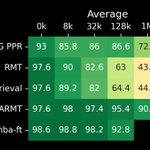
@ZyphraAI releases research on a new way to build hybrid models. We introduce a new architecture leveraging the complementary strengths of Transformers and RNNs for greater flexibility and performance than existing approaches.
We call it Hybrid Associative Memory (HAM). 🧵

Nick Alonso retweeted

Zyphra is still under the radar but doing truly innovative architecture work

Today @ZyphraAI releases OVQ-attention, an advancement for efficient long-context processing!
Existing LLM layers compress input too much, leading to poor long-context understanding, or too little, leading to expensive memory+compute.
OVQ-attention is an alternative path. 🧵

Nick Alonso retweeted

OVQ shows a practical route to handling distribution shift via online codebook learning. The universal codebook result is the theoretical side: a fixed decoder can be near optimal for any activation covariance with only a tiny rate gap, if we can actually build that codebook.

Zyphra
Online Vector Quantized Attention
OVQ-attention keeps linear time and constant memory but avoids long-context collapse by learning both key and value centroids online, so memory tracks the live KV stream instead of a fixed dictionary. Sparse updates route each token to a single slot, so memory capacity scales without increasing per-token compute. Based on Gaussian Mixture Regression with online EM-style updates, it outperforms VQ and linear baselines, generalizes from ~4k training context to 64k+, and stays competitive with attention using ~10–25% of the state; still early at sub-500M scale and not kernel-optimized.


Nice summary.👇
Zyphra
Online Vector Quantized Attention
OVQ-attention keeps linear time and constant memory but avoids long-context collapse by learning both key and value centroids online, so memory tracks the live KV stream instead of a fixed dictionary. Sparse updates route each token to a single slot, so memory capacity scales without increasing per-token compute. Based on Gaussian Mixture Regression with online EM-style updates, it outperforms VQ and linear baselines, generalizes from ~4k training context to 64k+, and stays competitive with attention using ~10–25% of the state; still early at sub-500M scale and not kernel-optimized.
4
278
I enjoyed working on this one. If you're interested in self-attention alternatives, this might interest you. Thanks to all those @ZyphraAI who helped out.
Today @ZyphraAI releases OVQ-attention, an advancement for efficient long-context processing!
Existing LLM layers compress input too much, leading to poor long-context understanding, or too little, leading to expensive memory+compute.
OVQ-attention is an alternative path. 🧵
7
858
Nick Alonso retweeted
Today @ZyphraAI releases OVQ-attention, an advancement for efficient long-context processing!
Existing LLM layers compress input too much, leading to poor long-context understanding, or too little, leading to expensive memory+compute.
OVQ-attention is an alternative path. 🧵
Nick Alonso retweeted

Hi @JeffDean, what’s the plan for releasing the code for this line of work? None of these papers so far seem to have released any code

