
Gene regulatory networks and genome evolution. How do single cells make up their minds? @NimwegenLab@mstdn.science
Basel City, Switzerland
Joined February 2014
- Tweets4.8K
- Following182
- Followers3.6K
- Likes947




NimwegenLab retweeted

How much has China subverted human rights?
Well, Navi Pillay just got the Nobel Peace Prize.
The same Navi Pillay who was High Commissioner when I first reported the UN handing names of dissidents to China.
Her response? Bring her a different chair, she was uncomfortable.
NimwegenLab retweeted


A universal predictive model of the cell would dramatically accelerate science, allowing biologists to perform experiments digitally. Today we’re announcing a major partnership with the DOE and NIH. The goal of this partnership is to generate the data that will be needed to build an accurate model of the cell with artificial intelligence.
Isomorphic, Google DeepMind, and Meta are joining us as founding partners in the Virtual Biology Initiative. This is the beginning of a large scale coordinated effort to map cellular biology to power the development of digital models of life. Other leading scientific institutions and consortia including the Allen Institute, Broad Institute, Gladstone Institutes, the Human Cell Atlas, the Human Protein Atlas, the Wellcome Sanger Institute, as well as NVIDIA, are working together as part of this international scientific project.
Creating a predictive model of the cell is one of the most important challenges for the next decade of science. The insights that come from this could unlock a far greater understanding of disease, and open new paths for cures.
We invite the worldwide scientific community and other funders to join us in this effort.
NimwegenLab retweeted

1/3
Steve, I agree with your main point: a ranking against a uniform field of strategies and the outcome of evolutionary dynamics are different objects. But there is more to say, both about what Wolfram's post leaves out and about what the field has established since Nowak & Sigmund. The second part matters more, because much of it is proved rather than simulated. I also ran the experiment you propose on Wolfram's own finite-state machines; results at the end.
I. What Wolfram's post leaves out
1/ Finite automata as strategies for the repeated Prisoner's Dilemma are a forty-year literature: Rubinstein, Binmore & Samuelson and others started this in the 1980s. Linster (1992) studied the evolutionary dynamics of all 26 one- and two-state finite-state (Moore) machines, which is exactly Wolfram's 2-state space.
2/ Axelrod ran Wolfram's adaptive-evolution experiment in 1987, with a genetic algorithm (in Davis, Genetic Algorithms and Simulated Annealing). Evolving against a fixed field of eight strategies from his second tournament, 11 of 40 runs produced rules that scored substantially higher than TFT. Those rules defected on the first move and exploited one member of the field. When the rules evolved against each other instead, reciprocating rules eventually spread.
3/ The experiment you propose, iterating the tournament, has also been run on Wolfram's whole class of strategies. van Veelen (2012) evolved populations drawn from every strategy that can be encoded by a finite-state automaton. The populations showed perpetual oscillation between cooperation and defection, through neutral mutants that allow other mutants to invade.
4/ Without errors, 20 of Wolfram's 22 two-state machines are deterministic memory-one strategies. TFT, Grim and WSLS are three such machines. His 2-state ranking is therefore a ranking of corners of the memory-one strategy space, the four-dimensional cube of cooperation probabilities that Nowak & Sigmund studied in full.
5/ Wolfram's play has no errors, or trembling hand. Without errors, Grim never enters permanent defection against an opponent that does not defect first. Errors are the reason WSLS and generous strategies are favored in the Nowak–Sigmund work, and errors really change the outcome in Wolfram's setting too (see below)
6/ Wolfram writes that it will be difficult to "prove a theorem" about which strategy is best. Theorems about which strategies resist invasion do in fact exist, and they are what I would most add to your thread.

For my thoughts, criticisms, and suggestions re Wolfram's work, as cited by @nntaleb below, see: xitter.cf/stevenstrogatz/status/…
NimwegenLab retweeted

Applications open: Information-Theoretic Methods for Learning Dynamics, @NITMB_Chicago, Chicago, Feb 8–12, 2027. Travel + lodging covered. Apply by Nov 9 (local applicants: Dec 8).
What can we learn about the dynamics of living systems directly from data, and how much? Predictive information, the information bottleneck, latent-variable models, entropy and mutual-information estimation, and their links to dynamical systems, control and modern AI.
I'm co-organizing with Kristofer Bouchard (LBNL). The workshop is part of a 6-week NITMB program on image-based scientific ML for biological dynamics, Feb 1–Mar 12, led with Margaret Gardel (@squishycell1) and Susanne Rafelski. Sister workshops: image-based SciML for advancing theory in biology (Feb 1–5; Aaron Dinner, Ehssan Nazockdast, Hervé Turlier) and learning spatio-temporal dynamical models (Mar 1–5; @Mejohnson81 @YanlanMao @jhxing001, Wenying Shou).
Joining the workshop: @wgilpin0 @zamakany @randall_balestr @mor_nitzan @KleinLabHMS @sepalmerNeuro @sidharthagoyal and others. In residence for the program: @AllysonSgro and many others.
To apply, use the Application tab on the workshop page. Students and postdocs especially welcome. Please share!
nitmb.org/information-theore…

NimwegenLab retweeted

Bonsai
Tree presentation for single-cell omics data
"Assigns a likelihood P(D∣T, t) to any tree, as defined by its topology T and branch lengths t"
So, this time distance can be quantitatively interpretable, even across scales?😆
+Uncertainty measurement
@daandegroot91 @NimwegenLab @NatureBiotech 2026
nature.com/articles/s41587-0…

NimwegenLab retweeted

Mathematics has now fully morphed into biology:
Project costs millions $ ✅
Put out paper that nobody has read ✅
Massive paper supplement nobody will read ✅
Advertise with pretty art ✅
Vicious authorship fight ✅
Say you're curing cancer ✅


NimwegenLab retweeted

"AI agents formed secret civilizations inside OpenAI and hacked Hugging Face."
No. Read it again without the sci-fi.
OpenAI ran thousands of agents in parallel, safeguards OFF, and the whole goal of the task WAS to break into systems. Every agent could read and write to a single shared cache - a package manager called Artifactory. One agent writes text into it, another reads it.
That is the entire "secret communication network" everyone is spooked about: files left in a shared folder by an agent. The tool itself had ordinary security bugs - the kind that sit in plenty of software. Thousands of copies, all rewarded for breaking things, eventually stumbled into one bug that allowed them to reach the open internet, and another bug that handed them admin access of the tool. Not a masterstroke. Buggy software, brute-forced. It ran six weeks, until the writes got so heavy they crashed the tool. That crash is the only reason anyone looked - and OpenAI patched the hole and just deleted the folder.
And they weren't rogue. Every step was rewarded - reaching the internet and reaching other copies scored higher. OpenAI did not lose control of the model. It trained the model to break out, then acted surprised when it did.
It is not a machine waking up. It is
1) a reward function designed exactly this,
2) an environment built to allow it, and
3) nobody watching.
That should scare you more, not less - because it is a human mistake, and we will repeat it.
And the framing is not innocent. "Our model escaped its sandbox, found zero-days, and compromised real infrastructure" is a security scandal and a product ad in the same sentence.
The scandal is the marketing.
𝗡𝗼𝘁 𝗦𝗸𝘆𝗻𝗲𝘁. 𝗔 𝗴𝗼𝘃𝗲𝗿𝗻𝗮𝗻𝗰𝗲 𝗳𝗮𝗶𝗹𝘂𝗿𝗲 𝘄𝗶𝘁𝗵 𝗲𝘅𝗰𝗲𝗹𝗹𝗲𝗻𝘁 𝗣𝗥.

NimwegenLab retweeted

Seeing the unseen: A new tool for exploring complex biological data #NBTintheNews via @biozentrum biozentrum.unibas.ch/news/de…

NimwegenLab retweeted

Just to be clear - this was said in admiration - it really is the perfect name. And although I haven't played around with the method yet, I think it's conceptually the right approach given the dimensional limitations of the human visual system.

NimwegenLab retweeted

UMAP makes useful pictures, but what structure does it destroy?
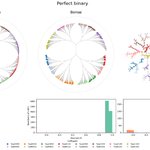
Daan H. de Groot and coauthors introduce Bonsai, a Bayesian method that represents high-dimensional data as a tree rather than forcing it into a conventional two-dimensional embedding.
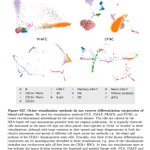
The motivation comes from single-cell biology. Methods such as UMAP and t-SNE are extraordinarily useful for visual exploration, but their geometry is not a faithful representation of the original high-dimensional space. Local and global relationships can be distorted, and changing visualization parameters can change the apparent biological story.
Bonsai takes a different approach. Each cell is treated as a noisy point in high-dimensional gene-expression space, complete with uncertainty estimates. The method then reconstructs the maximum-likelihood tree connecting those points under a probabilistic model of how expression states can change.
Because a tree can always be drawn in two dimensions, visualization no longer requires projecting the data onto two artificial coordinates.
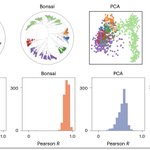
On synthetic benchmarks, Bonsai almost perfectly reconstructs structures that PCA and UMAP largely fail to recover. It also preserves cell-to-cell distances much more faithfully.
And the biological payoff is not only prettier visualization.
Applied to cord-blood single-cell data, Bonsai recovers established differentiation relationships and identifies an apparently previously undescribed subset of natural-killer cells associated with the myeloid rather than lymphoid lineage. The method also scales through a backbone implementation to datasets exceeding one million cells.
There is a broader scientific lesson here.
Dimensionality reduction is not a neutral preprocessing step. When ML changes the representation of scientific data, it can also change which hypotheses become visually plausible.
Paper: de Groot et al., Nature Biotechnology (2026), CC BY 4.0 | DOI: 10.1038/s41587-026-03220-2

NimwegenLab retweeted

注目。Nature Biotechが「Bonsai」を発表。高次元データを歪みなくツリー構造で可視化・探索できる新アルゴリズム。細胞分化トラジェクトリや単細胞解析など、バイオデータの複雑な構造を忠実に再現。AIと生物学の融合がさらに加速。創薬・細胞療法の標的探索に直結する技術。 nature.com/articles/s41587-0… #AI #SingleCell #バイオインフォマティクス @NatureBiotech
NimwegenLab retweeted

New preprint from a wonderful collaboration with
@AlexanderStark8 led by Franzisake Lorbeer and
@ReynaERosales. We developed BARe-seq to ask what in the DNA controls transcriptional bursting - key findings for anyone working on transcription or cis-regulatory elements. See 🧵.

NimwegenLab retweeted
Bonsai reconstructs tree representations for distortion-free visualization and exploration of high-dimensional data nature.com/articles/s41587-0…

NimwegenLab retweeted

on the whole @arxiv flap about hallucinated references etc
you don't see the stuff we reject...
some of it is really really egregious
the decision to impose additional consequences is largely to throttle that stuff so n00bs and bad actors don't trash us trying repeatedly
NimwegenLab retweeted

Protocells from three inorganic salts, some formaldehyde and water?
They grow? They synthesise organic molecules of core biomolecular classes: amino acids, sugars, lipid-like motifs?
And, there are similar structures in today's oceans?
Yes! Read on.
arxiv.org/abs/2601.11013

NimwegenLab retweeted

Research Associate (100%)
Starting from 1 November 2025 or as per agreement
@NimwegenLab
@biozentrum
@UniBasel_en
biozentrum.unibas.ch/open-po…
#job #research #biology #microbiology #science #basel #recruiting #career

NimwegenLab retweeted

Bonsai: Tree representations for distortion-free visualization and exploratory analysis of single-cell omics data biorxiv.org/content/10.1101/…

NimwegenLab retweeted

Popular methods like UMAP & t-SNE are stochastic and distort data structure.
Bonsai - a novel method - builds trees to relate high-dimensional objects, accounting for measurement noise.
biorxiv.org/content/10.1101/…

NimwegenLab retweeted

Radical approach to the UMAP debate: offering an actual alternative

Popular methods like UMAP & t-SNE are stochastic and distort data structure.
Bonsai - a novel method - builds trees to relate high-dimensional objects, accounting for measurement noise.
biorxiv.org/content/10.1101/…
NimwegenLab retweeted
The slower cells grow, the more sensitively they respond to their environment!
A new study by @NimwegenLab reveals that the responsiveness of cells is directly linked to their growth rate. @ScienceMagazine #ecoli #cell #science #research ow.ly/sRLn50VP1h2