

Curating unique moments from history and the world around us.
Joined July 2015
- Tweets1.2K
- Following312
- Followers1.1K
- Likes14.7K





Pinned Tweet
In May 1945, at the end of WWII, thousands of Axis-aligned soldiers and civilians were executed without trial by Yugoslav Partisans and sealed inside the Barbara Pit coal mine in Slovenia.
This chilling photograph was captured in March 2009, when investigators finally breached the concrete walls mended by the communist regime to hide the crime. Over 1,400 victims were uncovered, preserved for decades in total darkness.

Taken in May 1944 at Auschwitz-Birkenau, this haunting photograph shows a young Jewish child handing a dandelion to another child while sitting in a clearing surrounded by family members. Unaware of their fate, these Jewish men, women, and children from Carpatho-Ruthenia (then part of Hungary) were waiting in a small grove of trees near Gas Chambers IV and V shortly after arriving at the death camp. The photograph is part of the "Auschwitz Album"—the only surviving visual record of the mass extermination process inside Birkenau, taken by SS guards. Within hours of this image being captured, almost everyone depicted was murdered.

2
73
Opened in 1874, the Old Main Library in Cincinnati, Ohio, featured breathtaking five-story cast-iron book alcoves, spiral staircases, and a grand skylight ceiling. Originally intended as an opera house before being converted, the magnificent architectural masterpiece served readers for eight decades. Despite public outcry, the overcrowded and deteriorating building was tragically demolished in 1955 after a new modern library was opened down the street; today, a parking lot and a commercial building occupy its former site.

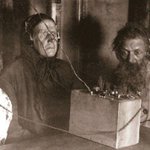
In 1928, Soviet peasants in a rural village are photographed listening to a radio receiver for the first time, their expressions reflecting awe and intensity. During the late 1920s, the Soviet government heavily promoted radio technology as a primary tool for mass education, literacy campaigns, and state propaganda across vast, remote rural areas. Because individual radio sets were scarce and expensive, community listening sessions with shared headphones or primitive crystal receivers became a defining cultural bridge between isolated agrarian life and modern technological advancement.

5
63

On March 8, 1935, Tokyo residents, station staff, and family members gather in solemn mourning around the body of Hachiko, the famous Akita dog. Hachiko became a national symbol of loyalty in Japan after returning to Shibuya Station every single day for nearly ten years to await his owner, Professor Hidesaburō Ueno, who had suddenly passed away on May 21, 1925. Photographed at the baggage room of Shibuya Station, this image captures the grieving widow Yaeko Sakano (far right) and station officers offering prayers for the loyal dog, whose immortal story continues to touch hearts worldwide.

In 1960, Otto Frank stands alone in the empty attic of the "Secret Annex" (Achterhuis) at Prinsengracht 263 in Amsterdam, photographed by Arnold Newman. Otto was the sole survivor among the eight Jewish individuals who hid in the annex for over two years during the Nazi occupation before being discovered in August 1944. Captured shortly before the building was opened to the public as the Anne Frank House museum on May 3, 1960, this poignant image depicts a father confronting the quiet space where his family spent their final years together, reflecting the profound grief and enduring legacy of his daughter Anne’s diary.

On May 14, 1998, a crowd gathered in Times Square, New York City, to watch the series finale of Seinfeld broadcast live on the giant Astrovision jumbotron screen. Over 76 million viewers tuned in nationwide, making it one of the most-watched television events in American history. The iconic gathering in Times Square captured the cultural zenith of broadcast television in the late 1990s, where millions shared a single, synchronized pop-culture moment in public space before the streaming era.

3
76
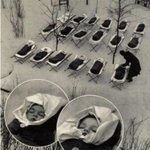
In 1958, babies at a Soviet sanatorium or nursery in Moscow are pictured sleeping outdoors on cots in freezing winter conditions. In the Soviet Union, outdoor napping in sub zero temperatures known as zakalivanie (hardening) was a standard public health practice aimed at strengthening infants' immune systems, boosting resistance to respiratory illnesses, and improving sleep quality while heavily bundled in protective layers.

7
116
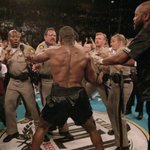
On June 28, 1997, Las Vegas police officers and ring security attempt to restrain a furious Mike Tyson inside the ring at the MGM Grand Garden Arena. Minutes earlier, during his heavyweight rematch against Evander Holyfield, Tyson was disqualified at the end of the third round for biting off a chunk of Holyfield's right ear and subsequently biting his left ear. As chaos erupted in the arena, police were forced to step between the enraged fighter, officials, and Holyfield's corner to prevent further escalation.

2
123
On June 2, 1953, Queen Elizabeth II was crowned at Westminster Abbey, and this iconic portrait was taken shortly after at Buckingham Palace by renowned photographer Cecil Beaton. The official coronation portrait features the 27-year-old monarch wearing the Imperial State Crown, holding the Sovereign's Sceptre with Cross in her right hand and the Sovereign's Orb in her left, dressed in her embroidered coronation gown and ceremonial purple velvet Robe of Estate.

On June 28, 1998, during the infamous Hell in a Cell match at King of the Ring, The Undertaker looks down from the top of the cage as medical staff and officials tend to Mankind (Mick Foley). Moments earlier, a chokeslam through the chain-link roof unexpectedly gave way, sending Foley crashing 16 feet down onto the ring canvas a brutal fall that was entirely unscripted and knocked him unconscious. Despite severe injuries, Foley miraculously finished the match, cementing this moment as one of the most legendary and iconic incidents in professional wrestling history.

3
145
In 1925, shortly after his release from Landsberg Prison, Adolf Hitler rehearsed his public speaking hand gestures and body language, photographed by his personal photographer Heinrich Hoffmann. Hitler studied these images to perfect his oratorical presence and theatrical delivery before addressing massive crowds. Although Hitler strictly ordered Hoffmann to destroy the negatives claiming they were "beneath his dignity" Hoffmann kept them hidden in his studio, leading to their eventual publication after World War II.

In 1960, an advertising agency created a clever and iconic stunt for Coca-Cola in Saint Mark's Square (Piazza San Marco), Venice. By strategically scattering birdseed across the pavement to spell out "COCA-COLA," thousands of local pigeons flocked to the area, forming the giant logo on the ground. Photographers captured the spectacle from above, turning a simple feeding session into one of the most creative and memorable Guerrilla marketing campaigns of the 20th century.

On November 11, 1979, beloved actor and comedian Robin Williams performed as the first male cheerleader for the Denver Broncos in front of over 74,000 fans at Mile High Stadium. Donning the official "Pony Express" cheerleading uniform complete with a sequined crop top, mini skirt, and knee high boots Williams joined the squad during an actual NFL game against the New England Patriots. The stunt was filmed for an episode of his hit sitcom Mork & Mindy ("Hold That Mork"), becoming one of the most memorable and hilarious moments in television and sports crossover history.

4
176
In 1958, German photographer Max Scheler captured a young coal miner covered in soot, waiting for his turn at the communal washroom (Waschkauen) after a underground shift in Gelsenkirchen, Germany. Located in the heart of the Ruhr Valley Germany's industrial powerhouse mines like Consolidation employed generations of workers during the post-war economic miracle (Wirtschaftswunder). The striking image illustrates the grueling physical labor and raw reality of mid-20th-century coal mining, where workers suspended their street clothes from the ceiling on hooks and chains to keep them clean while working hundreds of meters underground.

Max Scheler’s photography bypassed the polished narrative of the 1950s economic boom to focus on the raw groundwork. In 1958, the Ruhr Valley alone had nearly half a million miners powering Europe's post-war recovery. A notable technical detail of this daily grind was the "Schwarz-Weiß-Kaue" (Black-and-White washroom) seen here. Hoisting clothes to the ceiling wasn't just to save floor space; the warm air circulating at the top naturally dried the sweat-soaked mine gear between shifts, preventing mold in an era before modern industrial ventilation.
On June 22, 2000, 36 year old Gary Graham (Shaka Sankofa) is forcefully carried into the Huntsville Unit death house in Texas by a five member extraction team after physically resisting his impending execution. Convicted for a 1981 murder, Graham maintained his innocence until the end, claiming he was wrongful convicted based on a single eyewitness identification. His case sparked intense international debate over capital punishment and fair trials, supported by prominent activists including Jesse Jackson and Danny Glover.

The case of Gary Graham (Shaka Sankofa) remains one of the most contentious milestones in the history of the American death penalty. Beyond the immediate details of his 1981 conviction, several key factors made his case a global focal point.
Single-Eyewitness Controversy: The prosecution’s case rested almost entirely on the testimony of a single eyewitness, Bernice McFarlane, who identified Graham through a car window from 30–40 feet away at night. Two other eyewitnesses at the scene, who said the shooter was not Graham, were never called to testify by his original defense attorney.
Inadequate Legal Defense: Graham was 19 at the time of his arrest and represented by a court-appointed lawyer who failed to present key alibi witnesses and ballistics evidence a failure that later highlighted system-wide flaws in legal representation for indigent defendants.
Symbol of Systemic Reform: Supported by figures like Jesse Jackson, Danny Glover, and Amnesty International, the case transcended a single legal battle. It accelerated international scrutiny over Texas's execution protocols, racial disparities in sentencing, and the catastrophic risk of executing potentially innocent individuals.
5
453
In June 1938, Canadian inventor Carl Rich unveiled his self designed "stratospheric flight suit" at Mascot Airport in Sydney, Australia. Intended for high-altitude military and exploratory aviation, the suit featured built-in oxygen equipment, a radio transceiver set on the leg, and heavy protective insulation. However, during test flights, the bulky and heavy suit proved highly impractical, suffering from severe overheating and restricted visibility for the pilot.
