

If u wanna hear d hard truth then fuck with me. My fav is d most logical person in any conversation. My tweets may trigger softies. CHELSEA FC (set of 05)
Joined January 2023
- Tweets9.8K
- Following2.8K
- Followers2.2K
- Likes8.6K


Pinned Tweet
ALL THEY REFUSED TO TELL YOU ABOUT FUEL SUBSIDY
This write up seeks to provide a lay-man information about the timeline facts regarding fuel subsidy in Nigeria.
1. INTRODUCTION OF PRICE CAPS & PETROLEUM EQUALISATION FUND (PEF) (1973 - 1977)
Following the 1973 global Arab oil embargo, international oil prices skyrocketed. To protect everyday Nigerians from high petrol prices, the government stepped in to cover the price gap and created a uniform national pump price regardless of location.
GOAL:
Cushion citizens against external economic shocks, keep domestic transport affordable, and ensure petrol cost the same everywhere in Nigeria.
LONG TERM IMPLICATION:
Created a mental shift of the Nigerian public towards an economically unsustainable future as cheap subsidized fuel no matter the actual cost became the metric through which the Nigerian populace measures progress.
2. FIRST FORMAL PRICE HIKE (Oct. 1978)
A dip in international crude revenue led the General Olusegun Obasanjo military government to officially institutionalize fuel price regulation and increase petrol prices to offset declining state revenue.
GOAL:
Raising government cash flow and fund growing public sector budgets.
LONG TERM IMPLICATIONS:
It proved that fuel pricing was another political lever which was controlled by the Head of State. This ultimately led to decades of friction between ruling governments and labour unions over price hikes.
3. STRUCTURAL ADJUSTMENT PROGRAMME (SAP) HIKES (1986)
By the early 1980s, global oil prices crashed, driving Nigeria into a deep economic crises.
Government revenues collapsed, and Nigeria couldn't pay its growing international debts.
they was a sever shortage of basic imported goods, Foreign exchange etc.
Gen. Ibrahim Babangida’s regime, Under pressure from international lenders such as the IMF and World Bank offered conditional assistance. These conditions were that;
The regime slashed spending and reduced government support for domestic petrol prices so as to transition from a government-controlled economy to a more market-driven one.
SAP GOALS:
Secure foreign debt relief, stabilize national balance sheets, and meet international conditions for economic reform.
LONG TERM IMPLICATIONS:
These hikes triggered widespread inflation which led to a deep public distrust toward foreign-backed economic reforms and also became the reason why "subsidy removal"
is such a politically toxic concept in Nigerian civic discourse.
4. ABACHA ERA HIKES (1992 - 1998)
Days before Gen. Sani Abacha seized power, Chief Ernest Shonekan's interim government hiked petrol prices from 70kobo to 5naira per litre(a 614% increase).
Five days after Abacha took office, he reduced it to 3.25naira per litre. This was a calculated political move to gain immediate legitimacy and calm civil unrest.
In October 1994, Abacha's regime announced a 361% increase which meant the price of fuel jumped from 3.25naira to 15naira per litre. Intense street protests and labor strikes followed the announcements and the regime backed down two days later by reducing the price to 11naira per litre.
To soften the public blow as a result of the 1994 price hike, Abacha created the Petroleum Trust Fund(PTF) and made former head of state Maj. Gen. Muhammadu Buhari(BUBU) in charge.
GOALS:
Due to neglect, poor maintenance and corruption, Nigerian refineries deteriorated to the point of having to import refined petrol which meant the Abacha regime had to increase prices so as to be able to Offset the high foreign-exchange cost of importing petrol.
Another goal was to use the extra revenue that was generated from the price hike to fund state projects through BUBU's Petroleum Trust Fund (PTF).
LONG TERM IMPLICATIONS:
institutionalized Nigeria's dependency on imported refined fuel despite being Africa's top crude producer. In lay terms, we became waste men. We had the foodstuff but needed someone else to cook the food for us.
5. OBASANJO CIVILIAN ADMINISTRATION YEARS(2000 - 2007)
President Olusegun Obasanjo attempted to phase out subsidies through frequent, incremental price hikes(Jejely), which were met by repeated nationwide strikes led by the Nigeria Labour Congress (NLC).
Across baba's 8 years, fuel prices were raised 11 times from 20naira in 1999 to 70naira per litre in 2007.
His administration witnessed the most frequent and structured attempts to dismantle Nigeria's fuel subsidy system prior to 2023.
GOAL:
Obasanjo's economic team which included key reformers like Ngozi Okonjo-Iweala who at the time was the Minister of Finance belived that a gradual transition to a market-driven energy sector was best and that as long as the state fixed fuel prices, private investors would never be confident enough to invest in the sector(build refineries etc).
LONG TERM IMPLICATION:
The Adams Oshiomole led NLC filled the void created by the administration's weak political opposition. This helped to solidify the labour unions as the primary defenders of the masses regarding fuel price increments.
The fuel subsidy question became a central test of political legitimacy for intending leaders.
Obasanjo's struggle proved that incremental price hikes(gradual subsidy removal) led to endless, recurring political conflicts.
6. "OCCUPY NIGERIA" (JAN 2012)
President Goodluck Jonathan(Man of Peace) abruptly ended petrol subsidies on New Year’s Day 2012, this caused a 117% increase in pump price of petrol overnight (from 65naira to 141naira). The nation erupted in massive "Occupy Nigeria" protests, shutting down the economy. Facing total paralyzation and security threats, Jonathan backed down. On January 16th 2012, His government compromised by restoring a partial subsidy and capping the price at ₦97 per litre.
GOALS:
Subsidy payments hit an unsustainable 2.1 trillion naira in 2011 which at the time was over 30% of the entire federal budget. Jonathan promised to redirect these trillions into roads, rail and health through the Subsidy Reinvestment and Empowerment Program(SURE-P) modelled from the earlier PTF.
LONG TERM IMPLICATIONS:
This demonstrated the immense political risk of abrupt subsidy reform. The compromise meant the subsidy drain continued, while public trust in government fiscal promises reached an all-time low.
7. 2016 FX CRISIS HIKE
Plunging global oil prices created a severe dollar shortage in Nigeria, leaving the central bank unable to fund private petroleum imports causing scarcity of fuel in the country.
Prior to allowing importers source their own FX, the government forced every importer to buy their US Dollar from the Central Bank of Nigeria(CBN) at a cheap, preset rate by the government(197naira per dollar).
Facing fuel and FX scarcity problems, the government allowed petroleum marketers to source foreign currency independently and on the 11th of May 2016, Minister of State for Petroleum Resources Ibe Kachikwu raised the official pump price 86.5naira to 145naira per litre.
GOALS:
One of the major goals the government sought to achieve was to resolve severe fuel queues and scarcity by allowing private importers to operate profitably without relying entirely on Central Bank foreign exchange. While another was to try to lay the groundwork for a market-controlled downstream petroleum sector shifting away from a state-controlled one.
LONG TERM IMPLICATIONS:
This move worked for a short while because it actually temporarily shifted the subsidy burden off the government budget but it didn't have the desired permanent effect it was intended to have as it failed to permanently deregulate the market because fuel prices still remained capped by the government. Also the FX rates worsened.
8. COVID-19 OIL CRASH(March 2020)
Remember COVID-19 lockdowns in 2020?
You definitely remember the face mask and hand sanitizers but i'm guessing what you never remembered was the fact it caused global oil prices to crash from over $60 per barrel to below $20 per barrel, and this made the cost of importing petrol to drop below Nigeria's official retail price of 145naira per litre.
Seeing that the fuel import costs were rock bottom, the Petroleum Products Pricing Regulatory Agency (PPPRA) announced the complete removal of the fuel subsidy.
The government also introduced a monthly price-floating framework where instead of the government fixing the price permanently, monthly petrol prices would automatically rise and fall based on international crude oil prices and foreign exchange rates.
GOALS:
To abolish subsidies while global oil prices were low enough that consumers wouldn't feel a price surge. The government needed to urgently eliminate the subsidy obligations from its budget permanently because it became a seriously unsustainable practice.
LONG TERM IMPLICATIONS:
The policy failed when global oil prices bounced back in 2021. Unwilling to let domestic petrol prices rise accordingly, the government quietly resumed paying vast subsidy deficits.
Nigeria missed a rare window created by the pandemic to permanently exit the subsidy trap.
Resumption of subsidy payments as global oil prices surged after covid drove Nigeria's debt servicing costs to dangerous levels, and creating an existential crisis that directly forced the abrupt total removal of subsidy in the next administration(2023).
9. PETROLEUM INDUSTRY ACT (PIA)
After 20 years of legislative delays, President Muhammadu Buhari signed the PIA into law on August 16, 2021, completely overhauling Nigeria's 50year old oil and gas laws.
The most politically explosive part of The law was Section 205, explicitly declared that all petrol prices in Nigeria must be set by free-market forces, legally banning government price caps and subsidies.
Section 53 converted the government oil entity (NNPC) into a commercial company (NNPC Limited) that operates for profit. It was cut off from direct government funding and forced to pay taxes and dividends to shareholders (the government) same as any private company would.
Two clear regulatory bodies were also created namely:
NUPRC (Nigerian Upstream Petroleum Regulatory Commission) - overseeing oil drilling and exploration.
NMDPRA (Nigerian Midstream and Downstream Petroleum Regulatory Authority) - overseeing refining, transport, and retail gas stations.
Section 240 also mandated that oil companies allocate 3% of their annual operating expenditure (OPEX) directly into a trustfund for oil producing communities in the Niger Delta to fund schools, roads and local infrastructure bypassing federal bureaucracy.
Buhari's administration in early 2022, fearing election-year public backlash, paused the subsidy removal clause for 18 months, setting a hard deadline for mid-2023(June).
GOALS:
The administration sought to end government fixed pricing so as to attract investors to build domestic refineries and infrastructures.
Turning NNPC into a profit making company, rather than have it draining the government.
Bubu wanted host communities to enjoy from the money these oil companies were making in their backyards.
LONG TERM IMPLICATIONS:
It laid the inescapable legal framework for future administrations because the PIA explicitly forbids NNPC Ltd from legally absorbing subsidy losses without breaking corporate governance laws.
The PIA helped to modernize Nigeria's energy sector to match global standards, this has helped to attract foreign investment into gas, refining, and deep-water oil exploration.
10. FUEL SUBSIDY IS GONE (MAY 29, 2023)
President Bola Ahmed Tinubu’s declaration on Inauguration day May 29, 2023, ending Nigeria’s decades old petrol subsidy regime stands as one of the most consequential and i dare say misunderstood economic policy shifts in the nation's post independence history.
It is misunderstood because the timeline for subsidy removal was already explicitly stated in the PIA that was signed by Buhari in 2021 which was the reason why no budgetary allocations were made for the payment of subsidies beyond June 2023. It should also be noted that the reinstatement of fuel subsidy at any point after the July 1st 2023 timeframe provided in the PIA elapsed would have been breaking federal law.
Unlike previous presidents who relied on phased price increases or complex compromise formulas, Tinubu executed an immediate, full-step removal on his very first day in office in accordance with the PIA.
SEQUENCE OF EVENTS
MAY 29 2023
During his unscripted inaugural speech at Eagle Square in Abuja, President Tinubu uttered four words that altered Nigeria's economic landscape: "The fuel subsidy is gone!"
Tinubu declared that the 2023 national budget had no financial provision for petrol subsidies past June 30, 2023, and that continuing to pay it was fiscally unsustainable.
MAY 30 2023
Panic buying erupted nationwide. Drivers queued for hours as independent petrol stations shut down to adjust their meters or hoard stock.
MAY 31 2023
NNPC Limited officially released a revised price template, permanently ending fixed pricing. Retail petrol prices overnight jumped from an average of 185naira per litre to between 488naira and 555naira per litre depending on the state.
MID-2023 TO PRESENT:
The government simultaneously unified and floated the foreign exchange rate (allowing the Naira to depreciate to market value), the cost of importing fuel rose further. By late 2023 and into 2024, retail pump prices adjusted dynamically, rising past 600naira to over 1,000naira per litre across different regions.
JUSTIFICATION:
In 2022 alone, Nigeria spent 4.3 trillion naira on fuel subsidies. The bulk of this money was financed through central bank overdrafts (Ways and Means advances) and foreign borrowing.
This put Nigeria in a precarious position where on one hand was a subsidy practice that if continued would sooner rather than later lead the country into an existential economic crisis while stopping it on the other hand would bring about short to medium term pains and suffering to the Nigerian masses but with a better long term outlook.
SIDE NOTE:
Ways and means is a short term overdraft that the CBN gives to the Federal government.
Government has expenses that needs to be paid on a timely basis like salaries, debt service payments etc
Government also generates revenues from tax, oil sale etc
Unlike government expenses, for example, salaries that must be paid within a timeframe, government revenue doesn't have a fixed generation timeframe and most times they don't all(oil sale, tax etc) come in at thesame time because for example oil sales happens when there's a buyer and if no buyer then no sales.
To prevent the government from not being able to pay its workers or defaulting on its obligations, the law allows the CBN to borrow the FG money(short term) to be able to fulfill its expense obligations.
Nigerian petrol during the subsidy years was heavily subsidized, tens of millions of litres were smuggled daily into neighboring countries (Benin, Cameroon, Niger, and Togo), where petrol was sold at full market price. Taxpayers in Nigeria were effectively subsidizing West Africa's energy consumption while making the oil smuggling cabals richer at the detriment of the masses.
Since the subsidy removal, the almost non-existent arbitrage gap is the reason why fuel scarcity is now a thing of the past in Nigeria and amongst many other reasons, why the federal government can now invest in bigger infrastructural and human development projects.
LONG TERM IMPLICATIONS:
State and federal treasuries experienced massive revenue increases via FAAC (Federation Account Allocation Committee) distributions, giving governors and the federal government significantly more cash to service debt and fund capital projects.
It finally completed Nigeria's 50year struggle to transition to a market-driven downstream oil sector.
The removal created the commercial environment necessary for domestic refineries most notably the Dangote Refinery and revitalized public refineries to supply petrol directly to the domestic market in local currency without state price controls.
What did i miss out on?
What did i get wrong?
Took long hours of research to come up with this write-up which aims to educate Nigerians by breaking down everything regarding the fuel subsidy.
Please don't air me, like and repost, Thanks.
@OpeBee @egi_nupe
@Hybrid_Ola @Imranmuhdz @DanielRegha
1
249
NO CAP retweeted

That explains to you why as a Former Governor that served for 8years, not even 20% of people who worked with him are carrying him on their head to be President both in 2023 and 2027. He was also a Chairman of SEC for a while, I have not seen at least 5 persons who worked with him come out to say anything about how good he was with them. As someone who ran so many businesses allegedly, I haven’t seen at least 10 of his staff, either present or past, come forward to tell him how good a man he is to be President of this country.
That’s seriously telling.

NO CAP retweeted
Sarah gone
Tanko gone
lol

2027: Former Obidient Movement Coordinator, Yunusa Tanko dumps Peter Obi for Adebayo
The former National Coordinator of the Obidient Movement, Yunusa Tanko, has dumped Peter Obi, the presidential candidate of the Nigeria Democratic Congress, NDC, for the Social Democratic Party, SDP, presidential candidate, Prince Adewole Adebayo
This comes as the SDP Chairman, Prof. Abubakar Sadiq Gombe, announced Tanko as the coordinator of the party’s presidential campaign council on Wednesday.
Accordingly, Tanko, a key figure in Obi’s 2023 presidential campaign, will now coordinate support for Adebayo’s 2027 bid to unseat President Bola Tinubu
Lol 😆


NO CAP retweeted

Actually, I deliberately refrained from commenting on that PO’s tweet because, given the overarching culture of impunity under the Tinubu administration, I do not want to dilute the legitimate areas that deserve criticism by conflating them with issues that do not — such as this so-called mistreatment of Peter Obi.
Truth be told, when you examine the two incidents Obi is referring to, the claims of mistreatment appear rather exaggerated.
Take the alleged incident of March 25, 2025, in Uyo, following the World Cup qualifier. Obi claimed:
“Following the match, other government officials went to greet the players, but I was again prevented from doing so. I was told by the officials that they would lose their jobs if I proceeded.”
I find this difficult to accept at face value. A man of Obi’s stature, particularly when dealing with adult footballers, could easily have approached the players individually to congratulate and exchange pleasantries with them if that was genuinely his intention.
However, his own account provides a more revealing perspective. He stated:
“With genuine joy and enthusiasm, I asked my Protocol Officer, Jackie Wayas, to find out whether I could greet and welcome the team.”
This suggests that Obi was not simply interested in an informal interaction with the players. He wanted a formally arranged reception, presumably involving an organised opportunity to meet the team, have handshakes and possibly take photographs. Given how Obi and his Obidient supporters have repeatedly politicised such photo opportunities, it is not entirely unreasonable for officials to decline that particular request.
Consider what happened when Obi recently visited the Nigerian Air Force Headquarters to commiserate with its leadership over the unfortunate military aircraft crash and sign the condolence register.
What should have remained a sober moment of national mourning was quickly turned into a political opportunity by his supporters. They circulated photographs of Obi sitting down to sign the condolence register as evidence of his presidential demeanour and supposed readiness to become Nigeria’s next Commander-in-Chief.
Obi himself went further by sharing photographs from the Nigerian Air Force facility alongside his NDC presidential campaign branding and political slogans, including “Nigeria Will Be OK” and “The Rock.”
Quite frankly, this was unnecessary and amounted to cheap political posturing in the midst of grief and a national tragedy.


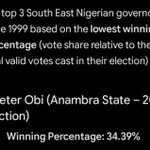
This same man set this record in his second term. This was after a full term of supposed "Good governance" btw.
If it was the first term, I'd say maybe a lack of believe in him since he was just coming on the scene but after 4yrs he still managed to post the worst winning percentage of any governor in the entire southeast governorship race since 1999. I find it hard to believe that a governor that actually did a great job and made tangible achievements while in their first term in office will struggle so much to get re-elected to continue to deliver "good governance" to beneficiaries who are the voting base of the election. Even harder to believe is the fact that he wasn't running on an unknown platform.
Every other past governor that she claims is not electable had better winning percentages than the guy that she claims is.
I like to stay objective and logical about things and the only logic that screams out to me are:
1. That this man did not do enough to warrant mass appeal for his re-election.
2. His second term was likely forced down on anambrarians because that kind of margin doesn't speak to mass appeal of anambrarians.
3. As a Nigerian, if the people he served could not overwhelmingly vote for him in a governorhip election against people who they openly call corrupt and bad leaders even after a full term of "good governance" why should I claim to know better than them because he no longer serves them?
4. What is the motivation for the sudden mass appeal amongst the people that he served who refused to overwhelmingly vote for him in an election that was devoid of participation from other regions?
5. Is this motivation Ethnic, religious or some other reason?
6. Does this performance number prove that the screenshots condemning him as a governor are actually valid complaints and not the machinations of the opposition?
Personally made my judgement about the man which I can live with but I'm asking for educated folks who are reserved, who want to ask these questions but too afraid to and who are still trying to figure where their vote should go.
@egi_nupe


So if orji Uzor kalu, rochas or umahi contest for president, I will vote for them cos they are Igbo
Omo God forbid bad thing
34
This guy killed a human being yesterday and will follow the rest of us Chelsea fans to call out the ref and the team today like nothing happened yesterday. I can even picture him insulting colwil right now.
What a sad and shameful reality, made possible because of the failure of the police.

"dey collect na, they collect, they know they know , they know, they collect, obi or nothing"
This is what one of the obidents saw saying after Keeling that innocent guy. @OfficialDSSNG and @PoliceNG these people did not wear any mask, fish them out and let them face the music, except we want to turn this country to banana republic
45

NO CAP retweeted
Alhaji, you were badly advised and you allowed sycophants around you to misguide you. There was nothing wrong with you joining a political party; but the rookie mistake of taking over a political party without conducting proper due diligence and following the party’s constitution,was/is something an experienced politician like yourself should never have been found in. Stop blaming Bola for your own missteps. You had all opportunities to do the right thing but you still allowed people to deceive you and take your money from you.
Instead of blaming Bola, focus on getting your mandate back, appeal the judgement and let your legal team challenge it. Hopefully, you will be able to participate in the election, which you are bound to lose anyways. If something as basic as following due process within the party, could be a problem for you, then what happens if you win the election?
So Bola is not your problem, you are.

BOLA CANNOT USE THE COURTS TO ESCAPE THE PEOPLE’S VERDICT; WE ARE ON THE BALLOT — ATIKU
Fellow Nigerians,
Let no one mistake the latest court ruling for the will of the Nigerian people. No manipulation, conjecture or concoction can erase our place in this contest, silence our campaign or deny Nigerians the right to choose their future. We are on the ballot, and the people must be allowed to decide.
Those who boast of having thirty-two governors and claim to have bought, pressured or coerced leaders from other parties into their fold should have no reason to fear a free and fair contest. Yet, instead of presenting their record to Nigerians, they continue to deploy every tactic available to weaken the opposition: political pressure, manufactured narratives, courtroom manoeuvres and attempts to compromise the voters’ register with AI-generated photographs, false names and fictitious identities. These are not the actions of people confident in their record. They are calculated attempts to make genuine competition impossible and push Nigeria towards a one-party state.
And what record do they have to defend? This government removed the fuel subsidy overnight without a plan to protect Nigerians. It presided over the steep decline of the naira and allowed food prices to rise beyond the reach of ordinary families. Factories and small businesses have shut their doors. Our young people are leaving in search of hope, while bandits and kidnappers continue to hold communities hostage.
Look around you. Market stalls stand empty. Feeding your family has become a daily struggle. Fuel prices keep rising, and silent pain fills homes across the country. Those in power may want you to believe that your suffering does not matter. They may want you to surrender your future before you even reach the ballot box. Do not lose heart. Do not retreat. Your vote is your power, and together, we will take our country back.
Let me be clear to every Nigerian who has stood with us: I am in this race. I am not going anywhere. We will be on the ballot. No threat, blackmail or court manoeuvre will make me abandon you or the cause we share.
We will resist with all our strength every attempt to turn Nigeria into a one-party state. Nigeria belongs to all its people. Our democracy must remain open to more than one party and more than one voice. If those in power believe in their numbers and their record, let us meet at the polls in a free, fair and credible contest.
Our campaign will continue. Our message on the cost of living will not be silenced or derailed. Stay calm, united and resolute. Together, we will fight for a Nigeria where life is affordable and every citizen’s vote counts.
Let me say this plainly: Bola cannot use the courts to escape the judgment of Nigerians at the ballot box.
Atiku Abubakar
Vice President of Nigeria, 1999–2007
Sokoto, Nigeria
6 November 2026
The older and more knowledgeable I've become on football matters, the more I realize how subjective this "Ronaldo being the best goal scorer topic" is.
It might not resonate with you and you may not agree but if you think about it thoroughly without any bias, you might at least see some sense in what I mean.
An analyst that values efficiency might pick messi because he has a better Goals per match ratio to Ronaldo and to them, that means Messi is the best goalscorer.
Henry vs Shearer, Mbappe v Haaland are all good examples to back this point.
Another analyst might say Ronaldo has scored more goals and hence is the best goalscorer.
Which argument makes more sense to you?
PS: This isn't me trying to diminish Ronaldo's greatness or starting any degen Messi v Ronaldo argument.
Just asking a honest footballing question.

NO CAP retweeted
If I tell you something, believe it. You don’t even need to like me. 🙈


NO CAP retweeted

The first thing my lawyer told me was that, don’t help them. Let them do their work and only confirm what they already know. I had a lawyer on retainer so he was at EFCC office even before I got there, this caused a big problem because they claim i shouldn’t have a lawyer on the go when I’m not a criminal.
EFCC combed my bank account for 5 days, going through every single transactions from 2017 till 2024, saw a transaction of up to N5M as at 2017 and claimed it was a red flag. Note that they didn’t have any evidence to link it to any crime.
EFCC combed through my phones, read hundreds of emails, browsing history, purchase receipts, etc dating back as far as 2017, took me in for profiling three times, and yet, they couldn’t find any shred of evidence linking me to internet fraud
EFCC told me that they have reason to detain me for up to 21 days without trial because according to them, I shouldn’t have N5M(single transaction) in my account as at 2017. Let that sink in!!
They detained me for 8 days, tortured me for 3hrs the first day and yet they couldn’t find a single, or any shred of evidence linking me to cybercrime. Do you know how crazy it is for EFCC to investigate you for 8 days without finding any evidence of the crime you were arrested for?
EFCC told me point blank that we know you’re not into fraud but “we can’t simply let you leave due to the huge sum found in your account”
EFCC told my lawyer I said I don’t want to see him three times before he was eventually allowed in
EFCC told my family that I declined their visitation request.
Lastly EFCC said those who confessed to have committed internet fraud will leave the detention before me and they did. I was the last person to leave despite not finding a single evidence of cybercrime or internet fraud even till now

NO CAP retweeted

I’m not defending or attacking any candidate. I’m just saying: when something looks too neat or perfectly timed, it’s worth checking before you repost it.

NO CAP retweeted

🚨 BREAKING: BLISTERING screams heard from the Learjet 60 pilot as she loses control of the aircraft and crashes into the ground in Palm Beach County, FL
“WE’RE GONNA CRASH INTO THE GROUND!”
“HOLY F*** WE’RE OUT OF TIME!”
God rest the souls of the 9 people on board.


