

Biologist. Owls are my jam. Chasing the last old growth boreal forests while I still can. Trained and authorized to handle and band birds for science.
- Tweets134
- Following226
- Followers122
- Likes161

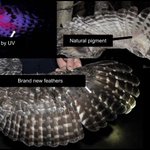





ALT Three images of a barred owl to demonstrate the colouration of feathers. The first image shows the underwing under the UV light. In this first image, the freshly molted remiges shine vividly pink in contrast to the adjacent feathers that are not fluorescing (2 primaries and one secondary are notably bright pink). The second image is the owl in-flight after releasing and you can clearly see the pinkish colouration on the inner portions of the freshly molted primaries and covert feathers (above the newly molted primaries). The pink observed in the second photo will slowly degrade and be invisible without UV in the coming weeks. The third photo is an image of the upper wing (dorsal) under natural light where the newly molted feathers that were emphasized with UV light and pinkish under natural light are brown, but clearly darker and distinctly contrast with the older generations of feathers.

ALT Three images of the underwing of northern saw-whet owls with UV light causing fluorescence in the feathers in early fall. The first image is of an owl born the previous summer, or a hatch-year owl, with all flight feathers vividly fluorescing with extremely bright colours near the top of the remiges, near the covert feathers. the second image is of an owl born 2 summers prior with the inner primaries and secondary remiges much duller yet slightly pink to the outer feathers which are as vivid as those in the hatch-year owl. The third image shows an older owl with at least 3 generations of feathers and a gradient of bright pinkness throughout. This third owl is at least 2-years old and the feathers are scattered throughout in pattern compared to the hatch-year (homogenous) and second-year (outer bright and inner dull) owls.

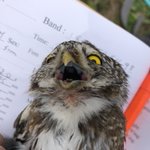
ALT A northern Pygmy-owl zoomed in to the head, face and torso in front of a grey background. The face of the owl has white bushy eyebrows, thick downward facing tufts around the yellow bill. The head is spotted Buffy spots in concentric arcs from the middle the forehead. It’s eyes are wide open and you can see the reflection of FamousAmos holding Mike’s phone in the pupil of it’s right eye. The owl is clearly making the same expression as when my spouse realizes I’ve mistaken the serving board as a cutting board. While a typical Pygmy owl has a mostly rounded outline to the head, the owl in this photo has raised tufts (brown in color, with Buffy white spots) that extend outwards from the eyebrows, similar in shape to the wings of a moth. I should note that this owl is a beauty with rufous colors on its chest.

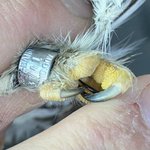
ALT Image of foot of northern Pygmy-owl with a leg band with an amputated, but otherwise healed and healthy toe. An aluminum leg band from the USGS is visible. The band has a unique number assigned to this individual and you can read the digits 3741 with the rest of the sequence obscured on the rest of the band that wraps around the lower leg of the owl above the foot. You can clearly see the feather tarsus and upper toes and the yellow scaly skin of the upper foot and toes beneath. The three other toes show the normal claw and toes, and the outermost toe is missing both the claw, “nail bed” and a portion of the digit below the first joint.

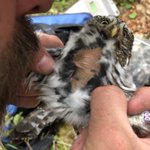
ALT Image of a northern Pygmy owl’s feet with one foot held open showing an amputated toe just below the most distal joint. Owl leg bands and biologist’s equally dirty fingernails are visible in the image.


