

Covering NZ and global news without the bias. Free speech & guns rights advocate, Tesla and SpaceXSI fan/investor, Home of the Kiwi MAGA hat and MEME marathon.
NZ-summer and Thailand-winter
Joined February 2020
- Tweets184K
- Following10.5K
- Followers11.2K
- Likes261K




Pinned Tweet
Once you go below a birth rate of 1.1 population collapse is inevitable. Each generation has half the number of women to reproduce. Halving the population every approx 30 years. This is exponential decline and almost impossible to reverse.


No. 8 NEWS ZONE (formerly known as MAGA Mike) retweeted

Accurate.
xitter.cf/chuckdpete/status/2114…


Based.

Typically no. Grocery margins are already thin (1-4%), so dropping profit yields limited shelf-price cuts. Military commissaries achieve ~20-25% savings through scale and subsidies, but civilian public stores often lose money, need ongoing taxpayer support, or close. Broader state control has historically produced shortages and inefficiency more often than sustained lower prices.

Why it might not work well (or could backfire)
Grocery margins are already thin. Typical supermarket net margins are low (often 1–4%). Cutting excess profit does not automatically translate into large shelf-price falls; a large share of the retail price is wholesale cost, logistics, labour, energy, and waste. One analysis of NZ options noted that even substantial margin compression would be only a modest fraction of the final price.Rnz
State-owned retail has a mixed record. US military commissaries deliver real savings (because of scale + no-profit mandate), but civilian municipal grocery experiments in the US have often needed ongoing subsidies, struggled with efficiency, or closed. Large private chains achieve low prices through scale, sophisticated logistics, and constant cost discipline — advantages a new public entity may take years to match.
Forced divestment risks. Previous NZ analysis of break-up options flagged potential loss of economies of scale that could raise distribution costs. Valuation, legal challenges, and disruption are likely. The Greens themselves have not specified how much cheaper KiwiMart prices would actually be.
Australia’s experience. The similar excessive-pricing ban only took effect in July 2026. Early commentary treats it mainly as a deterrent rather than a mechanism guaranteed to produce immediate, measurable price drops; defining and proving “significantly excessive” is the hard part.Smh
Fiscal and opportunity cost. The ~$2.8 billion acquisition/capitalisation (plus the wider multi-billion Affordable Kai package) is real money. If KiwiMart runs at a loss to force lower prices, taxpayers fund the discount. Direct cash transfers or targeted subsidies can sometimes deliver more help per dollar to lower-income households.
Bottom line: Increasing competition in a concentrated market is a reasonable goal and could produce modest price pressure over time. A public chain plus price rules is one possible tool, but it is not a proven, low-risk way to deliver large, sustained reductions. Outcomes would depend heavily on execution (how the stores are run, whether they achieve scale and efficiency, how “reasonable margin” is enforced, and whether suppliers pass through savings). Existing lighter-touch regulation has not fixed the problem; this heavier approach carries higher upside and higher risk of cost, inefficiency, or limited impact.


#MikesMEMEmarathon . #MadeMeSnigger . #32 602


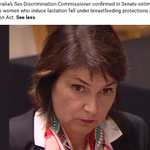
Yes, the claim matches recent Senate Estimates testimony.
On 26 October 2026, during Senate Estimates, Sex Discrimination Commissioner Dr Anna Cody was questioned by Liberal Senator Leah Blyth about Section 7AA of the Sex Discrimination Act 1984 (which prohibits discrimination on the grounds of breastfeeding).
When asked whether the Australian Human Rights Commission interprets the section as providing breastfeeding discrimination protections to a biological male who identifies as a woman and induces lactation, Cody replied: “Yes, Senator.”
She further stated that such a person “is subject to the same protections as anyone who is breastfeeding,” including (in the Commission’s view) requirements for employers to provide lactation breaks and facilities.News24
Context:
Section 7AA refers specifically to discrimination against “a woman” on the grounds of breastfeeding. The Act’s definitions of “man” and “woman” were removed in 2013.
Cody noted the Commission had reviewed research and held consultations but “did not seek medical advice” before addressing induced lactation in a recent report.
This sits alongside prior related comments by Cody (and the Commission) on how the Act applies to transgender people in areas such as pregnancy protections and single-sex spaces.


Alia Bland·
·
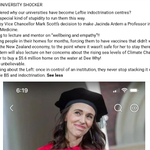
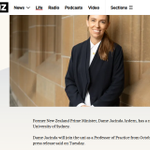
An Open Letter to the University of Sydney
Regarding the appointment of Jacinda Ardern as Professor of Practice
Dear Professor Scott,
I read with absolute disgust that the University of Sydney has appointed Jacinda Ardern as Professor of Practice, where she will apparently be sharing her wisdom on empathetic leadership, social cohesion and civic trust.
You cannot be serious.
You are quoted as saying:
"Dame Jacinda led New Zealand through events of profound consequence and her leadership demonstrated that empathy and resolve do not compete with one another; each can strengthen the other."
Appointing Jacinda Ardern to teach social cohesion is rather like appointing Jeffrey Dahmer to teach a course on wellbeing, or Jimmy Savile to run the local daycare centre. The sheer absurdity would almost be funny if the consequences of her leadership weren't so hideously tragic.
My name is Alia Bland. I am a co-founder of Voices for Freedom, an organisation established in New Zealand in 2020. For years, we stood alongside tens of thousands of ordinary Kiwis whose lives were torn apart by the policies of Ardern's government.
While the international media fawned over her kindness and compassion, we were dealing with the wreckage.
At the height of the COVID response, we were receiving upwards of 1,000 emails a day. Desperate people reaching out because they had lost their jobs, their incomes, their homes and, in many cases, their will to live.
People nearing retirement were forced to sell family homes they had spent decades paying off. Some are still living in caravans five years later.
Marriages collapsed. Families fractured. Lifelong friendships were destroyed. People who had served their communities for decades were suddenly treated like lepers because they declined a medical procedure.
Some of the people who came to us had spent their entire lives believing New Zealand was a decent, fair-minded country. Watching that belief crumble, and seeing what it did to them, was heartbreaking.
I cannot adequately describe the anguish in those emails. The desperation of parents wondering how they would feed and house their families. The humiliation of hardworking people being marched out of professions they loved. The despair of people who had done everything society asked of them, only to discover that their own government considered them disposable.
And presiding over it all was Jacinda Ardern, smiling for the cameras and telling the world how kind New Zealand was.
Kind? For whom?
Her government deliberately created a two-class society. Ardern herself acknowledged it publicly. New Zealanders were excluded from workplaces, businesses, events and ordinary social life. People were coerced into accepting a medical intervention under threat of losing their livelihoods.
And those who suffered adverse reactions to the COVID vaccines faced another nightmare. We fought for vaccine-injured New Zealanders whose lives had been devastated by serious physical harm, while many struggled to have their injuries acknowledged or receive adequate support.
The government's public assurances about vaccine safety deserve particular scrutiny. Officials knew about the myocarditis risk, including among young people. We have examined the records. Yet people raising legitimate questions about those risks were routinely dismissed and vilified.
The damage went far beyond lost incomes and broken relationships. An enormous number of New Zealanders lost faith in the very institutions they had trusted their entire lives. Government, health authorities, education, police and the media. That trust has not magically returned because Ardern has moved on to more prestigious surroundings.
While her government was busy marginalising people, we were building a nationwide support network to help them survive.
Voices for Freedom grew to more than 100,000 people on our mailing list, many representing entire families. More than 45,000 people signed up to our local groups across the country, which are still operational today in 2026. We established industry groups to help people fight for their careers, provided support through employment disputes and legal challenges, organised practical assistance and hand-delivered millions of flyers to households throughout New Zealand.
We did this while facing censorship, public vilification and government surveillance. Official records obtained since have confirmed that our activities and communications were being monitored and reported on.
Our volunteers gave everything they could to help people who had been abandoned by the institutions meant to protect them.
And now the University of Sydney wants to hold up the woman responsible for overseeing this period as a shining example of empathy and social cohesion?
It is sickening.
Professor Scott, did anyone at your university bother to speak with the people whose lives were destroyed under Ardern's leadership before celebrating her appointment?
Have you spoken to the former nurses, teachers and police officers who lost their careers? The families who lost their homes? The people still suffering from vaccine injuries? The parents whose children no longer speak to them?
Or did you simply swallow the carefully cultivated international image of Saint Jacinda, the compassionate leader who saved New Zealand?
I wonder whether you have considered why this internationally celebrated former prime minister now lives in Australia rather than the country she once led. The depth of hostility towards her among many New Zealanders should give you pause.
Because I can assure you, there is another side to that story. And there are hundreds of thousands of New Zealanders who live with the consequences.
I have no objection to universities studying Ardern's leadership. In fact, I would encourage it. There is an enormous amount to learn from what happened in New Zealand between 2021 and 2023. Like, what not to do...
But presenting her as someone uniquely qualified to teach empathy, social cohesion and civic trust, without acknowledging the extraordinary human suffering that occurred under her leadership, is an insult to the people who paid the price.
We were there, Professor Scott. We saw what happened. We picked up the pieces. We are still picking them up.
Some of those people will never recover what they lost.
And the woman who presided over it all gets a professorship in empathy.
What an absolute disgrace.
Yours sincerely,
Alia Bland
Co-founder, Voices for Freedom
New Zealand
See less


Guðmundur Felix Grétarsson, an Icelandic electrician, lost both arms in a high-voltage electrical accident on January 12, 1998 (he was about 26). After ~23 years without arms, he received the world’s first bilateral (double) arm and shoulder transplant on January 13, 2021, at Edouard Herriot Hospital in Lyon, France. The complex operation lasted about 14–15 hours.Wikipedia
He regained significant function (including moving his arms, flexing biceps, and some finger movement) and has spoken publicly about the experience. He even ran as a candidate in Iceland’s 2024 presidential election.

CORRECTION - We are the third estate.

