We use the law to promote and defend justice and human rights as part of the @OpenSociety Foundations.

New York
Joined March 2011
The Trump administration’s sanctions on the ICC as an institution create additional harms for those seeking justice for crimes against humanity, war crimes, and genocide, and threaten fundamental freedoms. We’ve joined with others to defend the ICC. thehill.com/opinion/criminal…
6
4
1
9
7,025
Open Society Justice Initiative retweeted
The ICC is a court of last resort, delivering justice and accountability for victims of war crimes, crimes against humanity, and genocide. The Trump admin’s actions are a direct attack on Ukrainians, Palestinians, the Rohingya, Darfurians, and Afghan women and girls’ right to pursue accountability.
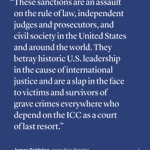
The Open Society Foundations today condemned the Trump administration’s announcement of new sanctions on the International Criminal Court (ICC) as an institution, an unprecedented escalation of its campaign against the independent court dedicated to ensuring accountability for the gravest crimes. “Since its establishment, the International Criminal Court has served as a court of last resort, delivering justice and accountability for victims of war crimes, crimes against humanity, and genocide when they have nowhere else to turn. The Trump administration’s actions are a direct attack on the victims’ right to pursue accountability for crimes against Ukrainians, Palestinians, the Rohingya, Darfurians, and women and girls in Afghanistan,” said Binaifer Nowrojee @NowrojeeOSF, president of the Open Society Foundations. “The attack on the ICC punishes the people seeking justice instead of the perpetrators. These actions threaten to create a new era of impunity, where grave crimes go unpunished, and the perpetrators are free to repeat them. No one should be beyond the reach of the law, no matter how powerful. Open Society is committed to a world where human rights are protected, power is constrained by law, and justice is available to all.” Open Society supported the campaign to establish the ICC following the genocides in Rwanda and the former Yugoslavia in the 1990s to prevent those responsible from evading justice. As a court of last resort for victims who have nowhere else to turn, the ICC investigates and prosecutes individuals responsible for war crimes, crimes against humanity, genocide, and the crime of aggression when national authorities are unwilling or unable to do so. Nearly two-thirds of UN member states have joined the court. Its work spans the globe; it has initiated 18 investigations in countries including the Philippines, Sudan, Venezuela, and Ukraine. Open Society has long supported the ICC’s engagement with civil society and has consistently opposed efforts to undermine the court’s independence. In August, the Open Society Institute, a part of the Open Society Foundations, joined three human rights groups in a lawsuit challenging the Trump administration’s previous sanctions targeting individuals and organizations affiliated with or assisting the work of the ICC. In 2025, the Open Society Justice Initiative joined more than 70 civil society and faith-based organizations in warning against the potential use of sanctions to attack the court. The group argued that the ICC performs a vital role in international affairs by investigating crimes that shock the conscience of humanity and that “it does so in a manner that protects the due process rights of the accused, the sovereignty of states, including the United States, and the rights of victims.” Open Society is committed to the independent and impartial pursuit of international justice wherever crimes that violate international law have been perpetrated.
17
24
2
65
5,003
Open Society Justice Initiative retweeted
The Open Society Foundations today condemned the Trump administration’s announcement of new sanctions on the International Criminal Court (ICC) as an institution, an unprecedented escalation of its campaign against the independent court dedicated to ensuring accountability for the gravest crimes. “Since its establishment, the International Criminal Court has served as a court of last resort, delivering justice and accountability for victims of war crimes, crimes against humanity, and genocide when they have nowhere else to turn. The Trump administration’s actions are a direct attack on the victims’ right to pursue accountability for crimes against Ukrainians, Palestinians, the Rohingya, Darfurians, and women and girls in Afghanistan,” said Binaifer Nowrojee @NowrojeeOSF, president of the Open Society Foundations. “The attack on the ICC punishes the people seeking justice instead of the perpetrators. These actions threaten to create a new era of impunity, where grave crimes go unpunished, and the perpetrators are free to repeat them. No one should be beyond the reach of the law, no matter how powerful. Open Society is committed to a world where human rights are protected, power is constrained by law, and justice is available to all.” Open Society supported the campaign to establish the ICC following the genocides in Rwanda and the former Yugoslavia in the 1990s to prevent those responsible from evading justice. As a court of last resort for victims who have nowhere else to turn, the ICC investigates and prosecutes individuals responsible for war crimes, crimes against humanity, genocide, and the crime of aggression when national authorities are unwilling or unable to do so. Nearly two-thirds of UN member states have joined the court. Its work spans the globe; it has initiated 18 investigations in countries including the Philippines, Sudan, Venezuela, and Ukraine. Open Society has long supported the ICC’s engagement with civil society and has consistently opposed efforts to undermine the court’s independence. In August, the Open Society Institute, a part of the Open Society Foundations, joined three human rights groups in a lawsuit challenging the Trump administration’s previous sanctions targeting individuals and organizations affiliated with or assisting the work of the ICC. In 2025, the Open Society Justice Initiative joined more than 70 civil society and faith-based organizations in warning against the potential use of sanctions to attack the court. The group argued that the ICC performs a vital role in international affairs by investigating crimes that shock the conscience of humanity and that “it does so in a manner that protects the due process rights of the accused, the sovereignty of states, including the United States, and the rights of victims.” Open Society is committed to the independent and impartial pursuit of international justice wherever crimes that violate international law have been perpetrated.
11
15
2
50
39,908
Tomorrow at 12pm EDT: Where did modern human rights come from? What went right? What went wrong? Join our discussion with Aslı Ü Bâli, Gay J. McDougall, Aryeh Neier, @AgnesCallamard, and James A. Goldston. RSVP to attend online: osf.to/TracingModernHumanRig…
1
624
Oct 8: Join Aslı Ü Bâli, Gay J. McDougall, Aryeh Neier, @AgnesCallamard & James A. Goldston to explore the modern human rights movement's origins—the first in a discussion series tracing its past, present, and future. RSVP to attend online: osf.to/TracingModernHumanRig…
1
448
Oct 8: Join the first in an online discussion series tracing the human rights movement’s past, present, and future. Aslı Ü Bâli, Gay J. McDougall, Aryeh Neier, @AgnesCallamard, and our James A. Goldston explore the origins of modern human rights. RSVP: osf.to/TracingModernHumanRig…
3
5
6,410
We welcome a significant development in our case before France’s Conseil d’État: France and the UK are joining 10 other countries in banning imports from Israeli settlements in the West Bank, a measure sought by five partners in their ongoing litigation: justiceinitiative.org/litiga…
4
8
6,283
Open Society Justice Initiative retweeted
The rule of law and human rights are vital to open societies. How can we imagine a world where international law is meaningful not just with lawyers and diplomats, but with everyone it seeks to protect? James Goldston, executive director of the Open Society Justice Initiative @OSFJustice, explains how we build cases to improve people’s lives and rights. All too often law is used to reinforce and expand inequalities in power and wealth in societies. We help people use the law to change systems for the better, amid a deeply unjust world. Through this work, we’ve successfully protected people deported from the U.S. to countries they’ve never lived in, outlawed racial discrimination and segregation against Roma in Europe, and required governments to take the risks and damage from the climate crisis seriously. Building on our own cases, the Justice Initiative provides financial, technical, and strategic support to partners around the world who file cases for marginalized people and seeks to foster connections among those practicing strategic litigation. As James says, “Our privilege at the Justice Initiative is to be able to help people use legal tools in their struggle.”
21
25
50
33,557
Open Society Justice Initiative retweeted
An update from Open Society Justice Initiative’s Natasha Arnpriester: The Trump administration’s forced removal of asylum seekers and people with U.S. orders of protection to countries they have no relationship to continues to accelerate and violate the U.S. government’s protection obligations and international law. Just last week, a 24-year-old Afghan whose family helped U.S. forces fight the Taliban, and who was protected from return to Afghanistan, was deported in shackles to the Central African Republic, a country the U.S. government itself warns against traveling to because of violence and insecurity. He was aboard a flight carrying 70 others, including other Afghans, Iranians, Nepalis, and Nicaraguans. They are among the 100 people who were sent thousands of miles to eight African countries in the last two weeks—where they have never been and know no one. They are leaving family and loved ones behind, forced onto long flights, not knowing where they were being taken. Most have already won protection from U.S. immigration judges after facing persecution or torture at home. That protection legally bars the U.S. from returning them to the country where a judge found they would likely face such harm. But the U.S. government is exploiting a loophole. People the U.S. cannot legally send home are sent somewhere else, where many are then returned to the very countries they fled. These removals are carried out through an expanding web of opaque agreements, struck in exchange for money or other promises by the Trump administration. Liberia is among the latest, agreeing to accept up to 1,200 people. The Open Society Justice Initiative continues to support lawyers in receiving countries who are challenging these transfers in domestic and regional courts, working to protect people caught in this system. More cases are coming. @NatashaArnpr @OSFJustice
The Trump administration is deporting thousands of asylum seekers and those in need of protection to third countries in violation of the U.S. government’s protection obligations and international law.
4
10
24
47,996
International justice is the last resort for victims of the most serious crimes. As @EstiTambay explains, we are standing with the victims and for the rule of law in seeking to overturn sanctions against international judges and other officials. osf.to/4hISjgh
1
1
1
1
917
Nearly two years after Australia, Canada, Germany, and the Netherlands had “formally taken steps” to take Afghanistan’s Taliban to account for imposing a “gender apartheid” on women and girls, progress has stalled.
1
890
A rare moment of the international community not only naming the offences against women and girls—no education beyond sixth grade, no leaving home unless accompanied by a male relative, no speaking in public—but doing something about it has lost momentum.
1
189
Open Society’s @NatashaArnpr asks why the process has stalled and how the four states could continue to pursue justice for Afghanistan’s women and girls under the Convention on the Elimination of All Forms of Discrimination Against Women (CEDAW): justsecurity.org/151401/just…
1
2
126
We’ve joined @afsc_org, @hrw, and @theCCR in challenging the Trump administration's Executive Order 14203, which imposes sanctions on the ICC. bit.ly/4g3fMX3
3
1
3
597
Open Society Justice Initiative retweeted
States must comply with obligations set forth by international law. That is what is being argued in a landmark case filed before France’s highest administrative court, the Conseil d’État, by five human rights organizations. The case challenges France’s failure to prevent companies and banks under its jurisdiction from contributing to Israel’s unlawful occupation of the Palestinian territories. The Open Society Justice Initiative advised these organizations—@fidh_en, @JURDIasso, @ICJPalestine, @LDH_Fr, and @law4palestine—on this case. xitter.cf/Law4Palestine/status/2…
🔴France’s failure to prevent companies and financial institutions under its jurisdiction from contributing to Israel’s unlawful occupation of the occupied Palestinian territory breaches its obligations under international law. We have filed a case before France’s highest administrative court to challenge this. 👉Read the full press release and Q&A document covering everything you need to know about the case here: law4palestine.org/rights-gro…
6
10
2
27
30,866
Open Society Justice Initiative retweeted
For over two decades, the Open Society Justice Initiative @OSFJustice has been using the law to advance justice and human rights globally.
3
4
1
22
19,824
Open Society Justice Initiative retweeted
In a lawsuit filed today, the Open Society Justice Initiative @OSFJustice is representing Kimberly Prost, one of the International Criminal Court (ICC) judges who are subject to U.S. sanctions issued by the Trump administration. The suit challenges the legality of these sanctions, which the U.S. government imposed against the judges in connection with their decisions on ICC investigations into alleged crimes in Afghanistan and Palestine. These sanctions are tantamount to a financial death penalty and include asset freezes and travel restrictions. “These judges are being punished for discharging their judicial duties independently by rendering decisions with which the Trump administration disagrees. This is an effort to pressure them to render future decisions more to the administration's liking,” said James A. Goldston, executive director of the Open Society Justice Initiative. This is the fifth lawsuit against these sanctions. In prior cases, courts have found them unconstitutional. This is the first time ICC judges have gone to court themselves to challenge their designation. Judge Prost is venerated for her contributions to international justice. She has been a judge at the ICC since March 2018 and previously held numerous high-level legal positions in Canada and abroad, including within Canada’s Department of Justice, the Commonwealth Secretariat, and the United Nations.
10
23
4
60
13,535