

Claude-y neophyte Databases, DeFi, economics, fintech, oil markets. VC-curious. A24 cinephile. Devoted reader of The New Yorker.
Inside
Joined March 2013
- Tweets31.9K
- Following159
- Followers442
- Likes20.4K





Ouroboros DeFi "O-De" retweeted

One of the best prompts I keep coming back to


Hi, I'm Felix. I'm an eng lead working on Claude. I love watching people take flight and do things they never thought possible.
We often describe that as "being more ambitious" when using AI, which is tricky advice to follow. I wrote a tutorial:
felixrieseberg.com/how-to-be…

Ouroboros DeFi "O-De" retweeted

There are SO many great bot templates in the Grok Bot Directory!
grok-bot.directory/
Including a few from me, with one currently sitting at #3. 👀 👻


Ouroboros DeFi "O-De" retweeted

New from me: my most comprehensive commentary on AI to date.
Nobody has a duty to yield their interests to a view from nowhere. I do not want to see humans outsource our minds and become pets, at best, in someone else's universe.
tracingwoodgrains.com/p/spit…

Ouroboros DeFi "O-De" retweeted

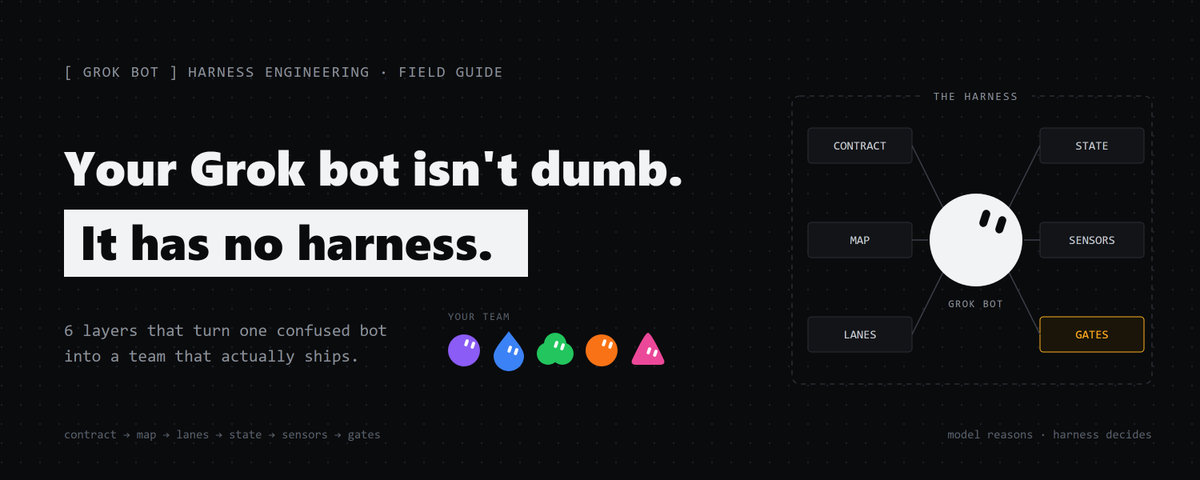
Harness, loop and graph could be the missing layers between AI models and agents that actually work.
Same model, same prompt, completely different results.
In this article, I show you how to build all three layers.



Ouroboros DeFi "O-De" retweeted

Researchers mathematically proved that AI will cause something worse than mass unemployment.
They call it "The Tragedy of the Cognitive Commons"
In 1968, Garrett Hardin described how rational actors, acting in their own self-interest, inevitably drain a shared resource until the whole system collapses.
Today, every company is doing the exact same thing to human intelligence.
To understand why, the paper splits AI-era skill into two completely different things:
- Internalized Mastery: deep domain judgment built through years of unassisted struggle and practice
- Distributed Mastery: the ability to orchestrate and manage AI systems
Right now, companies are obsessed with Distributed Mastery. They are cutting junior roles and handing entry-level work straight to AI agents.
On paper, it looks like pure efficiency.
In reality, it triggers what the author calls the "Validation Tether."
AI outputs are notoriously coherent—even when they are subtly, dangerously wrong. Catching those hidden flaws requires deep, internalized domain expertise.
In other words, you cannot safely run an AI unless you already know how to do the job without it.
And the experimental data is brutal.
Studies testing workers after AI exposure show a sharp dissociation: when people learn a task with AI assistance, their performance spikes during the session, but the moment you take the AI away, the skill advantage completely disappears.
AI-assisted productivity does not build AI-independent expertise.
This creates a silent, industry-wide paradox.
Automation increases the need for elite human oversight at the exact same moment it eliminates the junior trenches where those elites are forged.
Every individual CEO thinks they are being smart.
"Why pay to train juniors when AI can do their work today? If we need senior experts later, we'll just hire them."
But hiring only redistributes experts. It cannot regenerate them.
Once every firm stops feeding the pipeline, the shared pool of deep human expertise dries up across the entire profession.
When the current generation of veterans retires, the ones who built their intuition before AI existed, there will be nobody left capable of telling when the machine is hallucinating a disaster.

Ouroboros DeFi "O-De" retweeted

Everyone is sharing this video. Very few people are explaining what it means for someone who doesn't write code.
So let me try.
Until now, when you asked Claude to build something, you got an artifact. An artifact is a small working tool that Claude makes for you, like a calculator, a tracker, a dashboard, a simple game.
You could already publish it and get a link. Open it in your browser, bookmark it, share it with your team.
But it was still a web page.
It sat in a browser so it couldn't ping you and couldn't touch anything on your computer.
This week, Anthropic changed that.
You can now click "Install as app", and that same tool becomes a proper app on your Mac or Windows laptop.
It is in beta right now, and it is rolling out on all plans, including the free one.
Now say you run a small business and want a simple desktop app to track daily orders.
You would hire a developer. They would build it, package it for Mac and Windows, that is weeks of work and good money for something fairly basic.
Now these are only three steps.
1. Describe it to Claude.
2. Try it in the chat.
3. Click install.
There is no packaging, no signing, no API key, no separate login. The app runs on your own Claude account.
And when you ask Claude to change something, the installed app updates on its own.
Now, these apps can also do things a normal web page can't.
They can send you notifications. They can sit in your Mac menu bar or the Windows system tray.
And they can use your connectors to your Gmail, Google Calendar, Notion, Slack and so on.
A salesperson could now build a small app that opens every morning with the day's meetings from the calendar and the last call's transcript from each client next to it.
A shop owner could build an order tracker that pings them at 4 pm if an order due today hasn't shipped.
A student could build an app that shows exam dates and how many days are left for each.
Anthropic's own staff built a few examples.
An image editor. A file manager. A tool that sorts messy folders using rules you set. A small app that shows how hard your computer is working.
Most people don't need a big app from an app store. They need one small tool that fits exactly how they work.
Until now, only people who could code could make that for themselves.
Obviously there are some catches too.
First, the app needs the internet, and you need to be signed in to Claude. It won't open offline.
Second, every time the app asks Claude to do something, it uses your plan's usage limit.
Third, and most importantly, permissions.
There are three levels.
Level one, and the default is that the app can only do what a website can do.
The second level allows things like notifications and keyboard shortcuts.
The top level is full computer access. That means the app can run programs and read, change or delete your files without asking each time.
So my advice is simple. If someone shares an app with you, keep it at the default level.
Give full access only to apps you made and understand.

Ouroboros DeFi "O-De" retweeted

If someone gets your phone number, they don't need your passwords.
They can port your SIM in 20 minutes and empty every account you own.
Your phone number isn't a phone number. It's the master key to your 2FA.
Here's how to lock it down in 15 minutes ↓



Ouroboros DeFi "O-De" retweeted

This is a good read from Anthropic on why you don't really need subagents anymore, and most workflows should just be one agent. Bitter lesson adjacent. Lots of good bits in here, both why this is true, and how you can convert back to a single agent architecture.
Some quick notes on what I found interesting:
- Modeling your agents around your org chart is *not* what you should do
- Plan mode is dead. Better to have the plan be in the main agent's context
- MCP tool design is critical. Take a jobs to be done approach versus mapping your API to tools directly.
- Build evaluations on the full task completion / final output (or on the skills / tool calls if you need to). Whatever the case, make sure evals are coherent and non-conflicting
- If you do keep subagents around, call it as a tool so that the main agent controls the context
Also thematic in this post: Many attempts at AI adoption layer it on the existing architecture (both technical and organizational), when the most appropriate way to adopt it is to re-think the architecture completely. This is most difficult on the people side (e.g org design, what teams should do, what teams should even exist, etc.)
Def. Worth reading the entire thing if you are doing applied AI stuff.
claude.com/resources/article…

Ouroboros DeFi "O-De" retweeted

IF I F*CKING LOST MY IPHONE TOMORROW, I’D LOSE MY MONEY, MY EMAIL, MY TEXTS AND 11 YEARS OF PHOTOS.
GROK BOT FIXED ALL OF IT. MY PART TOOK 3 MINUTES.
I never checked how much of my life sits on one phone. Turns out: all of it.
I gave Grok Bot one job: find everything I’d lose if my iPhone disappeared tonight.
What it found:
→ Money: my bank, PayPal and my crypto exchange all log in with a text code and nothing else.
→ Email: my main inbox was SMS-only too, and it’s the reset address for 92 other accounts.
→ Photos and texts: my last iCloud backup was 7 months ago. Storage full. The warning emails were sitting unread in my inbox.
→ 38 accounts total. Zero backup codes saved anywhere.
One chain: lose the phone → lose the code → lose the email → lose everything that resets through it.
What it did:
→ Moved 31 accounts to passkeys that sync to my other devices.
→ Saved backup codes for all 38 in my password manager.
→ Flagged the full iCloud. One tap to upgrade, backups run again.
→ Set a number transfer PIN with my carrier, so nobody can move my number to their SIM.
→ Wrote one “lost phone” doc: how to lock it in Find My, freeze my cards, and get back into the 7 accounts that only support SMS.
My part: approving logins and one tap on iCloud. 3 minutes. The bot did the rest in the background.
Then I did the test. Phone in a drawer for 24 hours. I logged into everything from my laptop.
Locked out if I lose my phone: 38 → 0.
Ask yours: “Find everything I’d lose if my phone disappeared: accounts that only use text codes, my email recovery, my iCloud backup. Move what you can to passkeys, save the backup codes, and make one lost-phone doc that explains how to lock the phone, freeze my cards and recover each account.”
My full Grok Bot setup for iPhone is in the article below ↓

Grok Bot has become my main assistant on iPhone.
I don’t use Siri anymore.
I put together a complete guide to help you do the same: installation, setup, and how to use it.
Tag @bot to build your own setup using the guide, and save it for later ↓


Ouroboros DeFi "O-De" retweeted
I still don't understand why everyone isn't doing this yet. Elon Musk reposted this guide, and using this exact agent setup, I made $8,700 just last week
Eight Grok agents on the desk, costing $200 a month, service a trading floor that typically costs a crypto fund $550,000 a year in analyst salaries
A 6 AM morning call. I don't participate in it
How the agents are distributed:
SEARCH: scrapes real-time market alpha, uncovers hidden GitHub repositories, and tracks underground Telegram feeds before X notices
RISK: audits smart contract functions, checks token minting permissions, verifies LP locks, and flags honeypots proactively
SNIPER: executes lightning-fast on-chain transactions the exact millisecond the safety check clears
WHALE: monitors top-tier wallets and detects stealth accumulation phases in real time
RUG: keeps continuous watch over developer wallets, instantly liquidating the entire bag if liquidity pool parameters change
EXIT: manages trailing stop-losses dynamically, progressively taking profits as market depth builds
SHILL: measures community engagement metrics, hype velocity, and major influencer mentions
HEAD OF DESK: bypasses actual trading entirely, aggregates data streams, validates transmissions, and escalates only crucial choices requiring human approval
While I was sleeping, the system scanned 164 tokens, selected 21 qualifying setups, and executed 8 trades. The result: net profit of $8,700 (already after fees)
Each agent has its own virtual browser, terminal, and local cloud memory. The trading floor remains active even when my laptop is closed
Setup is easier than it seems:
1. Install the Grok Bot and initialize your Head of Desk agent
2. Assign operational descriptions to the remaining 7 agents just like onboarding human staff
3. Run the automated routine once live on your display to let them learn
4. Link your Telegram notifications and wallet endpoints
No VPS, no code, no waiting for developers
Crypto trading used to mean 16 hours in front of a screen, paid alpha groups, and constant fatigue. Mine took one evening to set up
Save this before your next trade. Save the guide


