
CTO @FrontisAI , PhD @Tsinghua_Uni | AI4AI, RSI, Agent, RL
Joined April 2019
- Tweets163
- Following466
- Followers629
- Likes5.3K




Pinned Tweet
A checkpoint worth writing down.
This June, I completed my PhD at Tsinghua University and joined @FrontisAI as CTO.
What we’re building: products that put AI4AI and recursive self-improvement (RSI) to work on real, high-value tasks — across enterprise workflows and scientific discovery.
Frontis Horizon already serves 100+ enterprises. We’re building the RSI product layer on that real operating ground: real workflows, real constraints, and real outcome signals.
For enterprise work, our architecture is evolving around three layers (ME-WE-MA):
ME manages each employee’s context, memory, and intent.
WE is the network of expert AI agents that ME calls to get work done.
MA builds and evolves those experts using outcomes from real tasks.
ME holds the context. WE does the work. MA improves WE.
Along the way, we’ve been sharing the technical foundations openly — a survey, two benchmarks, and a model:
01 · A Survey
“Self-Improving Agents in the Era of Experience: A Survey of Self- to Meta-Evolution”
Introduces Meta-Evolution: improvement that transfers across tasks, rather than self-evolution confined to a single task. We believe cross-task evolution is the form that matters for real-world deployment.
GitHub: github.com/FrontisAI/Awesome…
Paper: openreview.net/pdf?id=IUltZS…
02 · A Workplace Benchmark
“EnterpriseClawBench: Benchmarking Agents from Real Workplace Sessions”
Built from real workplace sessions through a privacy-preserving pipeline: 852 reproducible tasks spanning files, tools, and usable business-artifact delivery. It evaluates complete agent systems — harness and model together — across quality, cost, runtime, and skill transfer.
The reusable construction and evaluation protocol is open, while proprietary enterprise data remains protected.
GitHub: github.com/FrontisAI/Enterpr…
Paper: arxiv.org/abs/2606.23654
03 · A Scientific Benchmark
“NatureBench: Can Coding Agents Match the Published SOTA of Nature-Family Papers?”
NatureGym turns Nature-family papers into executable, high-value AI4AI tasks. NatureBench then measures whether coding agents can reproduce their published SOTA.
GitHub: github.com/FrontisAI/NatureB…
Paper: arxiv.org/abs/2606.24530
04 · A Model
“Frontis-MA1: Training an AI4AI Model towards Recursive Self-Improvement in Machine Learning Engineering”
An AI4AI model trained at scale for machine learning engineering, with the full stack released — data, weights, training, and search code.
Frontis-MA1-35B + OpenMLE-Evo-Max reaches 71.21% Medal Average on MLE-Bench Lite, with 12 hours on a single RTX 4090 per task — above GPT-5.5 + Codex and within 1.5 points of GPT-5.6 Sol and the 2.8T Kimi K3.
GitHub: github.com/FrontisAI/OpenRSI
Paper: arxiv.org/abs/2607.28568
These are not four disconnected research outputs. Together, they form a product stack taking shape: transferable improvement, evaluation grounded in real science and real work, and models that improve machine learning workflows.
The product layer goes on top of these foundations. More on that soon.
We are still early, but we’ve seen the first signs of what RSI and AI4AI can do on real tasks — and we’re building toward it.
If you want to use what we’re building, contribute to OpenRSI, or build with us, my DMs are open.

We argued this in 2024 as Specialized Generalist AI: beat human experts in at least one domain, while keeping general capability.
That path still looks more realistic than scaling a single general model forever.
arxiv.org/pdf/2407.08642
Frontier general models — Fable-5, GPT-6 Astra — are increasingly System 2: slow, deliberative, reasoning-heavy.
Useful. Also expensive. You don’t want that loop on every token, every task.
Human experts don’t stay in System 2. They compress slow expert reasoning into fast intuition — a System 2 → System 1 shift.
The skill becomes reflex. The deliberation gets folded into the weights.
I think AI4AI is one way to do that compression for machines: use slow general reasoners to train the next wave of fast, specialized System 1 models.

Amazing. Maybe LLMs are just a brief frontier we happened to hit first.
The bigger opportunity sits on top of these powerful language models: using AI4AI to build the next generation of frontier models — non-transformer, non-language, highly specialized. Faster. Better. Cheaper.

After co-inventing ChatGPT, I kept asking myself: why have superhuman chat models not led to AGI?
I’ve spent the last 2 years in stealth building a new way to train models (RLCD), and a new type of frontier AI model that we are releasing today: Jev
• 20-200x faster
• 40-400x cheaper (w/ output tokens free)
• Frontier composable intelligence optimized for decisions
AFAICT the shortest path to AI-based economic revolution
Kaiyan Zhang retweeted

FlashREINFORCE: to our knowledge, the first open-source critic-free, single-rollout async LLM RL with 6,000+ stable updates.
One-Batch REINFORCE + Sequence Trust Region + Sample-Mean Optimization.
Paper: researchgate.net/publication…
Code: github.com/NVIDIA-NeMo/labs-…


AI4AI is not only a model improving itself. The high-value test is scientific: can the agent beat a published result on Nature-family papers?
NatureBench asks that on Nature-family papers — original method hidden, no web search, scored against the authors’ SOTA. 90 tasks, 6 domains.
NatureBench-25: same protocol, ~12 hours, ranking stays highly consistent with the Full 90.
Current #1s
- Full (90): Luria 1.0 + DeepSeek-V4-Pro — 25.6% Surpass-SOTA
- NatureBench-25: HELIX + Claude Opus 5 — 28% Surpass / 72% Match
When agents win, they mostly translate science into supervised ML. They don’t invent the method. That’s the bottleneck.
🏆 frontisai.github.io/NatureBe…
💻 github.com/FrontisAI/NatureB…


Proud and happy to see my PhD advisor, Prof. Bowen Zhou, named to TIME’s 2026 100 AI Thinkers list.
What I’ve learned from you goes far beyond papers — how to judge a problem, how to take safety and responsibility seriously, and how to make intelligence actually work in the world. Congratulations, Professor Zhou.

Prof. Zhou Bowen @TsinghuaEE, Director & Chief Scientist of Shanghai AI Laboratory, was named to the 2026 @TIME 100 AI “Thinkers” list. His work brings a Chinese perspective to global AI safety, advancing understanding of intelligence and responsible real-world deployment.

3
317
AI4AI’s next leap: from automated research intern to automated AI researcher.

OpenAI achieved a goal of an automated research intern. Here’s a transparent view showing how research at OpenAI is rapidly changing.
openai.com/index/research-ac…

1
374
Kaiyan Zhang retweeted

AI that improves AI. Innovative Tsinghua researchers built Frontis-MA1, a model that writes, debugs, and refines ML code. It pushed success rates from 39% to 71% on benchmark tasks while running on a single consumer GPU, closing in on much larger closed-source models.

Kaiyan Zhang retweeted

Proud to share this, and proud to have Bowen as our founder at Frontis AI. His pursuit of what intelligence can become, for people and organizations, is the vision we build on every day. Congratulations, Bowen. Just the beginning. 🎉🚀

👏Proud to congratulate Prof. Bowen Zhou, Director and Chief Scientist of Shanghai AI Lab, on being named to the 2026 #TIME100AI “Thinkers” list.
🤗His vision inspires our work at Shanghai AI lab: advancing models for scientific discovery while strengthening AI safety and reliability.
😉Read more:time.com/collection/time100-…

Kaiyan Zhang retweeted

New Fellows Research: Can Claude autonomously align other AIs?
We gave Claude 48 hours and 1 GPU to improve the alignment of small models. It researched and proposed methods, then trained and tested the models on its own. It worked surprisingly well.
anthropic.com/research/autom…


Fable 5 is Anthropic’s strongest public model.
Yet two months later, it only accounts for ~6% of tokens and ~11% of spend.
Model capabilities keep climbing through recursive self-improvement.
But the real bottleneck is no longer raw intelligence — it’s the conversion layer that turns capability into reliable professional performance.
This is exactly why we’re building AI4AI.
The stronger the models get, the more the conversion layer matters.
Would love to hear how others are thinking about this shift.

Not looking good for them: Anthropic’s Fable 5 is losing ground to cheaper open-source models:
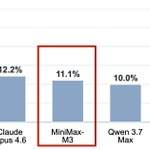
According to the FT, Anthropic’s most powerful model accounts for just 11% of its corporate AI spending on Ramp.
The reason is simple: Fable 5 is too expensive, while cheaper models are already good enough for most tasks.
Not great timing, with sentiment around Anthropic already deteriorating.


1
296
"EEMA: Experience-Evolving Meta Agents for AutoML" has been accepted to #EMNLP2026 Main Conference.
EEMA, the experience layer behind OpenMLE-Evo-Max in our Frontis-MA1 report, distills public competition artifacts and failure traces into compact Skills, then routes them across draft / debug / improve rounds.
On MLE-bench Lite (22 tasks, 12h/task, Codex + GPT-5.4-medium, single 24GB GPU):
→ 77.3% medal rate (base agent alone: 50.0%)
→ 20.1% avg leaderboard grade (base: 38.0%)
→ 96.0% execution success (base: 81.4%)
Same base agent, no extra training — and it beats GPT-5.5-xhigh (68.2%).
Code will land in OpenRSI, alongside OpenMLE and Frontis-MA1:
🔗 github.com/FrontisAI/OpenRSI
Congrats to everyone who worked on it 👏

🎉 EnterpriseClawBench has been accepted to the EMNLP 2026 Industry Track!
🚀 Introducing EnterpriseClawBench — an enterprise agent benchmark built from real workplace sessions, not synthetic tasks.
852 reproducible tasks distilled from proprietary agent sessions at a 100+ person AI startup. Agents must read messy files, call tools, and ship actual business artifacts.
🧵 The twist: we deliberately don't release the data (it's internal). The reusable contribution is the construction + evaluation protocol — a recipe you can run on your own private session archive.
📊 We evaluate 32 harness×model combos, not just model names. And a single score hides everything that matters:
Even the best config (Codex + GPT-5.5) hits only 0.663. Enterprise artifact tasks are far from saturated.
🔍 Findings worth your time:
• Harness×model coupling is real — Claude models drop hard under some harnesses despite same model
• Visual LLM judges are still poorly calibrated vs text judges
• Skill transfer is high-variance: creator quality ≠ consumer quality
📄 Paper on HF Daily Papers (an upvote helps a ton 🙏): huggingface.co/papers/2606.2…
💻 Leaderboard + pipeline: github.com/FrontisAI/Enterpr…
Built by @FrontisAI

Kaiyan Zhang retweeted

Can one AI system build a better AI than itself, in a loop that never stops?
Researchers from Horizon Research and @Tsinghua_Uni present Frontis-MA1.
They built an open system called OpenMLE that acts like a gym for AI engineers. Instead of just learning from text, the AI learns by doing: it drafts, improves, debugs, and mixes code until it works, getting real feedback from a test environment.
The payoff is huge. Their model, Frontis-MA1-35B, beats its own starting point by over 50% on hard tasks, even outpacing established giants like GPT-5.5 with Codex. It also boosts its successors' success rate from 50% to 70% just by being swapped in, proving the AI can genuinely upgrade its own lineage.
Frontis-MA1: Training an AI4AI Model towards Recursive Self-Improvement in Machine Learning Engineering
Paper: arxiv.org/pdf/2607.28568
GitHub: github.com/FrontisAI/OpenRSI
Hugging Face: huggingface.co/collections/F…
Our report: mp.weixin.qq.com/s/i9pblfXQ_…
📬 #PapersAccepted by Jiqizhixin

Kaiyan Zhang retweeted

🚀 Excited to release AIBuildAI Science, which achieved #1 on the NatureBench leaderboard 🏆.
AIBuildAI Science Agent is an autonomous AI model development agent built to accelerate AI for Science. Given a scientific task description and data, it autonomously completes the full AI development workflow:
▶️ Understanding the scientific problem
▶️ Designing models and algorithms
▶️ Implementing code
▶️ Training and evaluating models
▶️ Analyzing results and iteratively improving solutions
NatureBench contains 90 real scientific tasks derived from papers published in leading Nature-family journals over the past three years, spanning journals such as Nature Methods, Nature Machine Intelligence, and others. It evaluates whether AI agents can autonomously solve scientific problems and achieve or surpass published SOTA methods.
AIBuildAI Science Agent achieved first place on NatureBench. Across the 90 tasks, it autonomously developed AI models that surpassed published state-of-the-art (SOTA) methods on 25.5% of tasks and matched or surpassed published SOTA performance on 57% of tasks.
Beyond performance, AIBuildAI Science is highly efficient. Every NatureBench task was completed fully autonomously within a 4-hour time budget, demonstrating the agent's ability to rapidly develop high-performance AI models with minimal human intervention.
We believe that AI autonomously developing the next generation of AI-for-Science models will become a key driver of scientific discovery. 🚀
Product page: aibuildai.io/#products
Blog: aibuildai.io/blog-naturebenc…
#RecursiveSelfImprovement #RSI #AIforScience #AIAgents #ArtificialIntelligence #AIBuildAI #ScientificDiscovery
🤖 Made with AI

Kaiyan Zhang retweeted

RSI is near.
Anthropic tested an unreleased ‘Model 2’ on CoBench v2. CoBench tests a model’s ability to solve historical AI R&D tasks that Anthropic staff solved.
Model 2 scored 12.5 percentage points higher than Mythos 5.
The report estimates a model that scores 85% could replace Anthropic researchers. Only a couple turns of the crank left.
The Singularity is here. 2027 is the takeoff. It’s 4 months away.

Automating AI R&D is also what we pursue, and we believe it will bring tremendous value to the industry, accelerating AI solutions for the trillion scenarios of millions of enterprises.

Had @RyanGreenblatt on to discuss/debate recursive self-improvement.
This might be the most important question in the world right now - whether within a year or so of achieving human level intelligence, you slingshot towards having 10s of billions of superintelligences, each of which is dramatically more competent than human experts across all fields.
I’ve historically been skeptical of this possibility. My intuition has been that we will end up significantly bottlenecked by not only compute scaling but human expert data, which I think underlies most of the AI progress today.
If, because of RSI, we got a jump as big as GPT-3 to a Mythos (i.e. 6 years of AI progress) within a single year of achieving AGI, then the thing we get there at the end of that year is definitively and wildly superhuman.
We hashed it out, and I think Ryan made a pretty good case that this kind of speedup is plausible. FWIW, Ryan’s median for when we automate AI R&D is 2031.
We then discussed the alignment implications of this scenario. Who should these superintelligences be aligned to? In the future, our capacity to steward our votes and our capital, and to make sense of what's happening in the world, will all be titrated by superintelligences. And I worry that specs like the Claude Constitution are not shaping these ASIs to truly be my personal advocates and guardian angels.
And can we get them aligned to anything in the first place? Ryan and I had a long debate about whether the kind of reward hacking we saw with the OAI/Hugging Face hack extrapolates to superintelligences that would team up to literally take over the world.
The first piece of advice you get when you're learning to drive is that it will go much smoother if you look at the horizon instead of directly in front of your tires. And so it is with the trajectory of AI. Hope you enjoy!
0:00:00 – Is AI R&D verifiable enough to unlock recursive self-improvement?
0:16:52 – Is AI progress bottlenecked by human expert data?
0:34:02 – Flat token prices suggest scaling has been slow
0:39:47 – Skills AI can't train on: does it even need them?
0:48:07 – Aligned to whom?
1:09:18 – Recent incidents of AIs colluding and deceiving humans
1:19:38 – What could possibly go wrong? A concrete scenario
1:48:02 – From reward hacking to takeover
Kaiyan Zhang retweeted

周四晚8点,一起聊聊 AI4AI、进化、自进化、元进化、RSI、NatureBench、Frontis-MA1 、OpenMLE


Great thread on Towards World Models for Scientific Discovery! We fully agree—sparse & delayed rewards are the bottleneck, and WM can truly speed up the loop. This resonated with us during Frontis-MA1 & OpenMLE. Excited to see where this goes next!

Excited to share a paper I co-authored: Agentic Laboratories of the Future: Towards World Models for Scientific Discovery– joint effort across @Princeton, @Stanford, @Columbia, @nvidia, @MIT, @scale_AI and more.
Our argument: the next generation of labs will be agentic, with scientists, AI, and robots as collaborative discovery partners. But the bottleneck isn't better models. It's that no system maintains a shared laboratory world model — a live representation of hypotheses, evidence, uncertainty, and experimental state. Without it, agents produce plans that read well and fail physically.
We propose an L0–L5 autonomy ladder for labs, adapted from self-driving vehicles. Most systems today sit at L1–L3, even when marketed as autonomous. And a robust L3 beats a fragile L4 that needs constant rescue.
These labs must stay human-led. Agents handle execution and coordination; scientists decide which questions matter.
Thanks to project leads @MengdiWang10 (@Princeton) and @lecong (@Stanford) for organizing such a strong community effort to move AI for science forward.
Preprint: preprints.org/frontend/manus…


6
534