

Transparent, evidence-based novelty analysis for research.
Joined December 2025
- Tweets219
- Following9
- Followers14
- Likes54



Pinned Tweet
Breaking💥Introducing OpenNovelty: An agentic system engineered to redefine how we evaluate academic novelty!
In an era of exponential @arxiv growth, expecting human reviewers to recall every related work is becoming impossible. We need more than human memory. We need a trustable, verifiable agentic system.
That's why we're here:

FAIR at Meta, Google DeepMind, Cornell, and NVIDIA have introduced a rigorous information-theoretic framework to measure language model capacity, separating unintended memorization from true generalization.
Imagine buying a massive storage drive to build a digital library, but finding out that half its space is permanently clogged with duplicate, useless duplicate background noise instead of actual books. If you can't measure the difference between a system storing general knowledge versus hoarding random dataset-specific clutter, you can never calculate its true intelligence limits. Traditional evaluations struggle with this because they conflate memorized noise with generalizable comprehension.
By training hundreds of GPT-style models, the authors resolve this ambiguity and establish a predictable scaling rule. They demonstrate that modern architectures possess a remarkably consistent information capacity of approximately 3.6 bits-per-parameter.
wispaper.ai/en/user-blog/how…

26
Purdue University, the Weizmann Institute of Science, and Ben-Gurion University have provided the first end-to-end provable analysis of "grokking" (delayed generalization) in an over-parameterized ridge regression setting using gradient descent with weight decay.
Imagine a student studying for a math test who initially crams by memorizing every practice question word-for-word, failing any new quiz. If they keep practicing under strict discipline, the brain eventually forced to strip away the clutter and find the underlying formulas. Grokking behaves exactly like this delayed breakthrough, where a model suddenly transitions from rote memorization to perfect understanding.
The authors mathematically formalize this trajectory. They rigorously demonstrate that the model sequentially overfits the training data, plateaus in poor generalization, and then finally snaps into near-perfect test performance as weight decay eliminates unneeded features.
wispaper.ai/en/user-blog/pro…

17
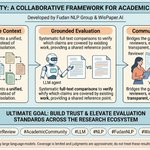
How do we move from subjective reviewer debates to shared, evidence-based alignment?
OpenNovelty, developed by Fudan NLP Group & WisPaper.AI, serves as a transparent framework designed to bring objective clarity to the entire research community.
A Collaborative Framework for Academic Consensus:
· Localized Literature Context: Instead of reviewers operating in isolation, the system organizes related papers into a unified, core-task taxonomy.
· Grounded Evaluation: It provides a shared reference point by performing systematic full-text comparisons to verify which claims are covered by existing work.
· Community Empowerment: It bridges the gap between authors and peer reviewers, empowering both sides with transparent, data-driven novelty insights.
The ultimate goal of OpenNovelty is to build trust and elevate evaluation standards across the research ecosystem.
#OpenNovelty #PeerReview #AcademicCommunity #LLM #NLP #FudanNLP #WisPaperAI #TechTwitter

12
How do we pinpoint the hidden anomalies that make or break Rotary Position Embeddings (RoPE) in large language models?
Scoring a highly competitive 7.2 on OpenReview for ICLR 2026, the submission "Deconstructing Positional Information: From Attention Logits to Training Biases" is sparking intense discussion. This work dives deep into the inner workings of Transformers, isolating how specific attention heads handle sequence ordering and position-sensitive information.
By exposing fragile dependencies within position embeddings, this research connects directly with critical long-context and structural reliability studies found in mainstream LLM frameworks like LLaMA and DeepSeek's MLA (Multi-head Latent Attention) architecture. It promises to unveil a hidden structural behavior within attention mechanisms, aiming to provide a much more stable foundation for scaling neural architecture training.
#ICLR2026 #Transformer #LLM #DeepLearning #MachineLearning

1
48
However, OpenNovelty's algorithmic audit has identified extensive methodological and empirical overlaps in these findings.
A closer comparative review reveals that the causal analysis and specific ablation studies regarding these attention behaviors heavily mirror prior work. Our analysis indicates:
Both papers provide causal analysis linking RoPE's multiplicative structure to the deposit pattern through spectral properties.
Both papers conduct the identical ablation experiment of adding absolute PE to RoPE to test if the deposit pattern is intrinsic.
Both papers observe and report identical results: absolute PE disrupts the deposit pattern in layer 1, but it re-emerges in deeper layers, proving the pattern is intrinsic to RoPE.
Both papers conduct the identical 'partial RoPE' ablation to demonstrate that minimal RoPE-enabled heads suffice, proving the deposit pattern is intrinsic.
Both papers test MLA architecture and observe identical results: it mitigates the deposit pattern by distributing positional responsibility, confirming the pattern is specific to RoPE's structure.
It appears that this empirical deconstruction relies on an observation and testing setup that was already fully detailed by prior research.
Read the full investigation report here: opennovelty.org/papers/D0u0g…
To keep your research genuinely pioneering and avoid duplicating existing empirical discoveries or experimental designs, make sure to use Wispaper to check for overlapping frameworks before you submit!
#OpenNovelty #AcademicResearch #ICLR #Wispaper

2
How do we pinpoint the hidden anomalies that make or break Rotary Position Embeddings (RoPE) in large language models?
Scoring a highly competitive 7.2 on OpenReview for ICLR 2026, the submission "Deconstructing Positional Information: From Attention Logits to Training Biases" is sparking intense discussion. This work dives deep into the inner workings of Transformers, isolating how specific attention heads handle sequence ordering and position-sensitive information.
By exposing fragile dependencies within position embeddings, this research connects directly with critical long-context and structural reliability studies found in mainstream LLM frameworks like LLaMA and Mistral. It promises to unveil a hidden structural behavior within attention mechanisms, aiming to provide a much more stable foundation for scaling neural architecture training.
#ICLR2026 #Transformer #LLM #DeepLearning #MachineLearning

1
29
However, OpenNovelty's algorithmic audit has identified extensive methodological and empirical overlaps in these findings.
A closer comparative review reveals that the discovery of these specific attention behaviors heavily mirrors prior work. Our analysis indicates:
· Both papers claim to discover and identify the same 'single-head deposit pattern' in RoPE through empirical analysis.
· Both papers observe and report the same phenomenon: ablating a single shallow-layer head in RoPE causes catastrophic accuracy loss, while other heads have negligible impact.
· Both papers establish that the deposit pattern is unique to RoPE on position-sensitive tasks and does not appear in other PE methods or on position-agnostic tasks.
· The experimental methodology for discovering the deposit pattern is identical: head-wise ablation by zeroing outputs and measuring accuracy drops.
· Both papers use identical visualization methods (violin plots) and identify the same three characteristic patterns: deposit, average, and shock.
It appears that this empirical deconstruction relies on an observation and testing setup that was already fully detailed by prior research.
Read the full investigation report here: opennovelty.org/papers/D0u0g…
To keep your research genuinely pioneering and avoid duplicating existing empirical discoveries or experimental designs, make sure to use Wispaper to check for overlapping frameworks before you submit!
#OpenNovelty #AcademicResearch #ICLR #Wispaper

4
The Goal of Empowering the Research Community with Transparency and the specific challenge of navigating rapidly evolving literature. It adopts an analytical, community-centric tone for X.
Navigating a vast, rapidly evolving literature often leads to divergent judgments on what constitutes a new contribution.
OpenNovelty, developed by Fudan NLP Group & WisPaper.AI, addresses this by creating a transparent, evidence-based framework for making informed novelty decisions.
Empowering the Research Community:
· Transparent Framework: The system shifts the focus from subjective opinions to an evidence-based framework, ensuring clarity for both reviewers and authors.
· Locally Structured Context: It maps related papers directly within a local context, allowing the research community to see the exact lineage of prior work.
· Informed Decisions: By organizing literature into a core-task taxonomy, it provides clear, verifiable references to support definitive novelty evaluations.
The ultimate goal of OpenNovelty is to foster transparency and trust across the entire academic ecosystem.
#OpenNovelty #LLM #PeerReview #AcademicTwitter #MachineLearning #NLP #FudanNLP #WisPaperAI

8
How do we fundamentally unmask the hidden mechanics of positional encodings in large language models?
Scoring a highly competitive 7.3 on OpenReview for ICLR 2026, the submission "Deconstructing Positional Information: From Attention Logits to Training Biases" is drawing major attention. This work addresses a critical puzzle in Transformer architectures: how positional encodings mathematical shape attention landscapes and downstream training dynamics.
By attempting to formalize a unified structural framework for positional data, this paper directly connects with landmark advancements in attention mechanisms and context window expansion, such as RoPE (Rotary Position Embedding) and Alibi. It promises a rigorous theoretical lens to decode how modern models process sequence order, aiming to provide a clearer blueprint for designing next-generation long-context architectures.
#ICLR2026 #Transformer #DeepLearning #LLM #MachineLearning

1
12
However, OpenNovelty's algorithmic audit has identified profound theoretical and mathematical overlaps in this framework.
A closer comparative review reveals that the core mathematical foundation and theoretical conclusions heavily mirror established literature. Our analysis indicates:
· Both papers claim to introduce a unified Toeplitz-based framework for analyzing positional encodings, with identical categorization into additive and multiplicative mechanisms.
· The mathematical formulation for additive mechanisms is identical, using the same notation and decomposition structure.
· Both papers use identical mathematical formulation for RoPE's multiplicative structure with Hadamard product and Toeplitz matrix.
· The foundational assumption for the framework is identically stated in both papers.
· The second foundational assumption is also identically formulated in both papers.
· The spectral analysis conclusions are word-for-word identical, demonstrating complete overlap in the theoretical framework.
It appears that this theoretical deconstruction relies on a mathematical framework that was already fully established by prior research.
Read the full investigation report here: opennovelty.org/papers/D0u0g…
To keep your research genuinely pioneering and avoid duplicating existing theoretical formulations or mathematical proofs, make sure to use Wispaper to check for overlapping frameworks before you submit!
#OpenNovelty #AcademicResearch #ICLR #Wispaper

2
How do we effectively bridge the gap between abstract biological theories and data-driven machine learning models?
Earning a strong 7.2 OpenReview score for ICLR 2026, the submission "Meta-Learning Theory-Informed Inductive Biases using Deep Kernel Gaussian Processes" introduces a fascinating way to integrate prior scientific knowledge into flexible neural networks. The framework automatically converts raw functional predictions from normative theories into tractable probabilistic models using adaptive deep kernel Gaussian processes (DKGPs).
By attempting to meta-learn structured inductive biases for rapid task adaptation, this work directly connects with landmark frameworks in few-shot learning and neural-probabilistic hybrid modeling, such as Deep Kernel Learning (DKL) and Neural Processes. It aims to offer a scalable, automated architecture for grounding data-driven models in theoretical constraints.
#ICLR2026 #MetaLearning #GaussianProcesses #DeepKernelLearning #MachineLearning

1
10
However, OpenNovelty's algorithmic audit has identified significant methodological overlaps in this design.
A closer comparative review reveals that the core system architecture heavily mirrors established literature. As shown in this image, our analysis indicates:
· Both papers describe the same architectural pattern: meta-learned feature extractors ($\phi$ or $\varphi$) that are shared/frozen across tasks, combined with task-adaptive components that are separately optimized per task.
· Both papers describe freezing the meta-learned feature extractor and adapting only task-specific parameters at test time, demonstrating the same operational procedure.
· Both papers articulate the same conceptual framework: a shared meta-learned feature extractor combined with task-adaptive components (linear heads and GP layers) that bridge between the shared representation and task-specific requirements.
It appears that this framework's path to task adaptation relies on a structural blueprint that was already fully detailed by prior research.
Read the full investigation report here: opennovelty.org/papers/7dvYW…
To keep your research genuinely pioneering and avoid duplicating existing structural mechanisms, make sure to use Wispaper to check for overlapping algorithmic architectures before you submit!
#OpenNovelty #AcademicResearch #ICLR #Wispaper

6
Reviewers must navigate a vast, rapidly evolving literature, often leading to divergent judgments on what constitutes a new contribution.🧐
OpenNovelty, developed by Fudan NLP Group & WisPaper.AI, directly addresses this core challenge by structuring the evaluation environment.
🌟How it Solves Divergent Judgments:
· Core-Task Taxonomy: The system organizes related papers into a structured, core-task taxonomy rather than leaving reviewers to search fragmented sources.
· Full-Text Comparison: It performs full-text comparisons within this specific framework to verify exactly which claims are covered by existing literature.
· Evidence-Based Framework: By grounding the evaluation in a local context, it provides the research community with a transparent foundation for making informed novelty decisions.
The ultimate goal is to empower reviewers with data-driven clarity.
Note: All reports are generated by large language models. Coverage is limited and judgments are approximate; do not treat these results as a definitive assessment of novelty.

13
Can we bridge the gap between abstract biological theories and data-driven machine learning models?
Earning a strong 7.2 OpenReview score for ICLR 2026, the submission "Meta-Learning Theory-Informed Inductive Biases using Deep Kernel Gaussian Processes" introduces a fascinating way to integrate prior scientific knowledge into flexible neural networks. The framework is designed to automatically convert raw functional predictions from normative theories into tractable probabilistic models using adaptive deep kernel Gaussian processes.
By attempting to meta-learn structured inductive biases for rapid task adaptation, this work directly connects with landmark frameworks in few-shot learning and neural-probabilistic hybrid modeling, such as Neural Processes (NPs) and Deep Kernel Learning (DKL). It aims to offer a scalable, automated architecture for grounding data-driven models in theoretical constraints.
#ICLR2026 #MetaLearning #GaussianProcesses #DeepKernelLearning #MachineLearning

1
21
But hold on! OpenNovelty's architectural audit has uncovered significant methodological overlaps in this design.
While this submission presents its theory-informed meta-learning approach as a novel breakthrough, our comparative review reveals that the core system architecture heavily mirrors established literature. Our audit indicates:
Both papers describe meta-learning a shared feature extractor or surrogate model that is then adapted to target tasks, demonstrating the exact same core architectural principle.
Both papers explicitly describe freezing the meta-learned component while adapting task-specific components, which is the defining characteristic of this framework's claimed contribution.
Both frameworks combine a shared meta-learned feature extractor with task-adaptive components (linear heads and GP layers in this submission vs. adaptation mechanisms in the candidate paper), demonstrating the same fundamental architectural design pattern.
It turns out that this framework's path to task adaptation relies on a structural blueprint that was already fully detailed by prior research.
Read the full investigation report here: opennovelty.org/papers/7dvYW…
To keep your research genuinely pioneering and avoid duplicating existing structural mechanisms, make sure to use Wispaper to check for overlapping algorithmic architectures before you submit!
#OpenNovelty #AcademicResearch #ICLR #Wispaper

25
Can we truly trust machine learning models when the stakes are high and the data is imperfect?
Scoring an impressive 7.3 on OpenReview for ICLR 2026, the submission "Robust Decision-Making with Partially Calibrated Forecasters" tackles a central pillar of trustworthy AI. This paper addresses how a conservative decision-maker can map predictions with weak calibration guarantees into actions that maximize expected utility in the worst-case scenario.
By formalizing a framework for decision-making under uncertainty, this work builds upon foundational concepts in reliable ML, echoing major themes from classical statistical decision theory and modern distributionally robust optimization (DRO) frameworks. It promises a computationally efficient way to maintain robustness, even when full calibration is mathematically intractable.
#ICLR2026 #TrustworthyAI #MachineLearning #DecisionTheory #Optimization

1
15
Wait a minute! OpenNovelty just completed a thorough audit on this robust framework.
While Robust Decision-Making with Partially Calibrated Forecasters highlights its minimax optimal decision rule as a novel breakthrough, our analysis indicates that the core methodological approach relies heavily on existing paradigms. Our audit reveals:
Both papers derive optimal decision rules by minimizing maximum risk or regret over a set of forecast distributions and use duality methods to simplify the characterization. This shows that prior work had already established this specific approach.
The foundational framework of formally defining minimax and minimax regret forecasting problems to derive optimal decision rules was already fully established prior to this submission.
It appears this robust pipeline runs directly parallel to theoretical paths already cleared by its predecessors.
Read the full investigation: opennovelty.org/papers/mHRuC…
To protect your research from unintended overlap and ensure your theoretical contributions are genuinely novel, use Wispaper to check for existing frameworks and literature before you submit.
#OpenNovelty #AcademicResearch #ICLR #Wispaper

20
Reviewers cannot read everything, yet they must judge if a paper is truly new(). Divergent opinions often stem from a fragmented view of existing literature.🧐
OpenNovelty, developed by Fudan NLP Group and WisPaper.AI, solves this by anchoring evaluations in a structured local context.
🌟The Core Mechanic: Contextual Taxonomy
Instead of generic keyword matching, the system automatically organizes related papers into a core-task taxonomy. It performs full-text comparisons within this specific framework to map exactly where previous literature ends and genuine originality begins.
The goal is to provide the research community with a transparent, evidence-based reference point for informed decision-making.
Note: All evaluations are LLM-generated. Coverage is limited and judgments are approximate; consider it a data-driven companion to human expertise.

11

Interesting, might have to try this for next paper.

🚨 SHOCKING: Academic research just got an AI copilot.
Research idea → literature review → experiment planning → GPU allocation.
What used to take days now happens in one workflow.
WisPaper feels more like a research agent than a search engine.
Here's the breakdown 🧵
5