

Open-source devices for medical and cognitive research.
San Francsco, CA
Joined March 2025
- Tweets121
- Following94
- Followers107
- Likes12






We're excited to spotlight Openwater intern Janet Shin, who is presenting her research at Neuroscience 2026 (SfN)!
🧠 Poster LBP078.12 | Board C57
Feasibility of a Closed-Loop EEG-Guided Low-Intensity Focused Ultrasound System for Real-Time Frontal Theta-Triggered Stimulation During Working Memory
Janet's research explores the exciting potential of combining real-time EEG monitoring with low-intensity focused ultrasound (LIFU) to enable responsive, closed-loop neuromodulation.
If you're attending #SfN2026, stop by Board C57 to learn more about her work and the future of precision neuromodulation!
#Openwater #Neuroscience2026 #FocusedUltrasound #Neuromodulation #EEG #ClosedLoop

1
32

From a summer internship to SfN!
We’re excited to share that Janet Shin’s summer internship project at Openwater has been selected for a poster presentation at the Society for Neuroscience’s Neuroscience 2026 in Washington, D.C., this month.
Her project explores closed-loop ultrasound neuromodulation: using real-time EEG signals to guide when to deliver low-intensity focused ultrasound through the OpenLIFU platform during a working-memory task. This early feasibility work brings brain sensing and stimulation together, and the code is open for the research community to explore and build on.
Join Janet to learn about the project, discuss the approach, and celebrate what a summer of curiosity and hard work can produce.
Wednesday, November 18, 2026
Janet’s presentation: 8–9 a.m. ET
Posterboard C57 | Walter E. Washington Convention Center
Presentation LBP078.12
Session: J.08. Methods to Modulate Neural Activity (LBP078), 8 a.m.–noon
Explore Janet’s poster (na2.hubs.ly/H08PT0q0)
Explore the project on GitHub (na2.hubs.ly/H08PT0s0)
Congratulations, Janet! If you’re attending SfN, stop by C57 and say hello.
#SfN26 #Openwater #OpenLIFU #Neuroscience #Neuromodulation #OpenScience

2
2
64
Open-Motion and Open-LIFU: Real-time Cerebral Hemodynamics and Non-Invasive tFUS, our open-source platform for human and pre-clinical research. Visit to see how we can transorm your research: na2.hubs.ly/H08LS350
2
39
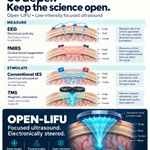
Go deeper. Keep the science open.
Every noninvasive brain technology works through the same anatomy. What differs is what it measures—or how it delivers stimulation.
• EEG measures electrical activity; the skull complicates source localization.
• fNIRS measures cortical blood oxygenation; superficial tissue can affect the signal.
• Conventional tES delivers electrical stimulation, with current spreading through tissue.
• TMS delivers stimulation through magnetic induction, with a tradeoff between depth and focality.
Focused ultrasound offers another approach: concentrating acoustic energy at a target beneath the brain’s surface.
Openwater’s Open-LIFU brings that capability into an open, programmable research platform:
→ Electronic beam steering to shift the focus within the array’s operating range.
→ Configurable ultrasound pulse sequences.
→ Open hardware, firmware, and software that researchers can inspect, modify, and build upon.
The differentiator is the combination: focused ultrasound for deep-target research, software-controlled steering, and an open foundation for scientific collaboration.
The skull remains an engineering challenge. Careful planning, acoustic characterization, and validation still matter.
What brain target would you investigate with a steerable, open ultrasound platform?
Explore Open-LIFU: na2.hubs.ly/H08LlHB0
Research use only. Not FDA-cleared.
#Openwater #OpenLIFU #FocusedUltrasound #Neuromodulation #OpenSource

3
1
51
Good research tools need clear instructions.
The Open-Motion Research User Manual is now available through Openwater’s documentation site, giving research teams a practical reference for setup, sensor placement, scan workflows and troubleshooting.
Making a platform accessible includes helping researchers understand how to use it, care for it and find answers when questions arise.
Explore the manual and bookmark the page:
Open-Motion Research User Manual (na2.hubs.ly/H08L61h0)
Open-Motion is for research use only, not for diagnostic or therapeutic procedures.
#Openwater #OpenMotion #ResearchTools #OpenScience
25
Heading to #SfN2026 in Washington, D.C.? Come see Openwater at Booth 204, November 15–18.
We build open-source tools for neuroscience: open hardware and open software that researchers can adapt and share. At the booth, you can try them yourself:
🧠 Open-Motion: a wearable that uses light to measure cerebral blood flow in real time
🔊 Open-LIFU: low-intensity focused ultrasound for precise, noninvasive transcranial neuromodulation research
👉 na2.hubs.ly/H08KvHh0
🧫 Open-LIFU Organoid: brings focused ultrasound to 3D cell culture. It targets individual wells in standard multi-well plates and logs every sonication, so acoustic stimulation becomes a precise, reproducible variable for organoid research.
👉 na2.hubs.ly/H08KvDB0
Book a time to stop by using either link. We’d love to talk about your research.
#Neuroscience2026 #OpenSource #FocusedUltrasound #Neuromodulation #Organoids #Neurotech
1
1
54
What if a neuromodulation system could listen before it acted?
That’s the question @JanetShin took on during her 12-week internship with us at @Openwater this summer, and we are proud of what she built.
👉 Explore Janet's blog describing her project: na2.hubs.ly/H08nDMg0
👉 Explore Janet’s interactive poster: na2.hubs.ly/H08nDMj0
📂 The repo is open for contributions: na2.hubs.ly/H08nDMl0
Janet, thank you for a great summer. Where would you take closed-loop Open-LIFU next?
Research use only. Open-LIFU is not FDA cleared or approved for clinical use.
#OpenSource #Neurotech #FocusedUltrasound #EEG #Internship #OpenLIFU

1
50
New buyer guide: How to evaluate wearable optical blood-flow platforms for cerebral hemodynamics research.
Use 10 criteria to assess brain sensitivity, calibration, motion control, synchronization, data quality, and validation—and see how they map to Open-Motion’s documented capabilities and limits.
Read it: na2.hubs.ly/H07VvTQ0
Research use only. Open-Motion is not FDA-cleared or approved for clinical diagnostic use.
#OpenMotion #CerebralHemodynamics
1
3
50
Comparing research platforms? Openwater’s Platform Evaluation Guide turns technical evidence into practical questions—what to evaluate, what evidence to request, and where study-specific validation remains necessary.
Explore the guide: na2.hubs.ly/H07V3rW0
38
More than one million patients have been treated with focused ultrasound worldwide. The Focused Ultrasound Foundation is marking that milestone and its own 20th anniversary at the FUS Celebration in McLean, Virginia, November 11 through 13, and we will be there.
The program covers a range of indications we follow closely: neuromodulation, psychiatric disorders, addiction, Alzheimer's, brain tumors with blood-brain barrier opening, and emerging work in ALS. Three days, 28 sessions, and over 70 speakers from institutions including Sunnybrook, Johns Hopkins, Stanford, Columbia, and the University of Virginia.
Openwater builds open-source focused ultrasound and optical imaging platforms for research. Events like this are where the people doing the work, running the trials, and publishing the safety data are all in the same room. If your research involves focused ultrasound and you are planning to attend, we would be glad to connect. Details and registration are on the Focused Ultrasound Foundation site.
#FocusedUltrasound #FUSCelebration2026 #Openwater #Neuromodulation #OpenSource

Open research deserves an easy-to-find home.
We’ve launched an Openwater Research & White Papers hub a growing library of studies and technical reports, connected to our community hub and product documentation.
First up: the Open-LIFU Transducer Localization Accuracy Study, exploring photogrammetry-based localization in a mannequin-based bench evaluation.
Explore the library:
na2.hubs.ly/H07KSG30
More papers, more methods, and more shared learning to come.
#OpenScience #Openwater #OpenLIFU #Research
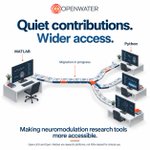
Someone outside Openwater has been quietly porting our neuromodulation software from MATLAB to Python.
It's not a flashy contribution. No press release, no conference talk. Just steady work moving openwater-neuromod-software off a license that costs money and onto a language most research labs can already run without paying for MATLAB.
That's the part of open-source that doesn't get talked about enough. The barrier to entry for a lot of neuromodulation research isn't the science; it's tooling. A lab with the expertise but not the MATLAB budget just can't run the analysis. A Python port doesn't change what the code does. It changes who can use it.
This is exactly the kind of contribution an open platform is supposed to attract: someone who saw a real friction point and started fixing it, without being asked.
Open-LIFU and Open-Motion are research platforms, not FDA-cleared for clinical use.

1
58
Today, we published something I’ve been looking forward to sharing ever since I joined the team.
The Open-LIFU Transducer Localization Accuracy Study is now on Zenodo with a permanent DOI. It’s open access under CC BY 4.0, stored at CERN, and listed in OpenAIRE. Anyone can read, cite, discuss, or build on it. There’s no paywall, no forms, and you don’t need to contact us to get the data.
If you work with focused ultrasound and have wondered whether the open-source registration method is good enough, you now have a number to compare against. I encourage you to check my work.
na2.hubs.ly/H07FxnV0

Open-LIFU just earned its certification from the Open Source Hardware Association, the second medical research device to get there, right behind Open-Motion.
I keep coming back to how these two fit together. Open-Motion reads the brain's near-infrared light, picking up blood flow. Open-LIFU acts on it with low-intensity focused ultrasound for neuromodulation research. One listens, the other nudges. Getting both certified in the same stretch wasn't luck. It's the thing we've been trying to build.
What I appreciate about OSHWA is that they actually looked. The certification isn't a logo you slap on a page; it's their read that the designs, the documentation, the files are genuinely open and available. Someone did the work of verifying that we mean it. For a device pointing acoustic energy at a brain, that outside confirmation carries real weight. A lab at Johns Hopkins working on targeting accuracy, or a group at Arizona on neuromodulation protocols, can open up the 64-element array, the firmware, the planning software, change what they need, and build on it - no black box.
And the math that makes all of this matter hasn't budged. Medical device development runs something like $94M and 20 years, and a lot of that is smart people redoing work that's already finished, just walled off where nobody can see it. Share the designs, and the next team starts where the last one stopped.
Thank you to OSHWA for taking open medical hardware seriously enough to certify it and to our engineering team, who did the actual work.
Open-LIFU is for research use only and is not FDA-cleared for clinical or diagnostic use.

1
72
A woman who struggled with heroin, cocaine, and meth for decades received a single 20-minute focused ultrasound session. Months later, she reports that her cravings are gone and she is back home in Vermont, working and living with her family.
In the same set of trials, another participant experienced small brain hemorrhages after the ultrasound intensity was raised. He was unresponsive for 24 hours and still has memory issues.
Both of these stories are true.
Emily Mullin covered both stories in WIRED this week. The full article is worth reading: na2.hubs.ly/H07jRpV0
Openwater is mentioned with Merge Labs, Nudge, and Sanmai as groups working to make these systems wearable. We are proud to be included. However, the most important point for our field comes later: there are no standard treatment parameters.
The Focused Ultrasound Foundation lists over 100 device makers and hundreds of ongoing trials. Each uses different frequencies, intensities, and duty cycles. Every group develops its own dose-response curve, but most of what they learn stays within their own institution.
This is not just a technology issue. It is a knowledge-sharing problem.
When 100 manufacturers each run their own trials, the field gets 100 partial answers to the same question: what dose is safe, at what depth, and for which group. If these trials used a shared, open platform and combined their results into one safety record, the field would get a single answer that becomes more accurate with every study.
Openness is important for this reason, too. One researcher in the article thinks the WVU machine might have been more powerful than needed. Whether that is true or not, no one outside the trial can know for sure because the parameters were never published. On an open platform, the beamforming code, skull-compensation model, and delivered intensity are all available for review. This lets others check the work instead of relying on a black box.
This is why Openwater makes its software, hardware, patents, and safety data open. The safety data often gets the least attention, but it is the most important.
If you're a researcher or developer who wants to work in a community designed for this purpose:s:
- Software (Python migration active, good first issues labeled): na2.hubs.ly/H07jNKQ0
- Hardware (manuals, drawings, 3D models): na2.hubs.ly/H07jNG90
- Community hub: na2.hubs.ly/H07jQhS0
Open-LIFU is for research only. The FDA has not cleared or approved it, and its safety and effectiveness have not been established through FDA review.

2
139
We're joining OSHWA's Show & Tell livestream this Thursday.
Dan Blizinski, our Director of Open Source, will walk through what we're building at Openwater — open-source platforms for medical imaging and neuromodulation research — and why we do this work in the open.
If you've been curious about Open-LIFU (low-intensity focused ultrasound for neuromodulation research, recently OSHWA-certified) or Open-Motion (near-infrared optical imaging, also recently OSHWA-certified), this is a good chance to hear where the platforms stand and ask questions directly. We'll be sharing the session with the COSMIIC system.
Thursday, August 20 · 1:00pm ET
Watch live → na2.hubs.ly/H07d7qR0
Both platforms are for research use only and are not FDA-cleared. Come say hello.

2
66
Transverse myelitis affects about 8 people per 100,000, and the field is still measuring it with instruments borrowed from MS and spinal cord injury.
In Clinical Leader, Dr. Irena Dujmovic Basuroski (Professor of Neurology, UNC Chapel Hill) lays out what has to change first: validated, disease-specific outcome measures; multicenter studies that are diverse racially and ethnically; and biomarkers for a disease that currently has none. Her team is building a biorepository to find them.
Her group is also using Open-LIFU to stimulate the spinal cord in patients who have plateaued after medication and physical therapy focusing at the lesion and testing above and below it.
Open-LIFU was built for transcranial work. A researcher pointed it somewhere else and asked a better question. That's what an open platform is for.
na2.hubs.ly/H06-3ps0
Openwater's platform is exclusively intended for research purposes and is not cleared or approved by the FDA for clinical use.

1
31
There are thousands of OSHWA-certified open-source hardware projects. Open-Motion just became the first biomedical research device to earn OSHWA certification
na2.hubs.ly/H06YDLJ0
Being "first" is worth contemplating. OSHWA has certified thousands of projects: dev boards, 3D printers, lab instruments, and satellites. Until this month, not one of them was a medical research device.
Certification isn't just a badge. It's a verifiable claim that the designs, documentation, and source files behind Open-Motion are genuinely available. A team at Penn conducting LVO detection studies, or at Birmingham working on stroke recovery, can inspect the hardware measuring blood flow, modify it, and build on it. Not trust a black box.
Complex medical device development runs roughly $94M and can sometimes take decades from concept to approval. A meaningful share of that is redundant work happening behind proprietary walls. When designs, code, and safety data are shared instead of siloed, the next research team doesn't have to repeat finished work.
Announced earlier this month at the Open Healthware Conference in San Francisco. Credit to the engineering team who did the actual work.
Certification UID US002835 → na2.hubs.ly/H06YDNB0
Open-Motion is for research use only and is not FDA-cleared for clinical or diagnostic use.

2
67
A new blog post looking at some of our Large Vessel Occlusion research results: na2.hubs.ly/H06Ld5K0
#hemodynamics #openhealthware #medtech #stroke #opensource #LVO
1
39