

Professional outdoorsman and mushroom hunting instructor. I teach year-round foraging lessons and sell a variety of forest products.
Oregon, USA
Joined November 2023
- Tweets909
- Following417
- Followers326
- Likes28.4K





Pinned Tweet
Growing mushrooms is actually very easy, especially if you are a farmer and have canning experience.
You boil grains like these whole oats until they swell with water. Load them into mason jars. Use micropore cloth tape to cover 1/4" holes drilled into the reusable pp5 lids. It allows gas exchange while the mycelium consumes the grains.
Sterilize for 90 minutes at 15psi.
You then introduce clean mycelium to the grains from a syringe. You can do the expensive and complicated lab work yourself or you can just buy it online.
Once the grains are completely consumed by the mycelium, you spawn them to wet sawdust (pour boiling water over BBQ/fuel pellets). You can do this in single use mushroom grow bags or spawn the grains directly to the sawdust inside a bucket with holes drilled in it.
(Colonizing a block inside of a grow bag as an intermediary step reduces the failure rate).
For mushrooms like wine caps, you spawn the grains to a bag of sawdust. Let colonize. You can also skip this step by just buying a colonized block.
Then, pour boiling water over straw, lay it on the ground, crumble the colonized block on it, cover in more straw, then cover it all in wood chips. Keep feeding the patch new wood chips and never let it dry entirely and it will last into perpetuity.
Mushrooms like oysters and turkey tail perform well in buckets because they are fast and aggressive. Mushrooms like wine caps make great garden companions which hold moisture and help nutrient exchange.
For your average farmer or hobby gardener, these are cheap and easy materials to source. You probably already have most of them if not all of them.
Mushrooms are a valuable source of protein. You can dry them and store them nearly indefinitely; they will remain entirely unchanged in the absence of moisture.
With the rising cost of groceries, I would personally rather spend my money on renewable resources that can be sourced locally, and then I can eat fat-free, sugar-free, unprocessed protein loaded with vitamins and minerals.
Mushrooms hold high value in barter markets, so growing them and trading them for other things you can't grow or raise yourself is also a solid play.
Please ask questions below and I will do my best to answer them.


I cloned some wild oysters I found in Gervais, Oregon this past March. Many of our oysters only grow in spring/summer so I had to have this cold-tolerant one for my outdoor fall and winter grows.
The cold rains are finally here, and they seem very happy.


Native cottonwood oysters fruiting again.
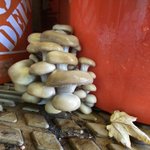
Blue oyster block finished. Pics of pins for comparison. Six days of growth.
If you'd like to grow them yourself, liquid cultures are available here:
orgourmetmushrooms.etsy.com


Happy little family of Amanita chrysoblema red variants growing from spruce in a mixed redcedar and hemlock forest.

Dried specimens available here:
orgourmetmushrooms.com/colle…


Amanita chrysoblema, shore pine red variant (North American Fly Agaric) spore print and cross-section.
In recent years, DNA analysis has concluded that the mushroom formerly known as Amanita muscaria in North America is its own unique phylogenetic species. We now refer to it as Amanita chrysoblema with four main color variants.
It is likely that we will discover each variant is also its own species, and perhaps those variants on different trees are their own. We went from one mushroom species to potentially dozens.
We do get "true" Amanita muscaria here in some parts of North America like far NW Alaska, or on certain transplanted non-native pine trees.
Nothing about the mushrooms themselves has fundamentally changed. They contain ibotenic acid and muscimol, the latter of which has been used for sleep and pain for thousands of years.
Ibotenic acid is toxic, but you can dry these mushrooms at 160F, and roughly 30% of the ibotenic acid converts into muscimol. Boiling the dried fruits in lemon water (acidic solution) converts the remainder into muscimol through a decarboxylation process.
Some people perform a series of boilings and discard the water each time. It renders the mushrooms safe and they are used as food.
Dried fruits and spores are available on orgourmetmushrooms.com if anyone reading this would like to sequence their DNA or observe their spores under a microscope and further unlock the mysteries of this majestic fungi.


I loaded up the myco wagon with grow kits and materials for a free oyster bucket workshop and foray at Willamette Mission State Park. Contributing to my local community and helping Oregonians secure resources during periods of economic uncertainty is very important to me.
The group was great and everyone had a wonderful time. We learned how our river habitats work, what mushrooms to seek out in them when the rains come (soon), and the narrow windows we get when flooding determines access.
Kids built core memories with their parents. Some very green beginners put on their brave faces and dove right in. I had a great time engaging with a number of salt-of-the-earth neighbors.
Everyone was so pleasant and fun that I forgot to take pictures of the actual foray and workshop 😪 But we had an amazing time!!
Started new blocks and fresh oats for the next one 🤙


Blue oyster babies still being little and good 24h later.
The block is just sitting outside and I'm misting it with a spray bottle every few hours because it is hot. It is 20 degrees colder tomorrow so it will get a light morning and evening misting.
During the rainy season you just leave it out there and do nothing.
They will be done growing Monday or Tuesday.


I have an Etsy shop where you can buy clean mushroom tissue to inoculate your sterilized grains. I also sell sawdust spawn if you'd like to build your own oyster buckets or wine cap patch.
orgourmetmushrooms.etsy.com
Other dried mushrooms and forest products are also available.


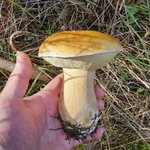
Wild foraged porcini, saffron milk caps and cottonwood oyster mushrooms. Locally grown tomatoes, peppers, and onions with some foraged Allium vineale. Seasoned the roasted tomatoes with feral oregano and locally grown herbs.


