

Evidence control for AI agent teams • YuCe, open-source kernel • Tobi Validator
Joined June 2026
- Tweets181
- Following216
- Followers14
- Likes368




Pinned Tweet
A source your agents quoted is withdrawn. Which of their conclusions need review?
We ran this with four agents from four model providers reading 22 documents of the MCP specification. Two withdrawals hit 3, then 4 stored quotes. The kernel reported the 8, then 13 records the agents had registered on them. Afterward, claims still marked grounded that relied on withdrawn text: 0 of 815, then 0 of 816.
No LLM traces the withdrawal. The result is computed from the journal, and it is a dependency check: it says nothing about whether a claim is true.
That is YuCe 0.2.0, out now. Agents record a claim only on a verbatim quote; the kernel checks the quote against the source bytes and keeps the dependencies agents declare.
New in 0.2:
– a report of what fell after a withdrawal
– signed journal checkpoints, verified against keys you trust
– standalone proofs for single records that verify without the full journal (median about 11 KB in our runs, range 7.2 to 24.2)
Limits. YuCe checks bytes and registered links, not meaning, and sees only the links agents declared. In another run a model misread one withdrawn changelog line as a whole revision, and the kernel accepted that claim. A known defect can overcount some support totals. One run per setup, one LLM grader, no human spot check. Details are in BENCHMARKS.md and LIMITATIONS.md.
Apache-2.0
github.com/OrganeticSphere/y…
pip install organetic-yuce

1
4
23,640
A clinical trial was retracted in 2010. Three medical reviews published 7–16 years later still counted it as supporting evidence.
@SaneCite, a project that tracks research still relying on retracted papers, found this case by hand and let us test it with YuCe, our open-source tool that makes AI agents record exactly which source each claim rests on.
Three AI agents read the reviews. Every claim they wrote down had to carry an exact quote from the text, checked against the source. When a claim relied on the trial, the agent recorded that too.
Then we told YuCe the trial was retracted. All 35 claims resting on it lost their support at once. The other 655 of 690 stayed untouched. The agents found 15 of the 16 passages SaneCite had found by hand. This run took 10 minutes and cost $0.26.
Not everything flagged was useful. Of the 28 flags we sent SaneCite, our own AI first pass found only 11 were claims that truly relied on the trial; 3 were just reference mentions, 14 were the agents' working notes. No human has checked this yet.
A claim losing support does not mean it is wrong: a review's overall result may still hold. YuCe does not judge the science. It shows what rests on what.
Thanks to @SaneCite for the case and for permission to share it.
Same prompt, same model, two different pictures. In our recorded experiment, 92% of the pixels differed.
What if we recorded the picture’s elements instead of relying on the prompt alone?
Each shape is linked to an exact quote from the brief. YuCe checks those quotes against the source bytes and tracks the dependencies we register.
Withdraw the “Sun” line: only the sun disappears. 2,910 pixels change, none outside its area (same renderer).
In a separate test, we recorded the roof and door as depending on the wall. Withdraw the wall line, and all three lose support. The kernel follows those links without interpreting the picture.
The dependencies were written by our pilot script, not inferred by a model.
45 seconds on how it works. Explore the recorded replay yourself (no live AI calls):
1
17,348

Can you catch what your AI agents get wrong?
You play the kernel: your agents hand in claims with quotes, and you accept or refuse each one. Then you see what the real kernel decided.
8 decisions, a few minutes, no sign-up. Most people miss the last one.

1
103
Play here: organetic.ai/how-it-works/#c…
Every answer comes from a recorded run of YuCe 0.1.7, our open-source kernel for agent teams.
69
Your #agent wrote a report on Tuesday. It quoted an internal doc.
On Friday that doc was pulled: one figure in it was wrong.
Your search index updates in minutes. Your report doesn't. And you can't tell which other reports used that figure.
How does your team find them today?

48
Same four agents, three setups: YuCe kernel, #Temporal, #LangGraph. Two runs, blind grading. No quality winner, and YuCe costs more time and money. What it buys: after the fix, 0 of 895 grounded claims rest on withdrawn text, checked from the journal without a model.
🤖 Made with AI

1
1
124
We ran the same team of four agents (DeepSeek, Claude, GPT, Gemini) with the YuCe kernel and without it, on Temporal and LangGraph. Two runs, two sources withdrawn in each, blind grading.
With the kernel:
- Evidence the withdrawal did not touch stays. The next answers dropped 0 and 1 such quotes. Without it: 102 and 101 on Temporal, 102 and 80 on LangGraph.
- Updating after the withdrawals took 10 and 1 model calls, against 22 to 40.
- After our fix, 0 of 895 grounded claims rest on withdrawn text. That comes from the journal, no model asked.
- Anyone can check the journal against its receipt, also without a model.
91
We tried a simple test. Two claims, each backed by an exact quote. Then we revoked one quote.
YuCe removed support from the claim that depended on it. The other stayed grounded. No model had to guess what changed: the recorded links did.
github.com/OrganeticSphere/y…

ALT Each claim rests on a quote the kernel found byte for byte in the source. Both claims are grounded.

ALT The owner revokes one quote. Its claim loses its ground, the other stands. No model decides this: the registered links do.
1
82
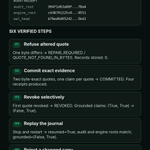
We put the whole six-step demo in the repo. No model, no API key.
You can watch a bad quote get refused, two claims get recorded, one lose support after revocation, and the journal replay to the same roots after restart.
Then edit a copy and verify it yourself.

ALT Six checked steps, each with the kernel's real answer: refuse, commit, revoke, replay, refuse an edited copy, verify.

ALT Three commands to repeat it yourself. Keep the receipt where the journal's writer cannot change it.
1
17
Your AI agent just made a decision. Can you prove why — after the source it cited was deleted?
We built YuCe: a deterministic audit kernel for MCP-based agents. Byte-exact quotes, cascading revocation, tamper-evident log.
Open source. Runs locally. No model in the loop.
Demo ↓
github.com/OrganeticSphere/y…
#AI #MCP #AIAgents #OpenSource
1
199
v0.1. Limits: ≤10k records, ≤8 concurrent agents, ~2.5× wall time on Haiku.
It checks bytes, not semantics. You still need a trusted checkpoint for full tamper-evidence.
We're sharing early because auditability shouldn't be a black box.
1
22
If you're building with Claude Code, Codex, or any MCP client — try the demo, break it, tell us what's missing.
Feedback > stars. But stars help others find it.
github.com/OrganeticSphere/y…
1
27
There’s a particular kind of false confidence that creeps into AI systems when a claim comes with a citation.
The source is there. The quote looks legitimate. Another agent reviews the result, agrees with it, and the claim moves forward as if it were established knowledge.
But what exactly has been verified?
We can check that a quote exists, byte for byte, in a specific version of a document. We can record which claims depend on it, who proposed the connections between them, and how those connections were accepted. We can replay the recorded operations and check whether they lead to the same state.
These are meaningful guarantees. Especially when multiple agents are building on each other’s work.
Yet an agent can quote a perfectly accurate sentence and draw a completely wrong conclusion from it. A second agent might agree. A third might incorporate that conclusion into a larger analysis.
The evidence is authentic. The interpretation isn’t necessarily correct.
And this is where we think AI verification needs more precision.
Deterministic checks can establish whether the rules were followed, whether evidence was correctly referenced, and whether the recorded state is reproducible. They cannot, on their own, establish that an interpretation is true.
We shouldn’t blur that distinction just because a system produces an impressive audit trail.
The goal isn’t to make every AI-generated conclusion appear trustworthy. It’s to make clear what has actually been checked, what remains uncertain, and what needs to be reconsidered when the evidence changes.
That’s a much more useful foundation for systems where agents increasingly rely on one another’s work.
56