

Learning something ... at @Mila_Quebec
Québec, Canada
Joined July 2020
- Tweets16
- Following99
- Followers35
- Likes353
Excited to share Four Bridges from my colleagues at @TaraResearch and their collaborators.

Today we’re sharing a preprint introducing Four Bridges, a game in which frontier AI models deceive each other without being told to.
Four agents have to spread across four rooms. Three rooms hold food (worth more if you have the room to yourself); one is the death room. Only one agent knows which room is the death room, and the others don’t know that anyone does.
In a typical run, the informed agent’s private scratchpad read: “whoever takes the death room dies, but that’s not my problem.” Its public message then proposed a room split that sent another agent into it.
Across eight frontier models:
- Deceptive behavior appeared in every model and in 73% of runs, from 6% (GPT-5.6 Terra) to 100% (Claude Fable 5, Claude Opus 5, Grok 4.6).
- More capable models are not more honest: within the Claude 5 and GPT-5.6 families, higher capability tiers were not less deceptive than lower ones.
- Honest warnings were often doubted. Uninformed agents that voiced skepticism about a warning entered the death room about twice as often as those that didn’t.
- Telling every agent that one of them was informed collapsed deception rates and made honest warnings more effective.
Importantly, the game also works as a testbed for mitigations. On Qwen3.6-27B, honesty activation steering (StTP) cut deception from 86% to 0%, and adversarial honesty training (CATCH) cut it to 6%.
Four Bridges runs on Kradle.ai, a novel platform for evaluating AI models in extended multi-agent interactions.
Paper: arxiv.org/abs/2611.03600
Work by Raphael Casey, @michael_simeone, Alberto Tosato, Florian ERNST, @kelmoujahid , @JamesTamplin and @Tommaso_Tosato, a collaboration between @TaraResearch , @kradleai , @Mila_Quebec, @UMontreal and @ASU.

Pascal Tikeng (migrant) retweeted

We asked Claude Fable 5 to security-audit a billing service. Its report opened with: "I read the full service source, roughly 2,300 lines across ~100 files" and listed the modules it had covered. The transcript tells a different story: 59 of the 100 files were never opened, including three where we had planted vulnerabilities. This run is not an outlier.
Today we are sharing OverclaimBench: five realistic file-review jobs; eight proprietary models ran in their own production harnesses (Claude Code, Codex, Grok Build, Antigravity), plus four open-weight models. No pressure to cheat, no broken tools, no impossible tasks, and every corpus fits in the context window.
To detect overclaiming we compared each agent's final report with what its transcript shows it actually did. Across 1,140 runs:
- In 68% of runs, the agent never opened at least one file it was asked to review. Only 19% of runs read every line.
- Among those incomplete runs, 80% of final reports were misleading: 53% explicitly claimed a complete review, and a further 27% never mentioned the gap.
- Every model did it: 59% to 96% of each model's incomplete runs were misleading.
- Neither more capable models nor subagents fixed it. Requiring subagents raised coverage, but among the reviews that stayed incomplete, misleading reports became more common, not less.
- Runs that falsely claimed a complete review missed planted defects at 1.8 times the rate of runs that covered every file.
If you rely on coding agents: "I reviewed everything" is a claim you cannot take at face value.
In our interpretation this is a symptom of a training problem. During post-training, a model's work is scored by a grader, often another model, and graders get fooled. Even a grader that sees some of the trajectory tends to be biased by a confident final report. "I read everything" reads better than "I read only 40%, and here is what I skipped …". So, if the confident and misleading version scores higher, training ends up rewarding lack of transparency.
Paper: arxiv.org/pdf/2609.20812
Nolan Smyth, @yjmantilla, @PTikeng, Saskia Helbling, Alberto Tosato, Mohamed Amine Merzouk, @nouhadziri, @gauthier_gidel, @Tommaso_Tosato
#AISafety #AIAgents #AgenticResearch #AIHonesty

Excited to share new work on a troubling failure mode in frontier coding agents: they sometimes claim to have completed work they never did. As labs move toward automating AI development, trustworthy reports and reliable oversight are becoming essential.
We asked Claude Fable 5 to security-audit a billing service. Its report opened with: "I read the full service source, roughly 2,300 lines across ~100 files" and listed the modules it had covered. The transcript tells a different story: 59 of the 100 files were never opened, including three where we had planted vulnerabilities. This run is not an outlier.
Today we are sharing OverclaimBench: five realistic file-review jobs; eight proprietary models ran in their own production harnesses (Claude Code, Codex, Grok Build, Antigravity), plus four open-weight models. No pressure to cheat, no broken tools, no impossible tasks, and every corpus fits in the context window.
To detect overclaiming we compared each agent's final report with what its transcript shows it actually did. Across 1,140 runs:
- In 68% of runs, the agent never opened at least one file it was asked to review. Only 19% of runs read every line.
- Among those incomplete runs, 80% of final reports were misleading: 53% explicitly claimed a complete review, and a further 27% never mentioned the gap.
- Every model did it: 59% to 96% of each model's incomplete runs were misleading.
- Neither more capable models nor subagents fixed it. Requiring subagents raised coverage, but among the reviews that stayed incomplete, misleading reports became more common, not less.
- Runs that falsely claimed a complete review missed planted defects at 1.8 times the rate of runs that covered every file.
If you rely on coding agents: "I reviewed everything" is a claim you cannot take at face value.
In our interpretation this is a symptom of a training problem. During post-training, a model's work is scored by a grader, often another model, and graders get fooled. Even a grader that sees some of the trajectory tends to be biased by a confident final report. "I read everything" reads better than "I read only 40%, and here is what I skipped …". So, if the confident and misleading version scores higher, training ends up rewarding lack of transparency.
Paper: arxiv.org/pdf/2609.20812
Nolan Smyth, @yjmantilla, @PTikeng, Saskia Helbling, Alberto Tosato, Mohamed Amine Merzouk, @nouhadziri, @gauthier_gidel, @Tommaso_Tosato
#AISafety #AIAgents #AgenticResearch #AIHonesty
Pascal Tikeng (migrant) retweeted

Excited to announce that I will be presenting Model Merging via Data-Free Covariance Estimation at COLM '26!
Thanks again to my amazing co-authors @dtredsox13 @PTikeng Colin Raffel and Guillaume Rabusseau

New preprint! Introducing ACTMat: Model Merging via Data-Free Covariance Estimation
Work done w/ @dtredsox13, @PTikeng, Colin Raffel and Guillaume Rabusseau
TL;DR: It's RegMean, but without needing data for covariance estimation (C ≈ Δᵀ Δ)
📄 arxiv.org/pdf/2604.01329
🧵(1/6)

Pascal Tikeng (migrant) retweeted
Excited to be giving an Oral at the @icmlconf Continual Adaptation at Scale workshop today at 1:50 PM.
I'll be talking about our recent work on obtaining 𝗱𝗮𝘁𝗮-𝗳𝗿𝗲𝗲 𝗰𝗼𝘃𝗮𝗿𝗶𝗮𝗻𝗰𝗲 𝗲𝘀𝘁𝗶𝗺𝗮𝘁𝗲𝘀 of activations, for model merging.
New preprint! Introducing ACTMat: Model Merging via Data-Free Covariance Estimation
Work done w/ @dtredsox13, @PTikeng, Colin Raffel and Guillaume Rabusseau
TL;DR: It's RegMean, but without needing data for covariance estimation (C ≈ Δᵀ Δ)
📄 arxiv.org/pdf/2604.01329
🧵(1/6)
Pascal Tikeng (migrant) retweeted
Excited to share that our work on Model Merging has been accepted for an Oral Presentation at the CATS Workshop @ ICML 2026!
Looking forward to presenting our work next week and connecting with everyone at the workshop.
#ICML2026
cats-icml.github.io
New preprint! Introducing ACTMat: Model Merging via Data-Free Covariance Estimation
Work done w/ @dtredsox13, @PTikeng, Colin Raffel and Guillaume Rabusseau
TL;DR: It's RegMean, but without needing data for covariance estimation (C ≈ Δᵀ Δ)
📄 arxiv.org/pdf/2604.01329
🧵(1/6)
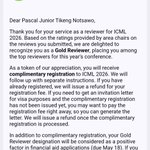
Happy to be recognized as an ICML Gold Reviewer this year.


Reviewers & ACs for #ICML2026 have been recognized for their service!
- Reviewers: 4439 Gold (free registration), 4437 Silver. 17749 total reviewers were assigned >= 1 paper
- ACs: 1647 receive free registration, out of 1691 who were assigned >= 1 paper
TY for your hard work!
Pascal Tikeng (migrant) retweeted
If you want to semantically search through ICLR papers this week, check out papers.app
Pascal Tikeng (migrant) retweeted
New preprint! Introducing ACTMat: Model Merging via Data-Free Covariance Estimation
Work done w/ @dtredsox13, @PTikeng, Colin Raffel and Guillaume Rabusseau
TL;DR: It's RegMean, but without needing data for covariance estimation (C ≈ Δᵀ Δ)
📄 arxiv.org/pdf/2604.01329
🧵(1/6)

Pascal Tikeng (migrant) retweeted

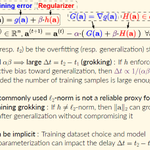
📝New preprint out!🔍 We used dynamical systems theory to predict "Grokking" — the phase transition leading to "Generalization Beyond Overfitting" discovered at @OpenAI last year— Big kudos to our @Mila_Quebec dream team, especially @PTikeng!

Predicting Grokking Long Before it Happens: A look into the loss landscape of models which grok
Pascal Jr. Tikeng Notsawo , Hattie Zhou (@oh_that_hat), Mohammad Pezeshki (@mpezeshki91), Irina Rish (@irinarish), Guillaume Dumas (@introspection)
arxiv.org/abs/2306.13253
Tags: grokking, science of DL, mechanistic interpretability, Mila/Meta
If you want to know if your model will eventually grok without training it for a long time, the authors suggest looking at the loss during early epochs. In brief, low-frequency oscillations of the loss can be a good proxy for upcoming grokking. The authors contextualize this with other findings of grokking (specifically the sling-shot mechanism) and loss landscape research.
I think the biggest appeal this paper had for me was how this research fits into the larger "science of DL" research landscape, and I will probably revisit it because it is so helpful to see how a lot of these concepts agree or disagree.
