

La Ciencia es divertida, empezando por la Física. Divulgación | Chistes | información Face: https://teapawt.net/t.co/SJ4Upp1ZCh IG: https://teapawt.net/t.co/4bb0F20Oac
- Tweets409
- Following80
- Followers99
- Likes48


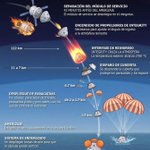





ALT La portada del Calendario de Ciencia de la NASA 2026 conmemora el 250.º aniversario de Estados Unidos. La ilustración utiliza tonos azules con detalles cálidos en tonos pastel que muestran el viaje de exploración espacial de la humanidad. En la parte inferior, un libro de historia abierto emite luz, y la Tierra emerge por encima de él. Un camino se extiende desde el libro hacia el espacio profundo, hasta más allá de la Luna, Marte y Saturno, y muestra naves espaciales, incluyendo a NISAR, la Estación Espacial Internacional, la sonda solar Parker, los orbitadores LRO y MRO, Dragonfly, el explorador NEO, y los telescopios espaciales Webb y Roman. Un astronauta de Artemis y un explorador robótico aparecen en las páginas opuestas del libro: el astronauta da un primer paso en el trayecto cósmico para simbolizar cómo el descubrimiento científico abre el camino a la exploración humana en nuestro viaje más allá de la Tierra.


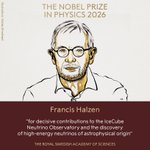
ALT Illustration of Nobel Prize laureate Geoffrey Hinton.


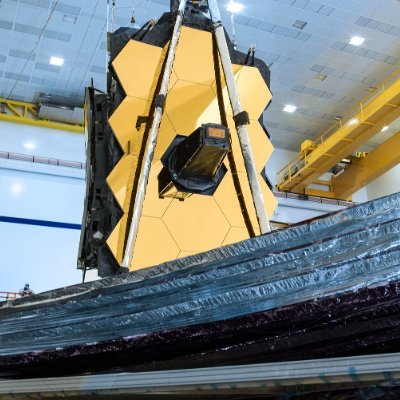
ALT Una cúpula grumosa de nubes de color gris azulado se eleva hasta casi un tercio de la imagen desde la parte inferior. Por encima de ella, franjas de translúcidas volutas rojas se extienden hacia arriba hasta casi la mitad de la imagen. La mitad superior de la imagen está ocupada por el fondo negro del espacio y una estrella blanca, brillante y prominente que tiene los picos de difracción de ocho puntas característicos de Webb. Por toda la imagen están dispersas estrellas y galaxias adicionales, aunque se observan muy pocas a través de las gruesas nubes de la parte inferior y todas son considerablemente más pequeñas que la estrella más grande. Crédito: NASA, ESA, CSA, Karl Misselt (Universidad de Arizona), Alain Abergel (AIM Paris-Saclay)

ALT Esta imagen es una ilustración compuesta muestra a Júpiter al fondo, con su luna helada Europa, mucho más pequeña, en primer plano. En la parte inferior aparece una imagen estilizada de la nave espacial de la NASA Europa Clipper.
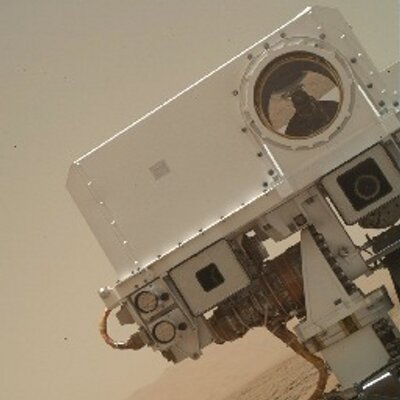

ALT A black-and-white 360 panorama taken by the Curiosity rover shows the rocky Martian surface. The image is cut off along the bottom and horizon because it was created with individual images stitched together by the rover's team on Earth. The panorama starts with rocks and sand along the surface and as it moves toward the right, the rover's body and its robotic arm are visible, along with the arm's shadow along the foreground. Toward the horizon is a large plateau and smaller hills as well has haze showing a larger valley off in the distance. As the image continues toward the right, more rocks and sand are visible.



ALT A black and white photograph of Maria Maria Goeppert-Mayer writing in her notebook.


ALT Esquema de las posiciones de la tierra en el equinoccio y en los solsticios: Hoy es el equinoccio de otoño en el hemisferio norte y de primavera en el sur.

ALT Visualización de la posición de la Tierra en el equinoccio: Lo que significa que la duración entre el día y la noche es la misma. Esto se debe a que ahora mi eje se encuentra perpendicular a los rayos del sol.

ALT La tierra mira alegre al público: A partir de hoy los días empezarán a prolongarse poco a poco en el hemisferio sur.

ALT La Tierra mira siniestra con la siguiente frase. Y las noches serán cada vez más largas en el hemisferio norte.

ALT Meme de humor sobre el superconductor. A la izquierda un superconductor levitando por el efecto meissner. A la derecha se ve a Superman conduciendo. Es un súper-conductor.



ALT A graphic titled “Exoplanet K2-18 b: Atmosphere Composition.” The graphic shows the spectra of the exoplanet K2-18 b from NIRISS and NIRSpec in the form of a graph, with the vertical y-axis labeled as Amount of Light Blocked and the horizontal axis labeled as Wavelength of Light (microns). The data is plotted as dots with vertical error bars. A jagged blue line running through the plot represents the best-fit model. There are semi-transparent magenta, red and green vertical columns also scattered across the plot, indicating where variations in the line represent the presence of methane, carbon dioxide, and dimethyl sulfide (combined with other molecules), respectively. Behind the graph is an illustration of the planet and star. The planet is a large fuzzy blue-ish sphere off to the right, taking up half of the background. The red star is smaller at the bottom left of the entire graphic.

ALT Un robot mira al espectador. No dice nada, solo mira.

ALT Un humano con barba y camisa verde se le acerca extrañado.
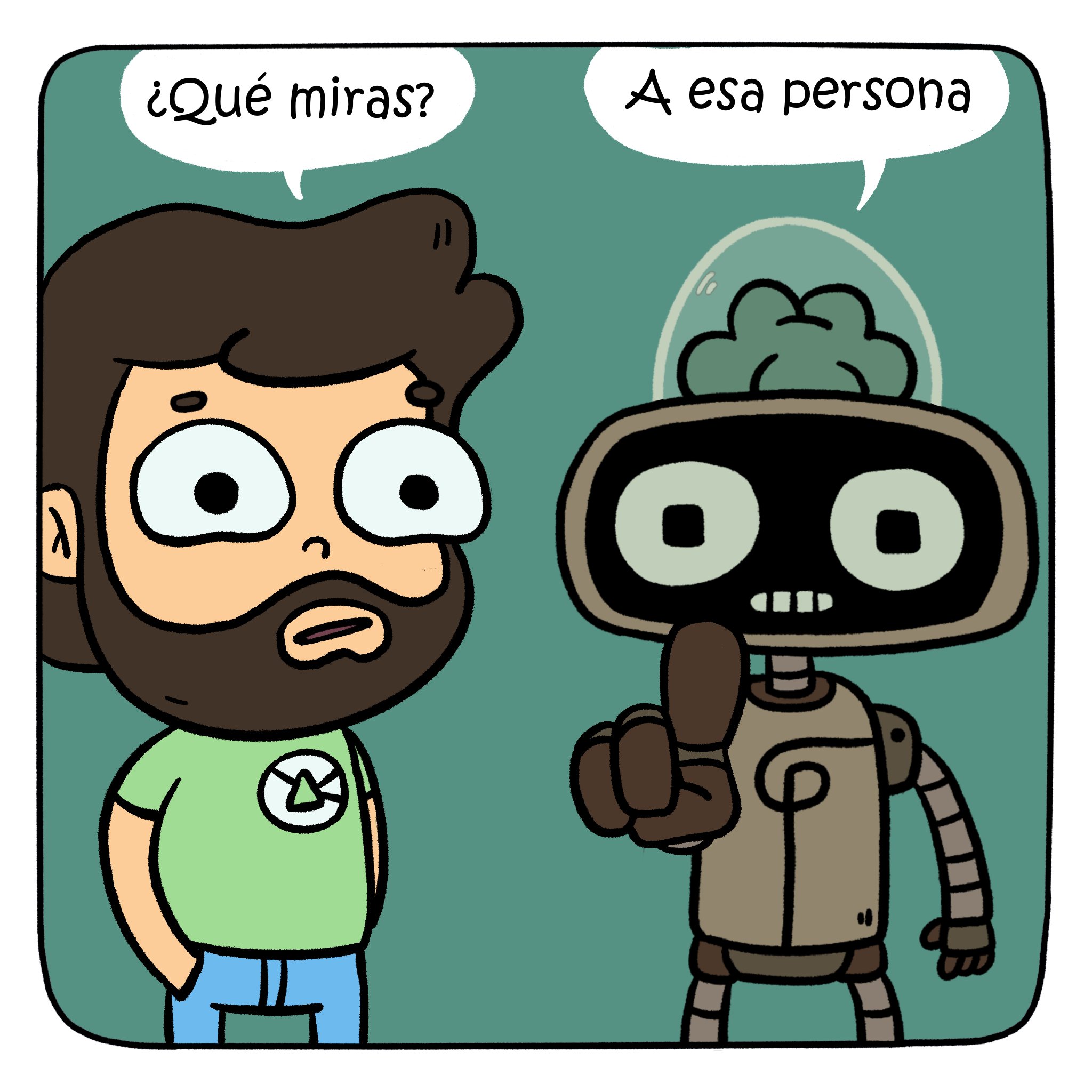
ALT Humano: ¿Qué miras? —pregunta mirando en la dirección en la que el robot está orientado. Robot: A esa persona —dice señalando al espectador.

ALT Humano: ¿De qué hablas? Allí no hay nada. Robot: Tu limitado intelecto no puede vero pero está ahí en otra dimensión.