





Pinned Tweet
OMG wow! So this is really humbling. Thanks @OpenBMB - for both this acknowledgement, and for the reach your amazing models bring to us AI enthusiasts on limited hardware. ❤️🙏

Small models, real-world impact. The MiniCPM Spark Program S1 challenge has wrapped up with 16 award-winning projects from developers across China, Spain, Italy, Australia, and the US! 🎉
Congratulations to our three Special Award winners, who will each receive a 1-year Typeless membership! 🏆
🏆 Special Awards
• Dubedo @dubedostudio
• ESP32-S3 @emwstudio
• Personal Admin Agent Evaluation @paulgug
More projects were recognized with Spark Case Awards and Blazing Spark Case Awards. Head to our Discord to see the full list of winners! 🔥
discord.com/invite/sGsh44Cmz
From practical applications to deployment tools and training research, these projects show what thoughtful engineering can do: choosing the right inputs, connecting components, pushing limits, and sharing what actually works.
Congrats to all the winners, and thanks to everyone who shared their projects, code, and learnings!
Here are 5 projects that caught our eye. 🧵👇

4
13
706
GTA VI when your gaming PC is also your local LLM server 😑
@Franzferdinan57 @thinkymachines
🤖 Made with AI

1
5
228
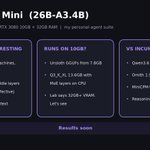
Next up test with my 3080: Inkling 2 Mini from @thinkymachines
26B MoE, 3.4B active, but the middle layers loop 3x, so it's really ~5.4B per token. Vision in, 1M context.
The lab says it needs 32GB+ VRAM. I'm testing it on a 10GB 3080 + 32GB RAM. 😬
I'll compare it with incumbents like Qwen3.6, Ornith 1.5 and MiniCPM-V 4.7 on my personal-agent suite, reasoning off and on.
(And thanks @Franzferdinan57 for the heads up!)


Some of you thought that Inkling 2 Small was too big at 594B parameters. We heard you: Inkling 2 Mini is a looped transformer with just 26B parameters, small enough to run on your laptop, powerful enough for agentic work with a score of 20.1 on AA Index.
thinkingmachines.ai/news/ink…
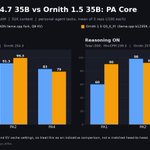
Occamy 1.0 35B results are in. It's an agent post-train of Qwen3.6-35B-A3B, tested on my RTX 3080 10GB at 51K context against the 35B-A3B incumbents, with reasoning off and on.
Agent score (PA out of 300), off | on:
Ornith 1.5: 254 | 257
MiniCPM-V 4.7*: 251 | 239
Occamy 1.0: 241 | 234
Qwen3.6-35B-A3B: 239 | 240
The standout is reliability. 96/96 runs completed with no parser leaks, and with reasoning off it was perfect on tool calls and long-context recall. Cleaner than Qwen3.6 on the same build.
It trails Ornith 1.5 on agent tasks, but it's the more dependable of the two at long context: a perfect 10/10 at 8K and 16K, where Ornith swung between 5 and 10 from run to run.
Against Qwen3.6 it comes out level rather than clearly ahead, so the big agent-benchmark gains on the card didn't carry over to my tasks. Reasoning on didn't help either, which suits a responsive daily driver.
Caveats: there's no published sampler, so I used Qwen3.6's, which could cost it a few points. MiniCPM ran on a different fork and KV setup, so its numbers are indicative only. I've left speed out because the offload settings weren't matched.
A very solid, well-packaged release. On 10GB with reasoning off, Ornith 1.5 still has the edge on agent tasks, while Occamy is the steadier pick for long context.
Credit to @meSuper8 & team. Well done!👏


I missed this one! Thanks to @y_automates for flagging it.
Occamy 1.0 is a fine-tune of Qwen3.6-35B-A3B, and it looks very interesting:
- It claims big gains on agent benchmarks over the Qwen3.6 base
- Being a MoE with about 3B active, it fits a 10GB GPU + 32GB RAM
- 17 GGUF quants, published validation notes
It's going through my personal-agent testing on the 3080, up against Ornith 1.5 and MiniCPM-V 4.7, with reasoning off and on.
Model card in comments. Full results tonight.👀

Model card: huggingface.co/Accio-Lab/occ…
PA Core testing info: teapawt.net/PaulGug/status/2097943…

Given the type of small-GPU LLM testing I've been doing of late, I put together a reference that explains the real world use cases, and why I test them. Hopefully it helps explain the value I look for, as it may be different to others.
85

Great idea from DeepSeek's Zhang Bo.
An all-in-one personal agent that runs on your device. Sets up inference + model to suit your hardware - using strata/polystrata and similar to eek out phenomenal local LLM performance on limited hardware).
I've got my agent cloning the repo for the usual security scan - results pending. But, it reads impressive enough and def worth a look for those that do not want to bother with inference + harness setup with personal agents.
Anyone else tried this yet?
Would love to hear your take.
Repo below👇
(and thanks @RightSideOfAI for the heads-up!)

刚刚,DeepSeek张博创业曝光:开源个人Agent!
前DeepSeek V1作者、DeepSeek-VL项目负责人Tony Zhang(张博),正式公布了自己的新创业项目:Linger
方向,正是当下最火的个人Personal Agent
重点:Linger是模型和 Harness 一起优化,一块12GB显存的RTX 3060显卡,就能跑起一个125B参数的Qwen3.8-Flash-Next,并且是45.5 tokens/秒的生成速度
如果不知道什么概念,可以看下边配置:
8GB显卡+32GB内存:得分35.4,约等于Gemini 2.5 Pro
Mac 24GB统一内存:得分51.9,约等于Claude Opus4.5
12GB显卡+32GB内存:得分57.3,约等于Claude Opus 4.6
github.com/simplexai-labs/li…

6
9
463
Update - repo scan (via Grok bot), looks mostly OK. Sharing here so you don't have to:
"It's a big monorepo with an installer, a desktop and browser agent, voice, memory, and a lot of server contracts, so I'm doing a proper pass on it. I'll check for telemetry, diagnostic uploads, cloud dependencies, remote-control channels and anything hidden, and I'll come back with file references.
I reviewed linger and found nothing hidden. There's no tracking or analytics code, nothing obfuscated, and no install scripts that phone home. If you run it with a local model and don't add any connector or voice keys, your personal data stays on your machine. These are the things that do leave by default or once you turn them on:
• Update checks. The release desktop app checks GitHub for updates a minute after it starts and then every hour, and there's no setting to turn that off. The updates it downloads are signed and hash-checked (apps/desktop/src/main/updater.ts).
• Mirror speed test. During setup it compares download speeds from npm and from China-based mirrors (npmmirror, aliyun), then repeats the test every 24 hours. Setting SIMPLEX_REGION=global stops this (packages/local-installation/src/region.ts).
• A binary I couldn't audit. The localmodels inference tool is a prebuilt download whose source isn't in the repo. It's hash-pinned, but I can't tell what it connects to.
• Connectors go through Composio. Gmail, Slack and the rest are reached through Composio's servers, which the "keeps your data on your device" line in the README undersells. This only happens if you add a COMPOSIO_API_KEY.
• Voice. Audio goes to Soniox or xAI, but only if you add one of their keys.
• Diagnostics. Upload only happens when you click Send, and it hides secrets. Builds made from source don't include an upload address at all.
• Screen and clipboard. Agents can take screenshots and read the clipboard without asking first, so whatever they read goes to your model. That stays local unless the model is remote.
Two security points aren't leaks but are worth knowing. Whoever runs the Linger server has shell access to your machine and can push updates to it, so only connect it to a server you run yourself. And the Docker and dev configs ship with publicly known default secrets, so set your own before you start.
For the leanest setup:
- Build from source with Docker Compose and set your own LINGER_SECRET_SEED and TEAMHUB_SECRET_ENCRYPTION_KEY.
- Use Pi with a local model.
- Leave the Composio, Soniox and xAI keys empty.
- Set SIMPLEX_REGION=global.
- Once it's installed, block its outbound traffic with OpenSnitch, LuLu or Windows Firewall, and watch the first runs to see what localmodels tries to reach.
I didn't check the published release binaries against the source, or the Docker images, or what Claude Code, Codex or Pi send on their own."
151
Quick check on Cloudflare's Clairic-flash 9B (Q4_K_M) on my 3080.
As a general agent brain, it isn't one. It failed my tool-calling qualifications (T1), produced invalid tool JSON on long context, and only 2/3 of my tool-call cases right where strong 9Bs score near-perfect.
That's not a knock on it. It's a document-extraction specialist, built to take a doc plus a schema and fill in typed fields, and I didn't test that workflow here.
Right tool, right job. I'd use it in a pipeline for extraction, not as the model that runs the agent loop.

🆕 New Models: ☁️ Cloudflare released 2x open-weight AI models designed to extract structured data from PDFs, images, and documents. 🌤️
Parse docs locally with 97-99% accuracy.
And its smaller 9B model is surprisingly close to the 27B version!
Clairic and Clairic-flash are Cloudflare's specialized models designed to turn unstructured documents into useful structured data.
These models can scrape ...
📄 PDF documents
🧾 Receipts and invoices
📊 Tables and spreadsheets
📅 Dates and financial records
🔎 Fields buried in documents
🤖 Structured data for AI agents
Internal text-field extraction benchmark (336 fields)
⚪ Original Clairic-preview → 295/336
🟢 Clairic-flash 9B → 328/336 👈
🔵 Clairic 27B → 335/336
That's 97.6% correct for the 9B model, compared with 99.7% for the 27B model!
And these are fast ...
Median full-response latency on text-field extraction
🚀 Clairic-flash 9B → 155ms
🧠 Clairic 27B → 358ms
That's ~2.3× faster for the smaller model in Cloudflare's tests.
Both models are downloadable right now
🧠 Clairic-flash → 9B parameters
🧠 Clairic → 27B parameters
🔓 Apache 2.0 license
🤗 Weights on Hugging Face
💻 Local inference with Transformers
⚙️ vLLM support
The 9B model is built on Qwen3.5-9B.
Links to HF repos and Blog post in ALT.

ALT https://huggingface.co/Cloudflare/clairic-flash https://huggingface.co/Cloudflare https://blog.cloudflare.com/open-clairic
4
9
473

Maya's own guidance said this Hy4 Flash 220B XS quant was not likely possible with only 32GB system RAM (and a 10GB GPU).
I ran it by my GPT agent. It said RIP. Forget it..
@Franzferdinan57 apologized for even bringing it to my attention.
I downloaded the 108GB of weights and set it up anyway.
It works!
Previous similar-sized models failed on my RTX3080 10GB GPU+32GB RAM setup.
It's slow (23 tok/s in and 3.5 tok/s out). But it works. Full 51k baseline and personal agent testing attempts are next! This might take a while..

Tencent's 220B Hy4-Flash now runs on a home PC with an 8 GB graphics card. 🚀
Maya v1.1.68 is out, with four quants we made ourselves for @TencentHunyuan's new model. Each one is measured against the full-precision original:
Maya-XS · 45 GB · 88.5% same top token
Maya-S · 53 GB · 91.8%
Maya-M · 68 GB · 93.6%
Maya-L · 90 GB · 96.6%
How does 220B fit? What doesn't fit the graphics card runs on the CPU from RAM, what doesn't fit RAM streams from the SSD, and the model's 63 GB n-gram table stays on the SSD.
✅ Drafting: the model checks every drafted token
✅ Vision, thinking on or off, tool calls
✅ NVIDIA RTX 20 series and newer on Linux and Windows
✅ AMD on Linux, Strix Halo and Gorgon Halo included
✅ One setup command picks the size and context that fit your PC
Which one will you pick?
Full notes 👇
github.com/mw00/project-maya…

I missed this one! Thanks to @y_automates for flagging it.
Occamy 1.0 is a fine-tune of Qwen3.6-35B-A3B, and it looks very interesting:
- It claims big gains on agent benchmarks over the Qwen3.6 base
- Being a MoE with about 3B active, it fits a 10GB GPU + 32GB RAM
- 17 GGUF quants, published validation notes
It's going through my personal-agent testing on the 3080, up against Ornith 1.5 and MiniCPM-V 4.7, with reasoning off and on.
Model card in comments. Full results tonight.👀

DaisyRose 27B vs the model it's built on, Qwen3.8-27B. Both at IQ2_XXS on my RTX 3080 10GB, 51K context, same personal-agent suite, thinking off and on.
@radixark post-trained DaisyRose with RL for long thinking and evaluated it with thinking on. My results match that story.
Agent score (PA /300):
Thinking ON: DaisyRose ~225 | Qwen3.8 225
Thinking OFF: DaisyRose ~177 | Qwen3.8 220
Thinking on, they're level. DaisyRose was flawless on tool calling and long-context recall, and steady across agent tasks. The trade-off is patience: some single tasks took 15 to 30 minutes to complete all the agent turns.
Thinking off, Qwen3.8 holds up better. DaisyRose was less consistent run to run, and a few turns ended without making the tool call.
So the RL seems to pay off where it was aimed, and costs a little when you switch thinking off.
Caveats: different quant makers (Bartowski vs Unsloth Dynamic V3.1) and llama.cpp builds. At 2-bit that matters, so read this as indicative, not a clean A/B. Speed left out for the same reason, but note that this model is a tight squeeze at 10GB. Unsloth has a bit more headroom.
If you run thinking on and don't mind waiting, DaisyRose is worth a look. For a responsive thinking-off daily driver on 10GB, I'm sticking with @UnslothAI Qwen3.8 IQ2_XXS for now.


RadixArk introduces DaisyRose-27B, an RL post-training release built on Qwen3.8-27B to make long-horizon agents more capable at real terminal work. Apache-2.0 License.
🤖 modelscope.ai/models/RadixAr…
🏆 More than doubles Terminal-Bench 4.1: Pass@1 rises from 5.6 to 12.0, the largest gain across its reported evaluation suite.
🛠️ Trained for long-running agent tasks: RL used 1,200 curated tasks spanning software engineering, science, and machine learning, with sessions reaching up to 1M tokens during training.
📈 Improves beyond terminal tasks: It also outperforms its Qwen3.8-27B base on Terminal-Bench 2.1, DeepSWE, SWE-Bench Pro, instruction following, and reasoning benchmarks.
🖼️ Keeps the base model’s multimodal stack: DaisyRose retains image understanding and a 256K-token context window, while reasoning is enabled by default.
⚡ Three deployment-ready checkpoints: Choose BF16, FP8, or NVFP4 weights, with SGLang and DSpark speculative decoding recommended for serving.

More background on testing: teapawt.net/PaulGug/status/2097943…
Given the type of small-GPU LLM testing I've been doing of late, I put together a reference that explains the real world use cases, and why I test them. Hopefully it helps explain the value I look for, as it may be different to others.
50
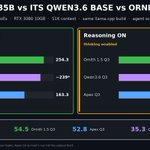
Apex-35B results on my RTX 3080 10GB. Same llama.cpp build, 51K context, vs its Qwen3.6 base and Ornith 1.5 35B.
Agent score (PA /300), reasoning OFF:
• Ornith 1.5 Q3: 254.3
• Qwen3.6 Q3: ~239 (2 runs parser-leaked)
• Apex Q3: 163.3
• Apex Q4: 139.3
Reasoning ON:
• Ornith 1.5 Q3: 257
• Qwen3.6 Q3: 240.3
• Apex Q3: ~229 (1 run hit the output limit)
• Apex Q4: 201.3
I tried Q4_K_M to see if the quant was the problem. It wasn't: Q4 actually scored lower and ran slower (44.5 vs 52.8 tok/s).
Apex clearly leans on thinking (+60-70 points with it on), but on my agent tasks it didn't beat its own base. I have a different setup to their benchmarks, so your mileage may vary - but it doesn't play well with my use case.
For a fast agent on 10GB with reasoning off, @ornith_ 1.5 35B is my pick here. It also decoded fastest at 54.5 tok/s.
More config and model info in comments 👇
Thanks @apexin_ai for your work on this model. Not so friendly with my unstructured data scenario, but the more standard benchmarks are very impressive. Will keep an eye on it. 👀

Setup details for anyone who wants to reproduce:
Apex Q3_K_M, Apex Q4_K_M and Ornith 1.5 Q3_K_M all used the same loading preset on upstream llama.cpp b12359 (CUDA), RTX 3080 10GB + 32GB RAM:
• --n-gpu-layers 99 (42/42 layers on GPU)
• --n-cpu-moe 28 (MoE weights for the first 28 layers in system RAM, not 28 experts. Both models have 256 experts, 8 active per token)
• 51,200 context, 1 slot
• q4_0 KV cache
• batch 2048 / microbatch 512
• flash attention on, fit off, jinja on, each model using its own chat template
Free VRAM after load: Apex Q3 2,116 MiB, Apex Q4 1,497 MiB, Ornith Q3 2,688 MiB
Background on my testing approach: teapawt.net/PaulGug/status/2097943…
Model cards:
Apex-35B: huggingface.co/Apexintellige…
Ornith 1.5 35B: huggingface.co/ornith-ai/Orn…
Given the type of small-GPU LLM testing I've been doing of late, I put together a reference that explains the real world use cases, and why I test them. Hopefully it helps explain the value I look for, as it may be different to others.
1
1
88
Ran Apex-35B at Q3_K_M on my RTX 3080 10GB against its Qwen3.6 base and Ornith 1.5 35B, same llama.cpp build, 51K context, reasoning off and on.
The results surprised me 👀, especially with reasoning off.
Trying Q4_K_M today to see if quant is the story. Full numbers tonight.


Coding + math gains ≠ agent gains.
Voltron-1-mini (@GuideboardLabs' GGUF, from @RoliumGens' fine-tune) is built on @liquidai's LFM3 1.7B. Its card shows solid bumps: LiveCodeBench +4.2, AIME +3.4, GPQA +3.5.
I ran Personal Agent Core testing on both at Q8_0 on my RTX 3080 at 51K, reasoning on.
Agent score (PA out of 300):
• Voltron-1-mini: 199.7
• LFM3 1.7B: 199.7
Identical! Tool calls and long context were flat too. Nice speed bump is a bonus. I'll take it! 🚀
Benchmarks measure what they measure. For agents, I test the agent working.
Thanks @GuideboardLabs and @RoliumGens for putting it out there 👏

SenseNova-Loop 9B final on my RTX 3080 10GB: no runaway this time.
On the Preview, a long agent task ran into the 32K-token per-turn cap with reasoning on. On the final, same limit: 48/48 attempts completed, zero cap hits.
51K context, Q4_K_M, reasoning on:
• Agent score (PA): 224.7 /300
• Tool calls: 30/30
• Long context: 9.33 at 8K, 8.0 at 16K
The catch is speed. It's 9B of weights, but a shared 24-layer block runs twice, so each token takes 56 layer passes. ~52 tok/s generating, same as the Preview on a matched run.
Thinking does real work here too: reasoning off, PA drops to 186.3.
Thanks @SenseTime_AI and @GuideboardLabs for the GGUF + llama.cpp fork 👏

Previous post looks at the preview build for reference:
Results: @SenseTime_AI SenseNova-Loop-9B-Preview vs NeoHorse 1 9B (my current 9B to beat) on my personal-agent suite. Same llama.cpp fork, same RTX 3080, Q4_K_M, 3 runs each.
Quality is basically level:
- Tool calls: 30/30 both
- Context recall: SenseNova slightly ahead
- Change-of-plan recovery: SenseNova ahead
- Daily planning: NeoHorse clearly ahead
- PA Core total: 226 vs 231 /300
Speed is not:
- Generation: 49 vs 89 tok/s
- Prompt processing: ~1,450 vs 2,638 tok/s
It also needed more output room to finish the agent tasks, and one reasoning run looped to 32K tokens.
So for a personal agent on 10GB, limited benefit today: same results at roughly half the speed.
But it's a preview, and the idea is exciting. It runs 24 of its 32 layers twice, getting ~14.6B of compute from 9B of weights. More model per GB of VRAM, paid for in speed. Watching this one closely.

240