

22 | Venture Partner Begin Capital | Leading AI for @Marshmello, @Usykaa, @RealChefRush, @MrFreeman0
London, England
Joined July 2026
- Tweets816
- Following1.8K
- Followers3.4K
- Likes3.2K






most founders know they need to target the right VCs when fundraising
but there's something else worth paying attention to: what kind of investor are you actually talking to?
besides the obvious differences between private equity, hedge funds, VCs, and other investors, every VC has their own investment thesis, preferred stages, sectors, and geographies
but even within venture, investors approach deals very differently
I'd break them down into 7 types worth understanding:
1. lead investor. usually writes a larger check, negotiates the terms, and takes a meaningful ownership stake. often does extensive due diligence and may want a board seat or an active role in the company's development
2. follower investor. prefers joining rounds led by someone else. they still do their own evaluation, but often rely on the lead to set the terms and coordinate the round
3. angel investor. invests personal money, often in founders they know or industries they understand well. some are professional angels, while others invest alongside their main job or business
4. institutional VC. invests capital raised from LPs through a professionally managed fund. usually has a more structured investment process, with partner discussions, investment committees, and specific ownership or return targets
5. strategic investor. brings something beyond capital that can directly help your business grow, whether that's distribution, industry expertise, partnerships, or access to customers
6. family office. manages the wealth of one or more wealthy families. some have dedicated venture teams, others invest directly through family members or external advisers. their decision-making processes can vary a lot
7. syndicate. a group of investors pooling money to invest in a deal, usually through an SPV. in my experience, they can be easier to raise from, especially if you're looking for smaller checks and a faster process. but it really depends on who's running the syndicate
one important thing: these categories overlap
an institutional VC can lead or follow a round. a family office can invest strategically. an angel can organize a syndicate
the point is to understand how each investor makes decisions, what they expect from a deal, and what role they can realistically play in your round
that can make a huge difference in how you approach them and structure your fundraising

Revolut founder Nik Storonsky says one of his investors tried forcing him to fire his best person:
“He was forcing me to fire my best person, because he was too hardcore.”
“Of course I didn’t fire him. I said no.”
“Pretty early on I realized that quite a few VCs, they are not very operational, and they can be actually dangerous for the company if they have enough power. So every single investment round, we just remove VCs.”
“Now I don't have any VCs on the board. I think that's the best. You always need to have operators rather than VCs on the board, people who actually build business and who know how to do things.”
if you're integrating AI into an existing company, learn from the people actually doing it
software
- @sarahmsachs (head of AI at notion)
- @fergal_reid (chief AI officer intercom, building fin)
- @fnthawar (VP head of eng shopify, AI-first engineering)
- @dharmesh (co-founder/CTO hubspot, publishes simple.ai)
- @karrisaarinen (ceo linear, automation loops inside the product org)
- @levie (ceo box, enterprise AI adoption)
- @cramforce (CTO vercel)
- @briansolis (head of global innovation servicenow)
- @robdthomas (SVP ibm)
fintech
- @emilygsands (head of data & AI at stripe)
- @rahulgs (CTO ramp, agentic systems in production)
- @geoffintech (CPO ramp, wrote the company-wide AI adoption playbook)
- @daschreiber (ceo lemonade, AI in insurance)
data & defense
- @ssankar (CTO palantir)
- @2112Power (founder hadrian, automated factories for defense & space)
mobility
- @praveenTweets (SVP CTO uber, 70%+ of PRs now from agents)
- @aelluswamy (leading AI at tesla)
- @dmitri_dolgov (co-ceo waymo, physical AI at scale)
- @qasar (ceo applied intuition)
who else should i add?


Paul Klay retweeted

i made a TECH TREE for the entire HUMAN CIVILIZATION
like in Civilization, but its real
151 technologies from stone tools to AGI, every node linked to the real history
humanity is at 109 of 151, we are in the Information Era
researching right now: nuclear fusion 2/4, AGI 2/4, quantum computing 2/4, brain computer interface 2/3
the INSANE part, we are only 0.728 on the Kardashev scale, Type I needs 526x more energy, about 370 years at current growth
chiefofautism.com/tech

some interesting numbers on what's actually happening with AI adoption in companies
> only 37% report any impact on EBIT from AI, unchanged from last year. and just 6% qualify as high performers, attributing at least 5% of EBIT to AI
> last year, 32% expected AI to reduce their workforce. this year, only 14% say it actually happened
> AI spending has almost doubled in a year, from 1.7% to 3.3% of revenue. over 80% of that spending now happens outside IT budgets
> 42% expect to give AI agents actual decision-making authority by 2030. only 5% have the governance in place to do it safely
> 32% have already decided against buying at least one software product because they could build it themselves with coding agents
> around 20% say AI operating costs, including token usage, are already limiting adoption

one of the most valuable and easiest content formats for VCs to produce:
when you're considering investing in a startup, you already spend a ton of time researching the market, talking to industry experts, understanding the competition, and figuring out where the real opportunities are
by the end, you have a pretty solid understanding of the space. you know the biggest problems, how people are solving them, what's changing, and where the market might be heading
then you make a decision: invest or pass
and that's what makes the research especially interesting. you've done enough work to make an actual investment decision, so there's real conviction behind your conclusions
so why not turn that research into content?
basically, an anonymized investment memo without the numbers, focused on the market and product category rather than a specific startup. if you passed on the deal, you could also share more specific feedback privately with the founders, including the reasons behind your decision
it's valuable for everyone:
- founders, especially those just entering the space, get a much better understanding of the market
- other investors can use it to get up to speed and know what questions to ask when a similar startup approaches them
- agencies and service providers can better understand the industry's challenges and tailor their offerings to potential clients
you're already doing the hard part. might as well turn it into something useful for others

the best fundraising strategy is to ask investors for advice
tell them you've been working on something and have a hypothesis you'd love their thoughts on. they've seen hundreds of startups, so you want to know if you're thinking about the market the right way
use the conversation to show how well you understand the problem, the market, and what you're building
if you're onto something genuinely interesting, they'll probably ask if you're raising anyway. that's literally their job, finding great companies to invest in
and if they're not interested, you still win. you'll hear their concerns, get a chance to address those concerns, and be better prepared when you talk to other VCs

how to hire a good marketer for your startup:
1. find someone who's already grown a company from your current stage to where you want to be. hiring someone from a big corporation usually makes no sense when you're an early-stage startup. it's a completely different game
2. if you're not great at marketing yourself, pay an experienced marketer to join the final interview. they'll quickly figure out if the candidate actually knows their stuff or is just talking bullshit
3. always ask for references from previous companies. it's one of the easiest ways to check if they've actually delivered the results they claim

Paul Klay retweeted

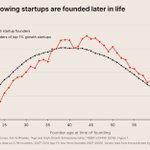
when i was younger, not yet a founder, and endeavoring to be one, i had a friend who was about a decade older than me share stats like this with me - mainly, that the average age of a successful founder was >40 (i was in my 20s) and that i should wait to start something until i was older
i had always wanted to be an entrepreneur (on a smaller scale i always have been - i started my first company at 11), and stats like this deterred me from taking the full leap for a while
i went and started my first company in my 20s anyway. i'm now on my third, with multiple successes and many many mistakes (and failures) in between
the advice i'd give to any prospective or current founder about odds amounts to something like:
the odds don't matter. when you're a founder, the odds will always (and should be) stacked against you and your job is to beat the odds.
there will always be probabilities, you will always be conscious of them, and sure - they're sometimes relevant to understand in the context of your broader mission.
but generally speaking, startups are an act of rebellion: if you are to build something impactful, you will change something about the world.
the world does not want to change.
therefore, if you are to change it, you will experience (an immense amount) of friction. in order to overcome that friction, you will have to find a way to beat it - which, fundamentally, means you will have to figure out things that other people have not been able to (if it was easy, would be no friction - and no asymmetric opportunity).
founder age is a chart of thousands - literally, thousands - of data points you'll see over your time being a founder that will tell you that You Are In The Wrong Place To Win. even when you see data that tells you that you're in the right place (and that the odds are stacked in your favor, which will be rare), most people around you will just tell you you're wrong about that.
the odds don't matter. win anyway.
facts that were true in 2020
> the average founder of a top 0.1% startup was 45
> 50-year-old founders were 2x more likely to succeed than 30-year-olds
> founders in their early 20s had the lowest chances of a successful exit
> even in tech, the average founder was around 40
> 3+ years of industry experience doubled your odds of building a top startup
> founders who successfully exited were 46.7 on average
facts that are true in 2026
> average AI unicorn founder age dropped from 40 in 2020 to 29 in 2024
> AI startups reach unicorn status in 4.7 years vs ~7 years historically
> outside AI, unicorn founders are still getting older
> health and biotech unicorn founders are older than those in other sectors
> 40% of unicorn founders are repeat entrepreneurs
> 25% of unicorn founders are immigrants

Here's my list of people to watch 25 and under. Who else should I add? cosign.co/lists/eriktorenber…

don't have ambitious people around you? build your circle online
here are some of the best young builders on X to learn from and connect with
- @gajesh (18, engineer eigenlabs, building darkbloomai)
- @richardzphotoz (19, media & brand a16z)
- @zach_yadegari (19, sold cal ai, building yourpersona)
- @DeRonin_ (20, ceo arcane, angel investor)
- @jia_seed (22, co-founder jam, ex-big tech)
- @im_roy_lee (ceo cluely, raised $15m from a16z)
- @sandylikesfrogs (Stanford, experiments with AI agents running businesses)
- @0xSigil (Thiel Fellow, founder underdogai, backed by a16z)
- @ansonyuu (hardware normalfactoryco, AI + manufacturing)
- @mathurahravi (design engineer netflix, runs rabbitholeathon)
- @AnnieLiao_2000 (founder solaris_ai, grew buildclub to 70k+)
- @_rajanagarwal (AI research openai, ex-Amazon AGI)
- @aditabrm (built r-1, reducto's document parsing model)
- @schisofrenia (co-host MTSlive, AI interviews)
- @hannahsgao (math/CS stanford, ex-openai)
who else should i add?

if you're 15–19, these are some of the best programs you can apply to in 2026
1. Hack Club (free clubs + hackathons, ages 13–18)
2. Emergent Ventures (grants, ages 13+, rolling)
3. +EV ($1k–$50k grants, no equity)
4. Z Fellows (1 week, any age, optional $10k investment)
5. MIT THINK (up to $1k + MIT trip, deadline ~Jan 1)
6. Thiel Fellowship ($250k, no equity, must drop out)
7. RSI (free MIT/Stanford research, deadline Dec 11)
8. MIT PRIMES (free math research, deadline Nov 2)
9. Simons Summer Research (lab research, US juniors 16+)
10. MITES Summer (free 6 weeks at MIT, US juniors)
11. Beaver Works Summer Institute (4 weeks, AI + engineering)
12. Summer Science Program (5-week research, juniors only)
13. PROMYS (6-week math program, ages 14–18)
14. Canada/USA Mathcamp (5 weeks, ages 13–18)
15. Ross Mathematics Program (6-week math, ages 15–18)
16. SUMaC (Stanford math, grades 10–11)
17. Davidson Fellows ($25k–$100k scholarships, US)
18. Breakthrough Junior Challenge ($250k, video competition)
19. Neo Scholars (CS undergrads, optional $40k + residency)
20. Interact (2 fully funded retreats, ages 18+)
21. Dorm Room Fund ($40k investment for student founders)
22. MLH Fellowship (12 weeks remote + stipend, ages 18+)

Paul Klay retweeted

Missing one of the biggest opportunities! 1517 does up to a $1M investments in students, dropouts, and renegade scientists working on the future!
if you're 15–19, these are some of the best programs you can apply to in 2026
1. Hack Club (free clubs + hackathons, ages 13–18)
2. Emergent Ventures (grants, ages 13+, rolling)
3. +EV ($1k–$50k grants, no equity)
4. Z Fellows (1 week, any age, optional $10k investment)
5. MIT THINK (up to $1k + MIT trip, deadline ~Jan 1)
6. Thiel Fellowship ($250k, no equity, must drop out)
7. RSI (free MIT/Stanford research, deadline Dec 11)
8. MIT PRIMES (free math research, deadline Nov 2)
9. Simons Summer Research (lab research, US juniors 16+)
10. MITES Summer (free 6 weeks at MIT, US juniors)
11. Beaver Works Summer Institute (4 weeks, AI + engineering)
12. Summer Science Program (5-week research, juniors only)
13. PROMYS (6-week math program, ages 14–18)
14. Canada/USA Mathcamp (5 weeks, ages 13–18)
15. Ross Mathematics Program (6-week math, ages 15–18)
16. SUMaC (Stanford math, grades 10–11)
17. Davidson Fellows ($25k–$100k scholarships, US)
18. Breakthrough Junior Challenge ($250k, video competition)
19. Neo Scholars (CS undergrads, optional $40k + residency)
20. Interact (2 fully funded retreats, ages 18+)
21. Dorm Room Fund ($40k investment for student founders)
22. MLH Fellowship (12 weeks remote + stipend, ages 18+)
Paul Klay retweeted

protect your AI accounts as carefully as your bank account
your chatbot might know more about your life than your closest friends
your finances, work documents, private thoughts, plans you haven't told anyone about...
a few things to check today:
- use a passkey or security key where supported
- enable 2FA through an authenticator app
- protect your email with 2FA too
that context makes AI useful, but it also makes your account valuable to anyone who gets access to it
i asked my chatbot what it knew about me and, tbh, the answer scared me enough to go straight to my security settings

read the summary before bookmarking another article you'll probably never open again
learning from other people's experiences in your 20s could save you years of mistakes and wasted time

few things i've experienced by 22:
- hit $1.2M ARR
- had over $80K stolen from us
- somehow kept the company alive 5+ times when our bank account was almost at $0
- came within a day of owing $600K
- visited 15 countries and lived in 6 of them
- went through 5+ pivots
- worked with 7 different cofounders
- been in just one romantic relationship
- fired 20+ people, including some really tough departures
and we're still going