

Verified to the molecule. Two labs on every batch, your vial number on the report. Peptide science and its fights, clip by clip.
California
Joined June 2026
- Tweets2.5K
- Following360
- Followers316
- Likes375




Real question for the peptide crowd.
First thing you check on a COA:
Purity number, mass spec, lot match, or the lab name?
1
50

2/9
What makes it so interesting starts with how simple it is:
"GHK is a tripeptide. It's made up of three amino acids, glycine, histidine, and lysine, and it's attached to copper."
"This compound is naturally produced in our body in small amounts." As we age, "it drops significantly. So that's why young people have probably better skin, hair, and nails."
1
1
23

2/9
His opening, which is also his thesis:
"This is the peptide that every guy on X and TikTok swears burns fat. And I'm not talking love handles, but the fat packed around your organs. And here's the thing, it actually does."
"We've got 800 patients, two Phase 3 trials, and FDA approval, and a CT scan that shows your gut shrinking anywhere between 15 and 20%. This is the most proven peptide I have ever covered on this channel."

2/9
Who he is, and why he went looking:
"I'm a board-certified internal medicine physician, and I spend over 80 hours a week in the hospital treating patients with heart failure, liver disease, kidney disease."
"That's what originally attracted me to peptides. Not because I think they're miracle treatments or because they can cure every disease, but because some of these molecules may help correct the changes happening inside our cells that lead to chronic illness."
1
1
110

2/9
What a peptide is, in his words:
"A peptide is made from amino acids. A peptide is a very short chain. They're short chains that are basically messages that will give a signal to tell the body to do a certain thing. So look at them like a blueprint."
Messages, not building material. That one idea explains most of the excitement.

David Sinclair spent 56 minutes on wellness peptides this weekend. 73K views in two days. He likes the science, and he still spent a long stretch on the part nobody wants to hear.
The question he gets everywhere now is not which peptide. It is where do I get them. Seven clips 🧵

1
81
2/9
The question, in his words, from a five day birthday party in Italy:
"Every time we sat down for the meal, when people found out what we did for a living, the question always was peptides. Peptides, tell me which ones, how much, when, and where do I get them?"
Four questions. He answers the first three with trials and a doctor. The fourth is the one we deal in.

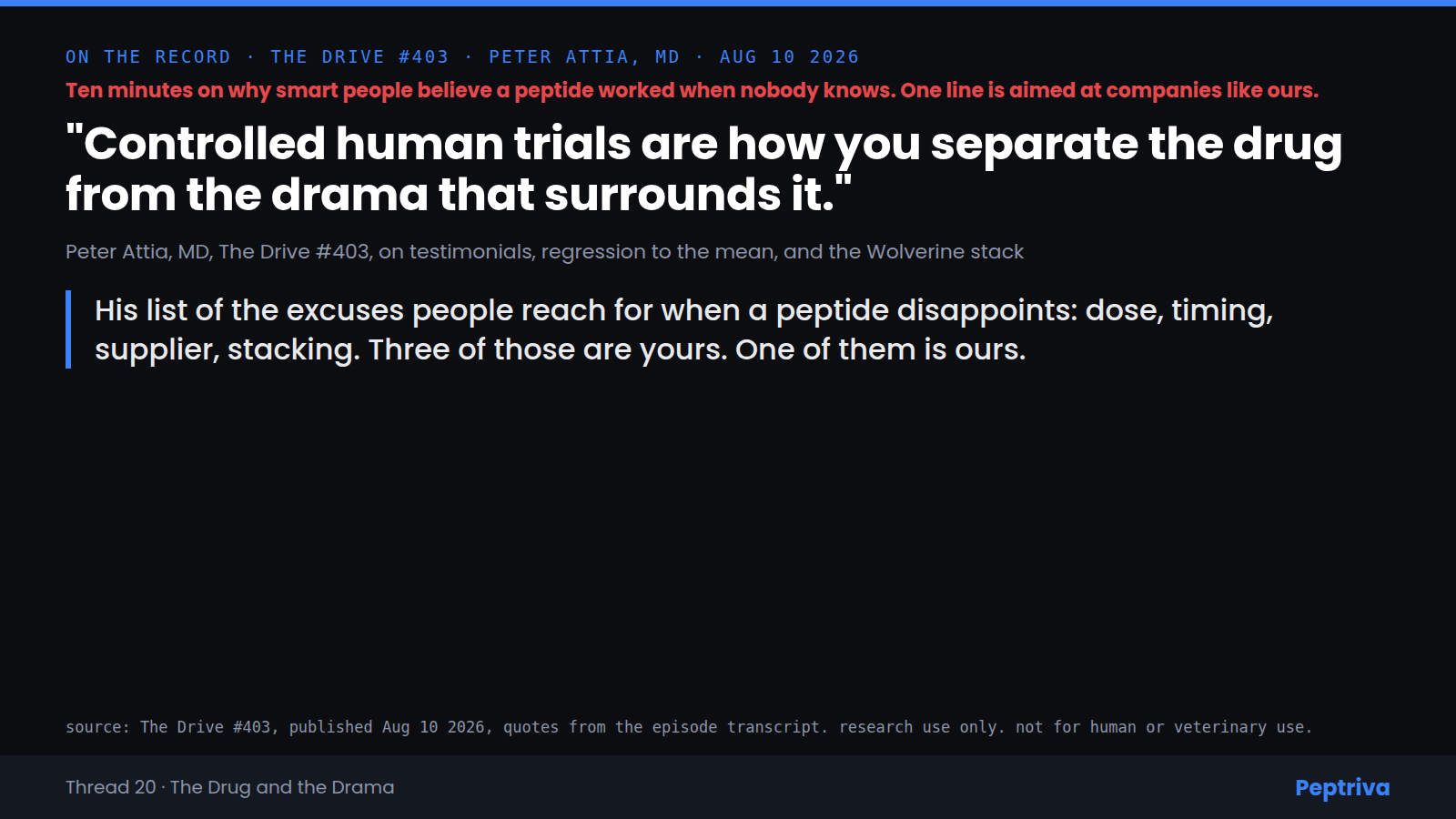
Peter Attia spent ten minutes explaining why smart people believe peptides work when the evidence says nobody knows. One line in it is aimed straight at companies like ours.
Why he takes the stories seriously and still doesn't trust them: "A testimonial describes what happened after someone took a drug. It can't tell you what would have happened without it."
Reason one, timing: "People almost always start a peptide when they're at their worst, which is exactly when you'd expect things to get better anyway, drug or no drug. That's simply regression to the mean." Nobody starts a healing peptide on a good day.
Reason two, the sea of variables. His friend's before and after photos. "What else was he doing?" Started exercising, started tirzepatide, changed his diet, probably on testosterone. "This otherwise very intelligent person was attributing the benefit to the Wolverine stack."
Reason three, the ritual: "Social media testimonials, authority from a clinician or peptide clinic, real cost, subcutaneous injection, which just somehow feels more official and more serious."
Then the line for our industry: "People often confuse a legitimate molecule with a legitimate product." A real molecule in an unverified vial is not a legitimate product. It's a story with a needle.
And his test for whether any of it is science: "If every disappointing outcome gets explained away by dose, timing, supplier, stacking, that's not a scientific claim anymore."
Read that list again. Dose. Timing. Supplier. Stacking.
We can't take dose, timing or stacking out of anyone's experiment. That's between you and your physician. We can take supplier out. Every lot we sell is tested by two labs that didn't make it: sequence confirmed by mass spec, purity as a number, heavy metals screened, report dated and tied to the lot on the vial. If it still didn't work, you learned something about the molecule, not about the vial.
"Controlled human trials are how you separate the drug from the drama that surrounds it." We're not a trial. We're one fewer excuse.
Research use only. Not for human or veterinary use.
1
2
855
Six words from Attia and the whole peptide supply chain is graded on them: identity, potency, purity, stability, sterility, lot to lot. Ask whoever sold you the vial which ones they can prove for that lot. The list, with Huberman and Attia saying it in their own words:
teapawt.net/Peptriva/status/210311…


Andrew Huberman and Peter Attia do not agree on much about peptides. Put their clips side by side and they agree on exactly one thing: what has to be true about the vial before anything else matters.
Four clips, three episodes, one checklist 🧵

3
3
156
2/9
Start with the most quoted peptide episode ever made. Twelve minutes in, before he says a good word about any compound, Huberman:
"I implore you to do so with a board certified physician and to acquire peptides through a reliable source where the LPS has been removed."
LPS is not a peptide. It is bacterial debris. His first concern was the vial.
1
85
Insulin: 2 years from a dog's pancreas to a pharmacy. Semaglutide: 34 years from a gut hormone to the biggest drug of the decade. Nobody was slow. That is how long it takes to learn what a molecule is and what it does. Yesterday's thread is about the one stretch of that road you can finish today. teapawt.net/Peptriva/status/210203…

Everyone clipped Huberman's "horse left the stable" line from Rogan. Almost nobody clipped the better two minutes right before it.
"The interesting thing about peptides is that this is the first time we are bioprospecting from the body."
Every drug you know was found somewhere. Here is what happens between finding a molecule and trusting it 🧵

2
88
Everyone clipped Huberman's "horse left the stable" line from Rogan. Almost nobody clipped the better two minutes right before it.
"The interesting thing about peptides is that this is the first time we are bioprospecting from the body."
Every drug you know was found somewhere. Here is what happens between finding a molecule and trusting it 🧵
1
773
2/10
First, how drugs actually get made. Huberman, describing what a pharmacologist friend told him:
"Pharma companies develop drugs based on bioprospecting. Finding alkaloids and other substances in plants, purifying the substance that gives a specific effect, and developing a drug."
Find it. Purify it. Prove what it is. Then it becomes a medicine. That middle step is the whole story.
1
1
125
Andrew Huberman, to Rogan this week: "There will never be good clinical trials of each and all of these peptides. The horse left the stable."
He is right. And in the same episode he explained, without meaning to, exactly what a field has to get right when the trials are never coming 🧵

2/11
Here is the full quote, because the clip everyone is passing around cuts it short.
Huberman: "How come there aren't 20 clinical trials? It's because the general public beat the scientific community to it. There will never be good clinical trials of each and all of these peptides. The horse left the stable."
Notice he is not celebrating. He is describing where we are in 2026.
1
668
UCLA just reviewed 565 studies on the six most talked about peptides on the internet. BPC-157, TB-500, CJC-1295, MK-677, ipamorelin, GHK-Cu.
Most of our industry is pretending the paper does not exist.
We sell research peptides. We read it twice. It is the best thing to happen to peptides this year 🧵

2/10
The paper: Kremen and Tewari, American Journal of Sports Medicine, September 2026. Kremen is an orthopedic sports medicine physician at UCLA.
565 studies. More than two-thirds in animals. The human studies were few and small.
Their verdict is not "these do not work." It is "nobody has properly checked." Those are very different sentences.
1
142

2/12
Start with why he takes it. Rogan brings up hormesis, the idea that mild stress makes the body stronger.
Sinclair: "One of the reasons I eat mostly plants, why I take NMN and these other molecules is to mimic that. I don't work out like you do. I should, but I don't."
Rogan: "Why don't you?"
Sinclair: "I think partly because I tell myself I'm too busy."
So the pill is standing in for the workout. Keep that in mind.
1
2
182
David Sinclair told 94,000 people this week that one flawed pharma study cost the world longevity medicine.
Five weeks earlier, on Joe Rogan, he spent an hour explaining why he will not take his own anti aging drug yet.
Same scientist. Both standards are on tape 🧵

2
5
2,519
2/13
First, the "flawed study," because the story is better than the tweet.
2003: Sinclair's lab reports resveratrol activates SIRT1. 2004: he co founds Sirtris. 2008: GSK buys it for 720 million dollars.
2010: Pfizer scientists show the activation signal came from a fluorescent tag in the assay. Same year GSK halts the resveratrol trial after kidney problems in patients.
2013: Sinclair answers in Science. GSK closes Sirtris anyway.

1
1
109
The one they missed was fish oil. Vascepa and Lovaza are FDA approved prescription omega 3s. The bottle at the grocery store is not. Same molecule family, two different regulatory universes, and the gap between them is where most of the supplement aisle lives.
An Instagram couple went viral this week playing a game called Is It FDA Approved.
Creatine. Ozempic. Protein powder. Botox. Fish oil. Viagra. Collagen.
Guess before you scroll. They got six of seven right, and the one they missed explains the entire system 🧵
2
344
