
Husband, Father, Director @centre4fe , Research Associate @famstudies . Substack: https://xitter.cf/t.co/GiVdv0CRkg. Views my own
Joined February 2025
- Tweets639
- Following118
- Followers163
- Likes619




Pinned Tweet
Two working papers in the past month ascribed fertility decline to the smartphone, but they couldn't tell us which aspect of smartphones do it. In this paper, I find that interest in mobile dating apps, unlike social media, leads to an immediate fall in fertility outcomes.

Fascinating piece! Read my review: persistentruminator.substack…

People usually say that the pill caused the sexual revolution but a) people started having premarital sex in the 1950s, a decade before the pill and b) contraception is widely used by people who don't live very post-sexual-revolution lives (like in Asia). I think the sexual revolution, i.e. more permissive attitudes about sex, caused the pill to be invented and not the other way round.
But then, why did the sexual revolution happen? I have cooked up a theory. Just as how women have more casual sex on college campuses with fewer men, I think women, as a collective, responded to the male shortage caused by the Second World War by shortening their hemlines and having premarital sex.
Read my column here: worksinprogress.co/issue/you…

Where I think there is a big sex ratio problem: differential migration. Women disproportionately move to cities for jobs in services economy, men disproportionately stay where there are industrial jobs. This creates sex imbalances by geography.
Peter Foreshaw Brookes retweeted

Even married couples aren’t safe from the "sex recession."
☑️ In 2008, 59% of married Americans ages 18–64 had sex at least weekly.
☑️ Today it’s about 49%.
@MariaBaerWrites @BradWilcoxIFS @Deseret

"Dartmouth economist David Blanchflower found that “married people have more sex than those who are single, divorced, widowed or separated.” The surest path to a good sex life still runs through the altar, not away from it." deseret.com/opinion/2026/10/… @Deseret

Peter Foreshaw Brookes retweeted

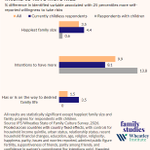
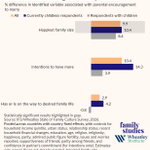
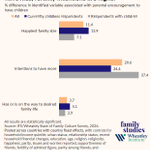
We tested whether religious people frequently hear religious leaders talk about family and the importance of having children.
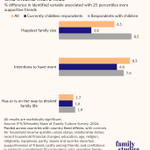
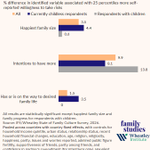
Across countries, we find that in places where religious people report having religious leaders who are more outspoken about having children, desired family size, intended family size, and current family size are all higher.
@lymanstoneky @PeterRFB @DrJasonCarroll

Peter Foreshaw Brookes retweeted
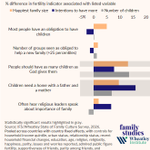
Duty doesn’t drive fertility. Joy does.
Seeing childbearing as a moral obligation doesn’t predict kids. (China ranks high on that view & its fertility is under 1.)
But people who see kids as one of life’s greatest joys are 30% more likely to intend another child.
@DrJasonCarroll @lymanstoneky @PeterRFB @Deseret deseret.com/opinion/2026/10/…

Peter Foreshaw Brookes retweeted
Views about the general or abstracted social good of children are not as consistently associated with actual childbearing, new research from @lymanstoneky @PeterRFB @DrJasonCarroll indicates.


Peter Foreshaw Brookes retweeted
As parents have more kids, they experience more social pressure to stop, or even discrimination for having too many children.
Overall, @lymanstoneky @PeterRFB @DrJasonCarroll find that as people have more children, society’s reaction gets less positive.
Many people celebrate their friends and family members having their first baby—and first babies usually have more baby showers thrown for them. Many people will celebrate a second child, but perhaps not as many; and even fewer still would celebrate a third child.
Social celebration continues to drop off further as a couple adds more children to their family.

Today is exactly 384 years from the first battle of the English Civil War. For such a big anniversary (the classic 3-8-4), I had claude prepare an overview.
Peter Foreshaw Brookes retweeted

PSA: ask to visit your friends with new babies!
I was worried this earlier phase might be isolating, but it’s been delightfully social (with all the proper precautions - we’ve been doing outdoor baby hangs thanks to the good weather). I’m sharing this because I was *not* this friend. I assumed new parents wanted their space. And I’m sure some do, but they’ll welcome the enthusiasm even if they decline the visit.
Peter Foreshaw Brookes retweeted
The extent to which individuals feel that their peers will celebrate and support their family plans may be a crucial part of how they make fertility decisions, new research from @lymanstoneky @PeterRFB @DrJasonCarroll suggests.

Peter Foreshaw Brookes retweeted

A new UN report published this month found a fertility rate of 3.3(!) for Mongolia, more than triple that of neighboring China.
Mongolia does what most Western governments are too squeamish to do. It directly asks women to have more children and celebrates those who do.


Upcoming work from @lymanstoneky on baby name trends and cultural ruptures!

The perils of choosing a baby name spectator.com/article/the-pe…

Peter Foreshaw Brookes retweeted

I was the first in my friend group to have a baby (I was mid grad school) and I just want to say that my friends really stepped up! And my neighbors. People were helpful in a thousand ways. I was also not afraid to let folks know that I could use help.
New @FamStudies: The baby bust has a friendship problem.
% who say friends would help with a first baby:
🇯🇵 Japan: 5%
🇰🇷 S. Korea: 15%
🇺🇸 U.S.: 41%
🇮🇱 Israel: 48%
The countries with the fewest babies are the ones where new parents expect to go it alone.

Peter Foreshaw Brookes retweeted

I was delighted to get to write this piece. Usually I have to keep my demography takes "demography, with a veiled hint of faith." Was nice to be able to lay out what I think the stakes really are for churches.


Happy to have @lymanstoneky debut @AmReformer discussing an important study he and his colleagues @FamStudies recently published on cultural factors influencing fertility and ways Christians can think about creating a culture that supports and encourages having children.
Peter Foreshaw Brookes retweeted
We know fertility is contagious, but we do not know what exactly is being “caught.”
@lymanstoneky @PeterRFB begin to open the "black box" of fertility culture in indispensable new research @FamStudies. Link below
Peter Foreshaw Brookes retweeted

Happy to have @lymanstoneky debut @AmReformer discussing an important study he and his colleagues @FamStudies recently published on cultural factors influencing fertility and ways Christians can think about creating a culture that supports and encourages having children.