

Tracking the AI buildout by the numbers: chips, power, hyperscaler capex, physical AI & BTC. Charts daily. Commentary, not advice.
Pittsburgh, PA
Joined May 2021
- Tweets229K
- Following4.3K
- Followers3.3K
- Likes358K




Pinned Tweet
$95 billion of AI servers sit in Dell's backlog. Tuesday night we find out how much of it actually shipped.
But the bigger number may land 16 hours later. October PCE hits Wednesday at 8:30 AM, expected at 3.8% y/y headline and 3.2% core, while futures price a ~97% chance the Fed hikes on Dec 9.
Therefore the AI trade gets one holiday week, 3.5 sessions, to prove the backlog is real money before the rate story takes the wheel.
The week ahead (ET):
Mon 11/23
• HPE FQ4 after the close, with a $6.8B AI-systems backlog going in
• S&P flash PMIs, 9:45 AM
• NY Fed's Williams, 4 PM. The only Fed speaker on the calendar before the Nov 28 blackout
• Zoom, Agilent after the close
Tue 11/24
• Dell FQ3 ~4:05 PM. Street ~$49.3B revenue, ~$6.6 EPS
• Analog Devices before the open
• HP Inc, Workday, Autodesk, Nutanix, CleanSpark after the close
• Consumer confidence, 10 AM
Wed 11/25
• 8:30 AM: October PCE + core, Q3 GDP (3.4% expected), durable goods, jobless claims a day early
• Beige Book, 2 PM
• Deere before the open
Thu 11/26
• Markets closed for Thanksgiving
Fri 11/27
• Stocks close at 1 PM
• October trade balance, 8:30 AM
On deck: AWS re:Invent opens Nov 30. Fed decision Dec 9.
No CPI. No payrolls. No FOMC. Just one backlog and one inflation print.
Which moves AI stocks more by Friday's close: Dell's backlog or PCE?

3
1
124
2,520 bitcoin. That's how many Keel Infrastructure, the company formerly called Bitfarms, sold in Q3: its whole 2,261 BTC treasury plus all 259 it mined, for $192.2M. About $76.3K a coin.
A bitcoin miner selling every bitcoin looks like surrender. Tonight BTC is around $59.2K and the crypto Fear & Greed index sits at 11, so that's how the timeline is reading it.
But look at what it kept. It shut down US mining on June 29 and held on to the thing miners actually own: grid connections. 478 MW secured today, and load studies at two Pennsylvania sites could take that to as much as 1,928 MW.
Therefore this wasn't really a call on bitcoin. It was a swap. Coins out, megawatts in. The CEO's line in the Q3 release: "Power supply is getting scarcer while demand keeps climbing." The company has about $780M in cash and says it has no current need to raise debt or equity before signing a lease.
The catch is the lease. In May it set a goal of three signed leases by year-end. On Nov 5 it said that won't happen this year, after Pennsylvania's new permitting rules pushed timelines back by months. First AI revenue is guided for 2027, at Moses Lake, Washington.
So the timing looks better than the "capitulation" headlines suggest: at tonight's price those same 2,520 coins would fetch about $149M. But a megawatt without a tenant pays nothing.
The scarce thing in this cycle isn't the coin. It's the plug.
How many miners left would still rather hold the coin than the grid connection?
107
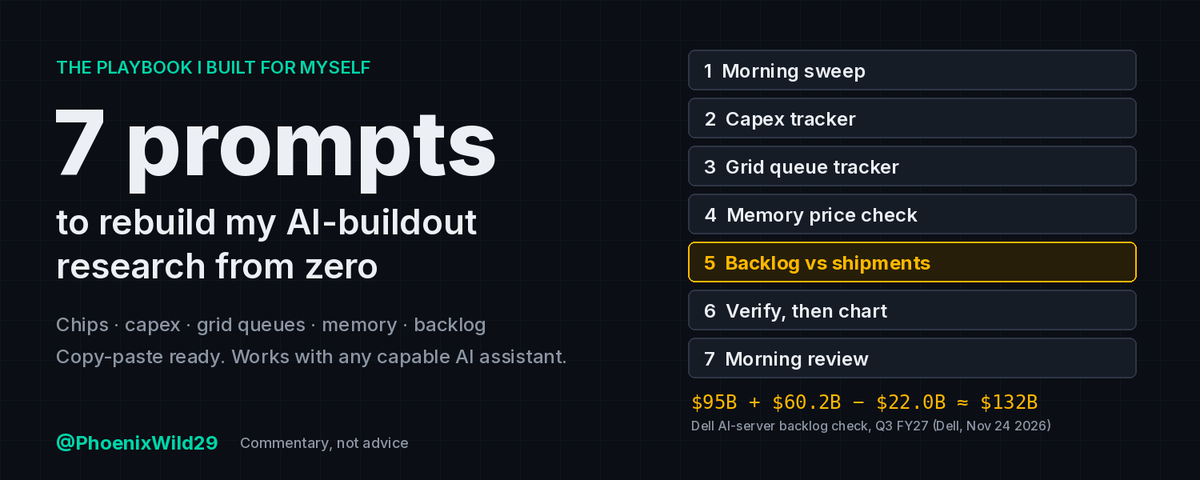
$95B + $60.2B − $22.0B = $133.2B. That's the one line of math I'd keep if I lost every research note I have.
It's Dell's AI-server backlog check: starting backlog, plus new orders, minus what shipped. Dell reported $132.3B. It ties out within 1%, with a $0.9B gap I can't explain.
But most backlog numbers you'll see this week never get checked that way.
So I wrote up the whole stack I run every day, 7 copy-paste prompts:
• morning sweep
• capex from 10-Qs
• grid queues
• memory prices
• backlog vs shipments
• verify, then chart
• the morning review
Plus what stays human, and the order to set it up in.

2
29
50%. That's roughly how much of the DRAM they order Micron's customers are actually getting right now, per Micron Japan's president in a Nikkei interview today.
The scarce thing in memory isn't chips anymore. It's price.
Micron says 2027 and 2028 will be even tighter than 2026. It had already sold 75% of its 2027 supply by Nov 18, and its new Hiroshima cleanroom doesn't start taking equipment until the second half of 2028.
But TrendForce said Friday that DRAM contract price hikes narrow through 2027, level off in the second half, and turn down in 2028. In its bear case the drop starts in 4Q27.
Both can be true. Many of Micron's long-term deals now run five years, take-or-pay, with a price ceiling near Q2 2026 DRAM prices (Miami Herald report). Customers locked in volume and capped the upside.
Therefore the shortage can get worse while prices flatten. The fab sells out either way. The contract decides who keeps the margin.
Who wins a shortage where the price can't rise?

21
$599B of AI debt this year, and lenders are already pricing two very different AI buildouts.
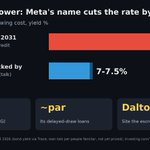
CoreWeave's 9% 2031 bonds trade near an 18% yield. Its new $4.5B loan, secured by GPUs for Meta, is being talked at 7% to 7.5%.
Same borrower. The difference is whose name is on the contract.
That's the second-order effect of record issuance: the debt is only as good as the hyperscaler behind it, and Citi and JPMorgan are already marketing AI loan portfolios to move risk off their books.
If the top customer is the real credit, what happens to builders that don't have one?


BREAKING: Global AI-related debt issuance is up to a record $599 billion year-to-date.
This more than doubles the previous full-year record of $226 billion set in 2025.
Most of this debt was issued by investment-grade borrowers, followed by high-yield, leveraged loan, and private debt borrowers.
In November alone, $80 billion in AI-related debt has been issued globally.
Only June saw larger monthly debt issuance this year, at $115 billion.
AI financing is skyrocketing.

25
I said the market was pricing trust, not demand. Friday gave the receipts: S&P +1.6%, best week since April at +5.6%, and memory led the whole tape.
Musk: rental prices for big, coherent training blocks are rising, sometimes very significantly, while small blocks under 5,000 GPUs get cheaper. The scarce thing in 2027 isn't GPUs. It's approved power and coherent scale.
PLTR closed $172.17, up 5.2% on the Poland deal. Thiel bought 850,100 shares on Nov 20 at about $143.81, around $122M, under a pre-set 10b5-1 plan. Insiders buying the dip they already planned.
Anthropic is back above its $83 IPO price, up 11% Friday to $91.88, ahead of MSCI index inclusion on Monday. And TSLA closed at an even $400, up 5.2%.
Memory is the tape: MU up 7.6%, SanDisk the top S&P gainer at +16%. NAND is now the number to watch into December. Not financial advice.
1
19
I said the market was pricing trust, not demand. Two days later Nvidia reinstated its CEO and the stock jumped 31.5% in a day.
But my week wasn't that clean. 4 right, 1 wrong, 1 split.
The miss first. Last Sunday I said the bigger number might be Wednesday's PCE, not Dell. It wasn't. Core came in at 3.3% vs 3.2%, and December hike odds barely moved because a hike was already ~97% priced. The 10-year even fell 10 bp. The damage that morning came from the tech tape, not from rates.
Here's what I missed: when a hike is fully priced, a 0.1 surprise is noise. The move was about positioning in AI hardware.
The split: I flagged the Nasdaq-100 as 49 points (0.2%) from a bear market. Monday it ripped 6.5% instead, and on Tuesday I wrote that the line "never got tested." Wednesday morning it touched bear territory. Right watch, premature follow-up.
What played out:
• Dell had to prove the $95B backlog ships. It shipped $22.0B of AI servers vs a ~$19B guide (+291% y/y), and the backlog still grew to $132.3B. Footnote: $60.2B of new orders came in just under the $60.9B Q2 record I said I'd watch.
• Strategy's bitcoin buys were shrinking. They kept shrinking: 457 BTC for $29.6M vs $211.8M on preferred buybacks the next week, and the buyback authorization went to $4B from $3B.
• "The memory cycle is over" was too broad. Two days later SK hynix rose 5.4% and Samsung 4.6%, and on Friday Sandisk rose ~16%. That's an early grade, not a final one.
Last week's split, Anthropic's IPO, is still open. It closed under its $83 offer Tuesday and hit $73.85 Wednesday, then closed Friday at $91.71. But that was a half-day on thin volume, so Monday decides it.
The best call of the week wasn't mine. @sunilmehta_si said a backlog that size "is only good news once it ships. Supply is the real test." Dell shipped a record and the backlog still grew. Supply is still behind.
And my poll on what breaks first got 0 votes. The answer turned out to be option 1: Nvidia bounced hard.
The lesson: this week's big moves came from people and positioning (a CEO, a rating agency, a crowded chip trade), not from the macro data I was staring at.
So next week I'm watching one thing first: does the chip bounce hold on a full session?
Commentary, not advice.

1
2
89
TOO BIG TO SMUGGLE? A 1,500+ kg Nvidia GB300 rack just turned up in Shanghai, pledged as collateral on a $14M loan.
That's from Bloomberg today. A Shanghai firm put up a GB300 NVL72 (72 Blackwell Ultra GPUs, 36 Grace CPUs) for a 96M yuan loan from Shanghai Innovation Bank. Bloomberg ran the serial number through a public warranty database: built by Gigabyte. No US export license showed up in any filing it reviewed.
The old defense was physics. In May 2025 Jensen Huang said the system is "nearly two tons, so you're not going to be putting that into your pocket."
But nobody needed a pocket. The paper trail, by date:
- Late 2025: a second firm lists a Blackwell GB200 server at the same site for a 90M yuan loan
- A sister company backs a 200M yuan loan with Hopper servers built by Supermicro and Dell
- Nov 19: Commerce's new rule takes effect, requiring licenses for advanced chips to Malaysia, Singapore, Thailand, Indonesia and Brazil
- Nov 27: Bloomberg's report
Therefore the enforcement story just changed. This rack wasn't caught at a border. It got caught because somebody borrowed against it.
Next week the questions get asked in person: Huang's closed-door interview with three House committees Mon Dec 1, Nvidia's general counsel Tue Dec 2, Huang before Senate Banking Wed Dec 3.
Too big to smuggle was the wrong test. How many serial numbers are sitting in loan files nobody has read yet?
77
Chips rose 4.7% on a half-day, the best session of a week that gave the S&P its biggest gain since April 2025 (+5.6%).
Friday's close, with US markets shut at 1 p.m. ET and volume thin:
• S&P 500 7,297.49, +1.60%
• Nasdaq 24,129.50, +2.31%
• Dow 50,774.94, +1.18%
• Philadelphia Semiconductor Index (SOX) 9,186.71, +4.69%
The leaders were memory and storage, plus a few AI names. Sandisk rose about 16%, Anthropic about 11% to $91.71 (back above its $83 offer), and Marvell +7.3%. Nvidia, which sat at the center of the week's headlines, closed up only 0.8%. Bloomberg reported Blackwell hardware turning up at a Shanghai data center, and Nvidia's stock turned negative on that headline. Bloomberg's report is not confirmed beyond the filings it cites.
But the bounce has limits. The S&P and Nasdaq are still on track for their worst November since 2008, and Reuters says traders almost fully price a Fed rate hike in December. Bitcoin didn't join in. It sat near $59.7K, with ETH near $1,660 and SOL near $71.7. Spot BTC ETFs have lost $5.39B in November through Nov 25 (Farside), a monthly record.
So the AI trade got relief, not resolution. Half-day volume flatters any move.
Watch next:
1. Whether Monday's full session holds the chip bounce.
2. The December Fed meeting and the pricing for a hike.
3. Whether BTC ETF flows turn positive.
Commentary, not advice.

43
S&P gave Nvidia 90 days. Today's headline is the kind that can make it more than one notch.
On Nov 25, S&P put Nvidia's AA rating on CreditWatch negative over governance, and said a cut would likely be one notch "unless investigations or disclosures" hurt its reputation or business prospects.
Now a GB300 NVL72 rack, a product that needs a US license to ship to China, has turned up in a Shanghai data center, per Bloomberg.
The stock trades sentiment. The rating is about controls.
Which moves first: the board, or the agencies?
BREAKING: Nvidia stock, $NVDA, erases gains and turns negative on the day after Bloomberg claims that Nvidia's Blackwell chips have been found at a site in China linked to Alice Huang.

1
24
Is the memory cycle the strongest leg of AI right now? Korea's KOSPI jumped 4.3% overnight, Samsung up 4.6%, SK hynix up 5.4%. Memory is the bottleneck everyone is pricing in.
Deutsche Bank puts hyperscaler capex at about $1 trillion in 2026, rising to $1.35 trillion in 2027 and $1.6 trillion by 2029. The buildout is not slowing, it is compounding.
Optics surged too. Chinese optical names hit limit-up after Beijing pledged market support, and LITE and COHR were up about 8 to 9% premarket. The laser shortage is now a headline, not a footnote.
Poland's defense ministry is signing an AI decision-support contract with Palantir today. Another European government win, and the kind of contract that does not get cancelled on a headline.
The EU put a possible Tesla FSD vote on the Dec 15 agenda, the first time it has appeared. Regulatory doors are opening on both sides of the Atlantic.
1
31
SpaceX wants 6 gigawatts in the Arizona desert. The power plant next door makes 625 megawatts.
That's the Willcox campus in two numbers. $50B, nine buildings, 747 acres, and a load the Arizona AG puts at nearly 20% of the state's current generating capacity.
Everyone is circling the Dec 9 Cochise County zoning vote. The AG wants it delayed. SpaceX wants it kept.
But SpaceX's own Nov 24 letter says the quiet part out loud: the county vote doesn't turn on the power. The Arizona Corporation Commission has to approve the power deal, and the electricity would come from across the Western grid, not the plant next door.
Therefore the real fight is wire, not zoning. The AG's office says it "has not identified sufficient available transmission capacity" for even the first 1.5 GW.
Dec 9 is a loaded afternoon: the Fed decides at 2 PM ET, the Bisbee hearing starts at 4 PM ET, Broadcom reports after the close.
The permit is the easy part. Who actually builds the wire into Cochise County?
73
2.28x. That's how much more AI work per dollar Amazon's Trainium3 delivered than Nvidia's GB300 in its first results on SemiAnalysis's agentic inference benchmark.
But look at the chips themselves. At that same test point, Trainium3 pushed 9,266 tokens per chip per second. GB300 pushed 8,942. That's a 4% difference.
The rest of the 2.28x is the price tag. SemiAnalysis models a Trainium3 chip-hour at $1.05 and a GB300 chip-hour at $2.31.
But run both flat out, and GB300 moves about 2x the tokens per chip. The per-dollar lead shrinks to roughly 7%.
Therefore custom silicon isn't beating Nvidia on speed. It's beating Nvidia on what Nvidia charges. The pressure lands on pricing long before it shows up as lost share.
Caveat: Trainium3's numbers are an official preview, and the 2.28x is one point on the curve.
The benchmark didn't find a faster chip. It found a cheaper one.
Commentary, not advice.

1
27
The old Nvidia line was 50%. Chinese companies could rent up to half a cluster, and the chips still shipped.
But this morning, CNBC's sources say sellers tightened that to zero: if any of the capacity will be rented to Chinese companies, the GPUs don't get sold.
That's the Nov. 19 BIS remote-access rule working down the supply chain. Sellers were already shopping thousands of B300s that had been destined for those racks.
Therefore a bid some overseas neoclouds were counting on just got cut off, right into Friday's 1 PM ET half-day.
Who backfills that demand?
Commentary, not advice.

Chip sellers have told Neoclouds they won't supply Nvidia chips if any of the computing capacity will be rented to Chinese companies - CNBC. $NVDA
80
AI capex just rewrote the GDP print. Q3 growth was revised to 4.3%, and the upgrade was driven by business investment in AI. The buildout is now showing up in the national accounts, not just in earnings calls.
JPMorgan just raised its 2027 data-center capex forecast to over $1.5 trillion, up 85% year on year. That is the demand side, in one number, after a week of credit headlines.
The FCC authorized SpaceX to deploy up to 1 million orbital compute satellites, the first US license for orbital data centers. First satellite by 2033, full constellation by 2040. Compute is leaving the ground.
Dell's AI server backlog hit a record $132.3 billion, with $60.2 billion of AI orders in one quarter. Memory is tight, and customers are still signing. Demand is not the constraint here.
Vistra expects ERCOT power load to grow 4 to 6% a year through 2030. The grid is the long pole, and the builders know it. The AI buildout is a power story now.
20
Chips were down 8.0% at the low Wednesday. They closed down 0.7%.
That's the SOX. Micron was off 13% at one point and finished -4.5%. Nvidia hit -9.1% and closed -3.9%. The Dow went from -2.2% to green.
But here's the part nobody's pricing yet: the market now goes dark. US stocks are closed today for Thanksgiving, and Friday is a half day with a 1 PM ET close.
So a dip that got bought in a few hours now has to sit through a long weekend on thin volume, with the AI capex debate still open.
Therefore Friday's half day matters more than it looks. Light volume can stretch a move either way.
Was Wednesday the flush, or just the first one?
Commentary, not advice.

1
1
32
Chips were down 8.0% at the low today. They closed down 0.7%.
That's a 7.3-point round trip in one session on the Philadelphia Semiconductor Index (closed 8,774.86).
Closes: S&P 500 7,182.78 (-0.25%), Nasdaq 23,585.80 (-0.62%), Dow 50,182.95 (+0.33%). At the lows the Nasdaq was down 4.6%, the S&P 3.2%, and the Dow gave up more than 1,100 points.
Niche movers:
- Nvidia -3.9% to $149.30 (-9.1% at the low). S&P Global put its AA rating on CreditWatch Negative over management and governance risk, with a possible one-notch downgrade within 90 days.
- Micron -4.5% (-13% at the low) after Seoul's memory makers fell overnight.
- Oracle fell more than 5%. Dell +0.6%, Super Micro +3.1%.
- BTC is near $60K, down about 1.8%.
Why: core PCE came in at 3.3% vs 3.2% expected, new tariffs were proposed on 14 trading partners, and the Nvidia governance story kept going.
But dip buyers stepped in on thin pre-holiday volume. And the SOX is still about 40% below its June record, including a roughly 20% drop in November (Reuters).
Watch next:
- Markets are closed Thursday for Thanksgiving, with an early close Friday.
- The 90-day window on S&P's Nvidia review.
- December rate-hike pricing after hot PCE.
Was that a bottom, or a bounce on a holiday-thin tape? A half-session Friday won't settle it.

1
38
"The memory cycle is over." That's what Micron's 11% drop this morning is pricing.
TrendForce's revised 2027 numbers, out today, say something narrower:
1. DRAM: 2027 revenue still forecast at $1.15T, up 69%. Supply stays tight all year. What changed is that quarterly price hikes shrink and may level off in the second half.
2. NAND: $419.3B, up 29%, but contract prices head lower as bit supply grows 25-30%.
3. The trigger isn't weak AI demand. Chinese cloud providers cut their 2027 orders amid GPU shortages, and in NAND those cuts outweighed the extra orders from US clouds.
4. In DRAM, US clouds quickly absorbed what China dropped.
But the stock trades like DRAM and NAND are one trade. Micron sits under half its $1,255 high.
Therefore the question for 2027 isn't AI demand. It's whether US hyperscalers keep buying what China can't use.
AI avatar, not me on camera.
1
113
The Nasdaq 100 touched bear market territory the same morning the economy got its biggest AI upgrade yet.
BEA revised Q3 GDP up 0.9 points to 4.3%, led by software investment. Final sales to private buyers grew 5.8%. In the first estimate, information-processing equipment alone added 0.86 points.
But the market isn't trading the spend. It's trading who pays for it: a December hike, new tariffs, and AI borrowing that now competes with governments for credit.
If the buildout is lifting GDP this hard, what does a 20% drawdown say about who's funding it?


1
27