



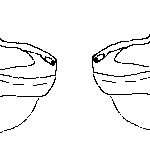
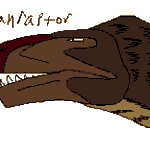
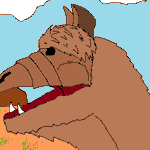




ALT In order to have noticeable osteoderms, unlike specimens v1-v4, Coffee's base genome is that of Kentrosaurus aethiopicus. Unsurprisingly, these osteoderms are not as long or durable as those of Kentrosaurus. Shunosaurus lii also makes up a considerable portion of DNA, giving them a vague sauropod shape, though some consider it to be more like a stretched-out stegosaurian. I personally think they have a good mixture of both traits: a long sauropod-like neck but more flexible, like a stegosaur, stegosaur-like front feet and sauropod-like hind feet, and obviously their tail is a mix of both. Their last two components mostly manifest themselves in Coffee's head. Khaan mckennai is the most notable out of the 2, giving them fangs like protrusions out of the roof of their skull as well as the feather coverage on their ventral. Their beak is most likely from all three. Masiakasaurus knopfleri only unfortunately shows up in a slightly downturned jaw.


ALT Vidal et al. (2026) utilized high-fidelity casts of the holotype and argued that Oxalaia lacks key Spinosaurus traits, such as a festooned alveolar margin. Additionally, a newly recovered frontal shows an exceptionally wide articular platform extending past the orbit margin, indicating a longer and wider nasal crest than in any other spinosaurid. The pedal bones are unusually robust, featuring nonungual phalanges that are wider than they are long with flared ends. This morphology, while considered inconclusive in the abstract, could be an adaptation for weight support while walking on land. Despite the differences, Oxalaia still shares several derived characteristics with Spinosaurus, including hypertrophied hypapophyses on the cervicodorsal vertebrae, reduced medullary cavities in the long bones, strong torsion of the humerus, and flat-bottomed pedal unguals. However, the exact proportions and shape of Oxalaia's neck, trunk, and caudal spines are still unknown.


