

Multi-disciplinary programme advancing urban ecological restoration research in New Zealand.
Joined January 2019
- Tweets208
- Following154
- Followers254
- Likes225





New research: Aotearoa's 120+ lizard species are "victims of ignorance"—legally protected but still declining due to enforcement gaps & weak policy integration.
Our Oct newsletter explores this + Wellington's successful low-mow trial & more.
Read: peoplecitiesnature.co.nz/med…

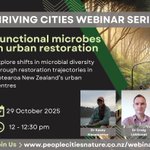
Microbes matter! Join Craig Liddicoat & Kasey Kiesewetter as they explore how microbial communities power #UrbanRestoration across Aotearoa.

Did you know the soil beneath your feet could shape your gut health?
In the Soil Yourself September series one of our Post-docs, Craig Liddicoat, joined host Jake Robinson to explore links between soil microbes, our gut microbiome, and human well-being.
youtube.com/watch?v=mzfWdaJg…
Webinar: Integrated ecological + cultural restoration in Taranaki
With Bruce Clarkson & Sera Gibson.
Blending mātauranga Māori & science for cross-cultural conservation.
📅 1 October 2025; 12-12:30 pm
🔗 peoplecitiesnature.co.nz/web…
#UrbanRestoration #Biodiversity #MātaurangaMāori

🕛 30-minute webinar!
Predator control in urban environments with Assoc. Prof. Stephen Hartley & Tamara Encina Becker.
27 Aug 2025 | 12:00 PM
peoplecitiesnature.co.nz/web…
#UrbanEcology #PredatorControl #Biodiversity #PCaN #Webinar
🌿 Research Assistant wanted! Join the People, Cities & Nature project developing the Aotearoa Design for Biodiversity Guide
Perfect for postgrad students in architecture/urban design/ecology with mātauranga Māori familiarity
Apply by Aug 15: peoplecitiesnature.co.nz/rec…

🦎 Urban lizards are vital—but often forgotten.
Our latest #ThrivingCities webinar is now online! Learn how land development affects lizard populations & what better conservation could look like.
Watch now: youtu.be/Tq1orx9HlAQ?t=1244
More info: peoplecitiesnature.co.nz/web…
Urban restoration isn't just technical—it's relational! New @PeopleCitiesNZ research shows Indigenous-led approaches create stronger, enduring outcomes. 🦎Join our "Thriving Cities" webinar July 23 - Urban Lizards! Read: peoplecitiesnature.co.nz/med… #UrbanEcology #IndigenousKnowledge

Discover the hidden reptile world in our cities and learn why these creatures are crucial parts of our urban ecosystems.
📅 Join our webinar - limited spaces available 🔗 Register: peoplecitiesnature.co.nz/web…
#UrbanLizards #CityWildlife #Conservation #Webinar

Urban parks matter for biodiversity!
A new NZ study finds insect richness is higher in parks with shrubs & near large green spaces. But high urbanisation levels = sharp declines. Time to rethink our green spaces.
Read: doi.org/10.1007/s11252-025-0…
#Biodiversity #UrbanEcology

“Restoration of nature through a values-led Indigenous approach... transforms cities and partnerships.”
Discover how Māori-led restoration is redefining urban futures.
Visit: peoplecitiesnature.co.nz/pub…
#IndigenousUrbanism #EcologicalRestoration #MāoriVoices #NatureInCities

Visit peoplecitiesnature.co.nz/med… to read our latest newsletter (July 2024)

Applications for 2 Hamilton-based research assistants close on 22 Nov. It's an opportunity to work at @waikato with some of NZs bird experts at @mwlr_nz and learn more about fantails - a charismatic native bird. If you are interested email your CV to [email protected].


Join us for the next in our series of wānanga on maramataka and mātauranga for restoring nature.
29 November 2023, 9 am to 12:30 pm at Mangaharakeke Pā
Register here: forms.office.com/r/VSDUHZfaB…

Visit peoplecitiesnature.co.nz/med… to read all about our experience a the recent Society for Ecological Restoration conference in Darwin in our special conference issue newsletter and view our award-winning film.

Māori species & place names carry significance and history of local hapū and iwi. In urban restoration, using traditional names helps restore important stories and cultural connection to urban nature, showcasing the integral role of mātauranga in restoring native ecosystems.


"Efforts for restoration in urban areas have largely drawn on western ideologies...There is an opportunity to expand these efforts and include Indigenous knowledge like Kaitiakitanga in constructing and implementing restoration work." Erana Walker
peoplecitiesnature.co.nz/pub…

Our latest newsletter is now available online at peoplecitiesnature.co.nz/med…
To become a subscriber email [email protected], or visit our website.

People Cities & Nature retweeted

12 Reasons Why Cities Need More Trees:
1. Temperature Control
One large tree is equivalent to 10 air conditioning units, and the shade they provide can reduce street temperature by more than 30%.
2. Noise Reduction
Trees can reduce loudness by up to 50%. In urban areas filled with the sound of cars, construction, sirens, aeroplanes, and music, trees are essentially the best way to block noise and keep cities — along with the homes and workplaces in them — quieter.
3. Air Purity
Trees remove an astonishing amount of harmful pollutants and toxins from the air. In urban areas air quality is often disastrously bad — with severe consequences for our health. Trees make the air we breathe much cleaner.
4. Oxygen
And, while absorbing all those pollutants, trees also put more oxygen back into the urban environment. Oxygen levels are significantly lower in cities compared to the countryside; trees help to solve that problem.
5. Water Management
Trees do more than just shelter us and our buildings from rain — which is, in fact, extremely important. They also absorb huge quantities of water, reduce run-off, neutralise the severity of flooding, and make flooding more unlikely altogether. Not to forget that their roots absorb pollutants and prevent them from feeding back into a city's water supply.
6. Psychological Health
Studies have proven what we instinctively know to be true: that human beings are significantly happier when surrounded by nature rather than sterile urban environments. Our emotions, behaviour, and thoughts are shaped by the places we spend time — and trees have a profoundly positive effect on our psychology. The consequential benefits of being happier and more peaceful — as individuals and as a society — are immense.
7. Physical Health
Beyond all the other ways in which trees improve air quality and the urban environment, much to the benefit of our health, they also encourage people to go outside. Cycling, running, and walking are all more common in urban areas with plenty of trees. A knock-on effect of people spending more time outdoors is also social integration and stronger communities.
8. Privacy
A simple point, but not inconsequential, is that trees provide privacy.
9. Economics
The total economic benefit of urban trees is hard to calculate. There are costs, of course, including the repair of infrastructure damaged by roots and maintaining the trees themselves. But the total economic benefit — a consequence of everything else in this list and more — far outweighs the expenditure. Trees make cities wealthier.
10. Wildlife
Trees are miniature cities all of their own, serving as a habitat for hundreds of different species, including birds and mammals and insects.
11. Light Pollution
Trees don't only block the light shining down, therefore keeping us and our cities cooler — they also disrupt light shining up, from street lighting, cars, houses, and billboards. Skies are clearer in cities with more trees.
12. Aesthetics
And, finally, trees are beautiful. They break up the potential monotony of urban environments — the sharp geometry, the greyscale roads and buildings, the endless rows of cars — with their trunks, boughs, canopies, and flowers.
Just think: the gold and red of falling leaves in autumn, the white and pink blossom of spring, the vast green canopies of summer, and the branches lined with hoar-frost in winter. Every single tree is a myriad of intricacy and texture, of colour and scent, of dappled light on the pavement, mottled bark, knotted roots, of clustered leaves and delicate petals and stern boughs.
Few streets would not be improved by the kaleidoscopic aesthetic delights of a tree, not to mention the many different species of tree, all over the world, whether willow, oak, lime, cherry, aspen, maple, birch, horse chestnut, dogwood, hornbeam, ash, sycamore... the list goes on.
There are some drawbacks to urban trees, most of them context-specific, and they are not — of course — universally appropriate. But it seems fair to say that many cities would benefit from at least a few more trees here and there.

Interesting review out with contributions from Craig Liddicoat and Martin Breed, from our soil biodiversity team, looking at opportunities and challenges for microbiomics in ecosystem restoration.
Read more here sciencedirect.com/science/ar…
or contact us: [email protected].
