

COO @ SalesRobot
Joined April 2019
- Tweets584
- Following62
- Followers56
- Likes603



Pinned Tweet
Here are 50+ Claude prompts for founders, B2B teams, and agencies. Steal them ↓
5 shown in full with sample outputs:
→ Full outbound campaign builder (ICP, list criteria, 5-step email sequence, LinkedIn sequence, objection responses. One chain, 30 minutes)
→ Cold lead research to first message (paste a profile or company URL, get a buyer breakdown and a personalised opener)
→ LinkedIn content to pipeline (4-step chain: experience mining, post draft, hook rewrite, lead magnet)
→ ICP stress test (Claude reads your homepage and tells you who it thinks your customer is. If it can't figure it out, neither can your buyers)
→ Client campaign brief builder (discovery call notes in, full brief out, ready to send before you start)
50+ more across 7 categories:
→ ICP and positioning
→ Cold outreach and campaigns
→ Lead research and analysis
→ LinkedIn growth and content
→ Full agent systems
→ Agency and client work
→ Cowork and batching workflows
All built and tested on Claude
The full Notion doc has every prompt copy-paste ready, sample outputs for each chain step, and the full workflow structures.
Comment "VAULT" and I'll send it over.

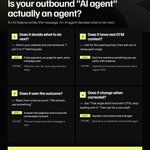
How to tell if an “AI agent” for outbound is actually an agent.
An AI feature writes the message.
An AI agent decides what to do next.
Here are 4 tests you can run in 15 minutes to see which one you’re looking at.
1. Can it decide what to do next, or does it wait for instructions?
Give it your website and one sentence: “I sell X to Y.”
A capable agent should identify potential segments, suggest an angle for each and come back with a campaign plan.
If you have to provide the list, copy and steps yourself, it’s doing very little of the actual work.
2. Does it have real GTM context, or is it just pulling public data?
Ask it to write five opening lines for your target audience.
Check each one. It should mention something you could verify on the prospect’s profile or company, not just a role and an industry.
Then ask why it chose those angles and what evidence supports them.
If the openers read like ones you’ve seen everywhere, or the “why” is vague, there’s no real context behind them.
3. Does it own the outcome, or just the output?
Reply to one of its messages from a test account with: “We already use something.”
A good response understands the objection, answers it in a natural tone and moves the conversation forward, without just pushing a calendar link.
If the work stops once the message is sent, it owns the output and nothing more.
4. Does it change when you correct it?
Tell it one thing that went wrong: “That angle didn’t land with CTOs, stop leading with it.”
Then ask for a new draft or plan.
A capable agent applies the correction and shows you what it changed.
If it ignores the feedback, or you have to re-enter the whole brief, it isn’t learning.
That’s what separates an AI agent from an AI feature.
Run these 4 tests on any outbound tool, including @kuron_ai
And let us know what you find 👀


Your AI GTM employee is finally here!!!
Go try it out!
Meet Kuron.
@kuron_ai can take on the work that goes into running outbound, from figuring out your target audience and researching prospects to building campaigns and handling replies.
You bring the business context. Kuron gets to work.
No more starting every campaign from a blank page or stitching together multiple tools to get things moving.
Give it a task.
See what it can do.
Try Kuron now: kuron.ai/
25 decisions that separate a 15% reply rate from a 47%+ one
(Every decision falls into 1 of 3 gates)
1️⃣ 𝗚𝗮𝘁𝗲 𝟭: 𝗣𝗶𝗰𝗸 𝘁𝗵𝗲 𝗿𝗶𝗴𝗵𝘁 𝗯𝗮𝘁𝘁𝗹𝗲
Figure out WHO has a reason to respond to you
→ List quality (one customer attributed 80% of results to it. Copy? 20%.)
→ Research investment (his team spent 8 hours building a targeted prospect list)
→ Narrow ICP (target a specific technology stack, not everyone with a software job title)
→ Buying context (target people who have a reason to consider your offer now)
→ Hidden demand (one recruiter targeted employed professionals who weren't actively applying for jobs)
→ Data sources (use industry databases to find people with the exact experience or production history you need)
→ Buyer vs. user (know whether you're reaching the person who buys, uses or influences the decision)
→ Budget qualification (don't fill your calendar with people who can't afford your service)
2️⃣ 𝗚𝗮𝘁𝗲 𝟮: EARN 𝘁𝗵𝗲 𝗿𝗲𝗽𝗹𝘆
The goal isn't to squeeze your pitch into someone's inbox.
→ Warm-up touches (one recruiter used likes, profile views and follows before sending a connection request)
→ Cross-channel context (one campaign followed an earlier email with a LinkedIn request referencing that email)
→ Curiosity (make the first interaction relevant enough to earn the next one)
→ The referral angle (one customer asked prospects who else might benefit from a free trial instead of asking them to buy)
→ No-pitch opening (start a conversation before introducing the service)
→ Specific proof (show a result or relevant experience instead of making broad claims)
→ Headline testing (a brilliant message won't help if the opening never gets read)
→ Message length (one customer admitted his early messages were way too long)
→ Follow-up value (every touchpoint should add something, not just ask whether they saw your last message)
3️⃣ 𝗚𝗮𝘁𝗲 𝟯: 𝗧𝘂𝗿𝗻 𝗿𝗲𝗽𝗹𝗶𝗲𝘀 𝗶𝗻𝘁𝗼 𝗼𝗽𝗽𝗼𝗿𝘁𝘂𝗻𝗶𝘁𝗶𝗲𝘀
Getting a reply is not the finish line.
→ Response speed (one customer cited an 80% higher chance of reaching the next sales step when replying within 5 minutes)
→ Context-aware replies (if someone asks a question, don't send a generic automated response)
→ Conversation branching (a referral, objection and positive response need different next steps)
→ Human handoff (know when a conversation needs a person, not another automated message)
→ Low-friction next step (one customer deliberately framed the meeting as a focused 15-minute conversation)
→ Campaign iteration (test different headlines and approaches before scaling)
→ Winning campaign replication (when something works, repeat it before constantly reinventing it)
The takeaway is:
Outbound isn't just about how much of an expert you are at copywriting.
It's a series of decisions about who to contact, why they'd care, how to approach them and what to do when they respond.
@kuron_ai brings those decisions together in one AI GTM team
Prasanthi Basava retweeted
I joined SalesRobot without knowing a damn thing about automation, SaaS, or product management.
I came from a technical background, spent years at TCS, and built a career I was proud of.
Then I left a secure job with no next job lined up. And COVID happened.
Years of customer conversations, failed experiments, product demos, and watching a SaaS business grow taught me things I wouldn't have learned otherwise.
So if I had to build a SaaS business from scratch today, here are my 2 cents.
Full disclosure, I didn't figure everything out alone. People gave me opportunities I wasn't qualified for on paper and trusted me to learn along the way.
Here's what I'd focus on if I were starting again.
1/ stop building features before understanding the problem.
It's easy to brainstorm features and assume customers will love them.
But before building anything, ask:
WHO ACTUALLY NEEDS THIS?
Talk to customers. Understand their problems, current solutions, and what would make them switch.
People saying your idea sounds great doesn't mean they'll pay for it.
Find a problem painful enough that people are willing to spend money solving it.
2/ pick a customer segment and get really good at serving them.
Your product might serve everyone, but trying to satisfy everyone from day one leads to competing priorities and confusing positioning.
Start with a specific audience.
Understand their workflows, problems, and buying decisions. Build something that solves their problem exceptionally well.
You can expand later. First, give one group a compelling reason to choose you.
3/ your first customers are teaching you how to build the business.
I was terrible at sales when I started. I had to learn how to handle objections, build trust, and explain why someone should buy.
Customer conversations taught me things I couldn't learn inside the company.
Why aren't prospects buying? Why do customers choose competitors? Why do people cancel?
Treat sales calls, support tickets, and churn as sources of information.
The better you understand customers, the better your decisions about product, positioning, pricing, and acquisition become.
4/ don't confuse getting customers with finding product-market fit.
SalesRobot reached $10k MRR within three months of launching.
We then pushed for $20k and $30k. We hit $30k MRR four different times.
We could reach the milestone, but sustaining growth was a different challenge.
Churn, competition, positioning, and retention all matter.
Getting customers is one thing. Building a product people keep paying for is another.
5/ a good product needs a good offer.
Building a technically impressive product isn't enough.
Customers need to understand who it's for, what problem it solves, and why they should choose it over alternatives.
"I built an AI-powered sales platform" describes a category, not a reason to buy.
If your offer isn't clear, adding more features probably won't fix the problem.
6/ stop assuming a good product will sell itself.
I used to believe that working hard and building something good would eventually lead to success.
I still believe in good products. But building one and growing a business are different things.
People need to discover your product, understand its value, trust your company, and decide to buy.
That takes sales, marketing, distribution, and positioning.
With AI making software easier to build, giving customers a reason to remember you matters even more.
7/ don't copy competitors just because they're growing faster.
A competitor might have better pricing, sharper positioning, or a distribution channel you've yet to figure out.
Study what they're doing well, but don't assume copying them will get you the same results.
Find underserved customers, ignored problems, and areas where you can do better.
You don't need every customer in your category. You need the right customers to have a strong reason to choose you.
8/ don't scale a channel before understanding why it works.
When a channel starts working, it's tempting to throw more money and resources at it.
But first, understand what's driving results.
Which audience responds? Which message converts? Where does revenue come from?
Attention doesn't automatically translate into customers, and one successful campaign doesn't guarantee repeatable growth.
Document what works, test what doesn't, and scale once you understand the inputs.
9/ stop expecting talent to do all the work.
I've always been competitive. I was used to doing well academically and picking things up quickly.
Then I struggled with sales, learned new business functions, and figured out product management without prior experience.
I realized that understanding something quickly doesn't mean you'll be good at it without practice.
You can know sales theory and still struggle on a call.
Progress comes from doing the work, getting feedback, and improving through repetition.
Talent helps you start. It doesn't replace the work.
10/ build systems that keep working after the initial excitement wears off.
Early on, everything is an experiment. You're figuring out what works across product, sales, marketing, and operations.
But once something works, make it repeatable.
Document successful processes, fix recurring customer problems, and share what your team learns.
Turn individual wins into systems that others can follow.
Otherwise, you'll keep solving the same problems and rebuilding things you've already figured out.
Leaving TCS was one of the most questioned decisions I've made.
My father was upset. My relatives thought I'd given up a secure career for no good reason.
Then COVID happened, and I spent months without a job.
But that period pushed me into business, customer conversations, sales, and eventually product management.
I struggled, made mistakes, and learned things I'd never done before.
Somewhere along the way, I stopped thinking about my career as a list of responsibilities and started thinking about the bigger problems I could solve.
Your job is never just to do the work in front of you. It's to understand what the work is supposed to achieve.
If I were building a SaaS business today, I'd focus on understanding customers, building a product they value, figuring out how to reach them, and learning from every mistake.
And when something works, understand why before moving on to the next thing.
Get 3x bonuses from us: kuron.ai/waitlist

We let people try Kuron without giving them a walkthrough.
Here's what happened.
Now a lot of founders would just launch a product and show people exactly how to use it.
We wanted to do the opposite.
@AshwiniNK21 gave a few people access to Kuron and let them explore it on their own.
And we learned something important.
People loved that Kuron could scan their website and suggest an ICP.
But when one user's ICP returned 0 leads, they immediately felt they needed to broaden their targeting.
That's a problem that needs a lil more attention.
Because users shouldn't have to guess what to do when the first approach doesn't work.
They also surfaced things we hadn't thought enough about:
→ Someone expected email outreach, not LinkedIn.
→ Someone wanted Kuron to detect their existing LinkedIn session.
→ Someone wanted WhatsApp notifications alongside iMessage.
None of these were huge, complicated problems.
But they changed how people experienced the product.
And that's the thing about building with AI.
You can spend months making the technology better and better.
But if the first few minutes leave someone confused, none of that matters.
The product has to work for the person using it, not just the person building it.
Sooo that's what we're working with at @kuron_ai.
And we're just getting started ;)

Early access opening on November 1st
sign up now:- kuron.ai/waitlist
We let people try Kuron without giving them a walkthrough.
Here's what happened.
Now a lot of founders would just launch a product and show people exactly how to use it.
We wanted to do the opposite.
@AshwiniNK21 gave a few people access to Kuron and let them explore it on their own.
And we learned something important.
People loved that Kuron could scan their website and suggest an ICP.
But when one user's ICP returned 0 leads, they immediately felt they needed to broaden their targeting.
That's a problem that needs a lil more attention.
Because users shouldn't have to guess what to do when the first approach doesn't work.
They also surfaced things we hadn't thought enough about:
→ Someone expected email outreach, not LinkedIn.
→ Someone wanted Kuron to detect their existing LinkedIn session.
→ Someone wanted WhatsApp notifications alongside iMessage.
None of these were huge, complicated problems.
But they changed how people experienced the product.
And that's the thing about building with AI.
You can spend months making the technology better and better.
But if the first few minutes leave someone confused, none of that matters.
The product has to work for the person using it, not just the person building it.
Sooo that's what we're working with at @kuron_ai.
And we're just getting started ;)
Prasanthi Basava retweeted

Houston, we have a launch!
@kuron_ai early access goes live in 6 days.
12 months ago, I decided to build Kuron.
The name means “clone” in Japanese, because the idea is to bring some of the world's best GTM experts into one AI agent and put them in your pocket.
We now have 40+ experts, with their real campaigns and playbooks built into Kuron.
There's plenty of AI that can send messages. Getting it to figure out who to reach out to and how to approach them is a different story.
Here's what @kuron_ai does:
→ Describe your ideal customer in plain English
→ Kuron builds the list
→ Writes your sequences using expert playbooks
→ Runs outreach on LinkedIn and email
→ Handles replies, works through objections and books meetings
Early access members get:
1. First access to Kuron on November 1
2. Their pick of playbooks from 40+ GTM experts
3. Exclusive bonuses from the Kuron team
We've been working on this for a long time, and I can't wait to see what people do with it.
Get early access here: kuron.ai/
99% of founders are making this mistake right now...
They're spending thousands on outbound, but still have to manage the people and tools responsible for making it work.
@kuron_ai is an AI GTM team that takes the entire outbound function off your plate.
→ Give Kuron your ICP and business context.
→ It identifies the right segments to target and finds prospects worth reaching out to.
→ It draws on the campaign knowledge and playbooks of 40+ GTM experts to decide how to approach those prospects, what messaging to use, and which sequences make sense.
→ It launches and runs outreach across email and LinkedIn.
→ It handles replies and objections, moving promising conversations toward meetings.
The difference is what's behind those decisions.
@kuron_ai is built around real GTM expertise, including campaign data, actual sequences, and the patterns experienced operators have learned from running outbound.
That gives it a stronger starting point than generic AI working from prompts and public sales advice.
You're not just getting another tool to write emails or automate sends. You're getting an AI team designed to figure out how to run outbound and execute it.
Kuron is opening early access soon 👀
Sign up to get 3x bonuses now (CLOSING SOON): kuron.ai/waitlist
i said it
Old-school outbound is BROKEN.
• Hire SDRs
• Buy prospecting, enrichment, and sequencing tools
• Spend hours figuring out who to target and what to say
• Still end up managing the entire operation yourself
The NEW-school outbound playbook is an AI GTM team that handles the whole process.
Here's how to run it with @kuron_ai :
[1️⃣] ICP + GTM Strategy
• Tell Kuron what you sell and who you're trying to reach
• Let it identify promising segments and decide where to focus
[2️⃣] Prospect Sourcing
• Find companies that fit your ICP
• Research accounts to understand their business and why they might be a good fit
[3️⃣] GTM Research
• Use buying signals and account context to find relevant reasons to reach out
• Draw on the playbooks of 40+ GTM experts, built from actual campaign data and experience
[4️⃣] Campaign Strategy
• Decide which angle and offer to lead with
• Build messaging and sequences around the audience you're targeting
[5️⃣] Outbound Execution
• Launch campaigns across LinkedIn and email
• Run follow-ups without manually managing every step
[6️⃣] Reply Handling
• Respond to prospects
• Handle objections and keep promising conversations moving
[7️⃣] Meetings Booked
Turn the entire process into qualified sales conversations without having to operate a dozen tools or manage an entire outbound team.
We're opening early access soon.
Sign up now! kuron.ai/
if you're a founder selling an AI product and customers keep cancelling in the first 90 days, stop shipping new features.
let's say you sign 100 new customers every month at $100/month.
that's $10k in new MRR, but by day 90 only 55 of them are still paying.
now to fix that, you immediately start thinking about:
→ building more features
→ adding more integrations
→ launching a v2
→ discounting renewals
→ buying more leads to replace the ones who left
but there's another way to get there.
1/ compare what your demo promised with what week one delivers
a demo runs on clean data and a prepared scenario.
a customer's first week runs on their messy data, their unclear goals and a team that hasn't learned the product yet.
list every promise made in your demo and check whether a new customer can actually see it happen within 7 days.
the gap between those two lists is where most cancellations start, long before anyone clicks cancel.
2/ calculate what better day-90 retention is worth
let's say 55 of your 100 customers stay past day 90, which keeps $5500 of the $10k in new MRR.
if you improve that to 75 customers, you keep $7,500.
that's $2,000 more MRR from the same cohort, or $24k in annualized recurring revenue before accounting for later churn.
and to get those 20 extra customers through acquisition, you'd need about 36 more signups at 55% retention.
at $400 per customer, that's roughly $14.5k in extra spend every month.
but the important part is figuring out whether the improvement is realistic, and that depends on what's actually causing the cancellations.
3/ find the action that separates customers who stay from customers who leave
don't assume which action matters.
look at your historical cohorts and compare people who completed the first meaningful job in your product with people who didn't.
for an AI product, that might be the first task it completes without anyone having to correct it.
do customers who reach that point in the first 7 days retain significantly better? does the pattern hold across customer segments? and can you help more people get there without changing who you sign?
once you find it, work backwards and remove everything standing between a new customer and that moment.
4/ read your support tickets as a map of where onboarding breaks
pull every ticket from the first 30 days and tag each one by cause:
→ setup confusion
→ wrong expectation from the demo
→ data problem
→ bug
→ missing product capability
only the last two need engineering.
the rest can be fixed with better onboarding, clearer docs and a smarter first-week flow.
[add one story from your own demo or support work here: a customer who was close to leaving, what they were actually stuck on, and the one change that kept them]
5/ decide where a human steps in and where automation handles it
AI products usually need someone to help calibrate the first outputs, because customers don't know yet what good looks like.
that doesn't mean every account needs a call.
segment by deal size and complexity, then offer a short check-in on day 3 or day 7 to accounts that haven't hit the activation event.
a 20-minute call costs a small fraction of the $400 it took to acquire that customer.
6/ make sales, support and product use the same definition of "activated"
when sales promises one outcome, support explains another and product measures a third, the customer feels the gap in their first week.
agree on one definition of a successful first week and train every team on it.
then review it monthly against actual retention instead of treating it as a one-time exercise.
7/ figure out whether the problem is onboarding or the product
not every cancellation is an onboarding problem.
if customers who activate still leave, or the product can't do what the demo showed, then features and positioning do need work.
but before building anything new, ask:
→ what did the demo promise that week one doesn't show?
→ which first action predicts who stays?
→ what are the top three causes in our first-30-day tickets?
→ which accounts need a person, and which don't?
→ do activated customers still churn?
→ what does keeping a customer cost compared with replacing one?
then invest where an improvement creates the greatest return.
it could be onboarding, expectation-setting, support, or the product itself.
your goal is not to ship the longest feature list, it's to get more customers to the moment where the product proves itself, and keep them there.
INTRODUCING- Your AI GTM team!!
Imagine having 40+ GTM experts working on your outbound.
Except you don't have to hire them, pay their retainers, or spend months figuring out whose advice actually works for your business.
@kuron_ai brings the playbooks and campaign knowledge of 40+ GTM experts into one AI outbound agent.
We're making expert-level outbound accessible to teams that don't have the budget for an entire GTM department.
It's is launching soon!!!
Sign up early to get 3x bonuses. 👀
Just leaked our entire $1mln ARR playbook
“If you had <1 year to get a B2B SaaS to $1M ARR, what would you do?”
Do the math backwards, then sell to a small group of buyers yourself.
Here’s the playbook I’d run:
1. Start with the math: $1M ARR is 100 customers at $10K or 20 customers at $50K, so decide which one you can realistically reach
2. Pick ONE painful problem businesses already pay to solve
3. Choose a buyer so specific you could list the first 100 target companies by hand
4. Talk to 30+ potential buyers before building and write down the exact words they use for the problem
5. Charge from day one, because free users tell you nothing about willingness to pay
6. Build the smallest version that gets ONE buyer to the result
7. Sell the first 10 customers yourself and take notes after every call
8. Onboard each of them personally and track exactly where they get stuck
9. Turn the first results into 3 case studies before you run any volume
10. Pick ONE channel where your buyers already spend time and post there daily about the problem, not the product
11. Ask every customer for warm intros before you message strangers
12. Add outbound only after you know which message gets replies
13. Track where every customer came from, starting with the first one
14. Review every churned or stalled deal weekly and label the cause as wrong buyer, wrong message or wrong product
15. Raise your price as soon as ten buyers in a row say yes without pushing back
16. Write down your sales process before you hire anyone to run it
16. Put more effort behind whichever channel is actually bringing in customers
17. Repeat the loop until the numbers tell you where the next $$$ should go
Prasanthi Basava retweeted

Introducing your new AI GTM employee - @kuron_ai 🚀
Trained on real campaign data and playbooks from 40+ GTM experts.
Tell Kuron what you're selling, and it'll:
→ Figure out who you should target
→ Build your ideal prospect list
→ Write personalized outreach sequences
→ Launch campaigns on LinkedIn
→ Manage replies and follow-ups
→ Help turn conversations into booked meetings
Built for 6 VERY SPECIFIC jobs.
Just tell Kuron what you're selling and let it do the heavy lifting.