

Independent publication covering crypto, technology and the minds shaping them. Telegram newsfeed: https://teapawt.net/t.co/tney0jOJVb 📧 Partnerships: [email protected]
New York, NY
Joined April 2019
- Tweets81.6K
- Following29
- Followers336K
- Likes1.6K






Blockworks is changing direction.
At least seven employees have announced departures from @Blockworks across the past few weeks, including researchers Jake Koch-Gallup, Nick Carpinito and Kunal Doshi, alongside Silvio Busonero, Westie, Nikhil and AJC.
There is no indication this was some coordinated walkout. The timing is still hard to ignore.
@immutablejacob, who spent two years at Messari before joining Blockworks through its acquisition, put the tension into words: he was disappointed to see “one of the leading crypto research firms” shifting its focus away from core research. His argument is particularly relevant in 2026. As AI gets very good at processing existing information, original analysis becomes one of the few things that cannot simply be commoditized into another interface.
And Blockworks is very clearly building interfaces.
🤖On Nov. 3, the company opened its MCP service to everyone, offering new users $100 in credits and letting ChatGPT, Claude, Cursor and other agents query Blockworks datasets directly. Protocol revenue, stablecoin growth, token unlocks, issuer information and market data can increasingly be pulled into an AI workflow without manually reading a stack of reports.
Three days later, @blockworksres published the final edition of 0xResearch: “Signing off.”
The contrast says quite a lot about where @JasonYanowitz and the company are placing resources after acquiring Messari in June.
Blockworks already had the raw material for this transition. Messari brought coverage of more than 40,000 assets, while Blockworks had spent years building proprietary research, standardized datasets and institutional intelligence. That research can now become infrastructure: structured information consumed directly by exchanges, funds, custodians and AI agents.
Some of the departing employees appear comfortable with that direction. Westie, one of the original research team members, had already moved deeper into product and described building those products as the company’s priority going forward. Others clearly place more value on maintaining an independent research institution.
So the interesting question around Blockworks is no longer whether crypto research has value.
It is whether the research report itself is still the product, or whether the valuable part is the proprietary data underneath it that thousands of machines can query instantly.
7+ departures
Messari acquired in June
40,000+ assets in the combined data universe
MCP opened publicly on Nov. 3
0xResearch signed off on Nov. 6
That is a fairly dramatic amount of change for one crypto media and research company in five months.

🟧A lot of the infrastructure problems from 2021 got better. Fees came down in many places, L2s became normal, wallets improved and onchain apps became much easier to use.
But cheap transactions alone never solved onboarding.
People still need a reason to care before they are asked to bridge funds, buy an asset or learn a new financial stack. The strongest consumer crypto products tend to give users something worth doing first and let the ownership layer become relevant after that.


A good throwback from 2021, when crypto gaming was still trying to figure out what participation was supposed to look like beyond buying assets early and hoping they went up.
Zoran Basich was writing about a pretty obvious tension that became more visible as Ethereum got expensive: the network was attracting more users at the same time that actually doing anything on it was becoming less accessible. Higher gas, more sophisticated bots, expensive NFTs, insiders moving faster than everyone else. The stronger the ecosystem became, the easier it was for a new user to feel like they had arrived too late: presence.news/articles/2021-…


The interesting shift here is moving from biomimicry to biological archaeology.
Instead of trying to copy what nature does today, biotech can start reconstructing solutions evolution tested under environments that no longer exist.
That makes extinction less like lost information and more like an unexplored design space.🔬
Four billion years of evolution produced far more biological experiments than the living world still contains.
Kaçar’s idea is to treat that history like a bioinformatic repository.
Ancient molecular systems could point toward better carbon capture, new enzymes, synthetic life and other tools for problems we have not solved yet.
CRISPR is already a reminder that some of the most powerful technologies can come from biology far removed from us.
Most of the life that ever existed is gone.
Betül Kaçar’s argument is that this doesn’t make extinct biology irrelevant. It makes it a lost archive of solutions that once worked under conditions very different from today.
Paleobiology is not only the study of what disappeared.
It is the study of what was once fit enough to survive: presence.news/articles/2021-…

hyperliquid:native is now Multicoin’s biggest hedge fund position
Spencer Applebaum (@SpencerApplebau), general partner at @Multicoin, says HYPE is currently the fund’s largest holding. Multicoin has not disclosed the position size or portfolio weight, but Applebaum confirmed the exposure was acquired in public markets and fits the firm’s usual approach of holding liquid crypto assets for years rather than trading around short-term moves.
The position has been building for a while. Applebaum, @shayonsengupta and @tushar_jain disclosed in June that Multicoin had accumulated a large HYPE stake earlier in 2026 and continued adding to it. Their thesis was much broader than another perp DEX trade: Hyperliquid could develop into an exchange layer spanning crypto, equities, commodities and eventually other financial markets.
That is also much closer to how @chameleon_jeff has been describing Hyperliquid lately, as infrastructure built to house more of finance rather than simply win crypto derivatives volume.
The numbers Multicoin used were already substantial. Its research estimated $873 million in Hyperliquid revenue on $2.9 trillion of trading volume in 2025, alongside user growth from roughly 301,000 to 923,000 and open interest reaching $6 billion.
Their 2028 HYPE model:
🔸Bear case: $109
🔸Base case: $319
🔸Bull case: $689
The $319 case came from a much more aggressive set of assumptions underneath it: roughly $8 billion in annual earnings, valued at 20x, against an adjusted supply of 502 million HYPE. That is the model Multicoin published in June, not $8 billion of current earnings and not a newly issued October target.
There is also a noisy onchain subplot. Wallet trackers have attributed 4.23 million HYPE, worth roughly $285 million at the time of transfer, in cumulative Coinbase Prime deposits since late July to Multicoin-linked wallets. Prime is both a custody and execution venue, so those transfers alone do not show how much was sold, moved into custody or remains inside the hedge fund.
Meanwhile, crypto venture capital is moving in several directions at once. Paradigm has widened its mandate into areas including AI and robotics, while Framework and Haun have also been looking beyond narrowly defined crypto infrastructure.
Multicoin is deliberately staying closer to its lane. Applebaum has pushed back on the idea that funds need to manufacture an AI angle around every blockchain thesis, while @tushar_jain has continued making the case publicly for concentrated exposure to high-conviction liquid assets.
The missing number is still the best one: Multicoin will say HYPE is No. 1 in the hedge fund, but it still won’t say what percentage of the fund that actually means.

🟧 AI has made the internet cheaper to fill and harder to search.
Creating and repackaging information now costs almost nothing. The supply keeps expanding, but the amount of genuinely useful material does not grow at the same rate.
That puts more value on curation.
Products that can consistently surface high-signal information, add useful context and build trust around what they exclude may have a much stronger edge than products simply trying to index everything.
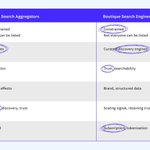
Google is great when there’s one correct answer.
It gets much weaker when the question requires taste, context or judgment.
Sari Azout made this point back in 2022: the internet no longer has an information shortage.
It has a signal problem.🔎

2,291
This also changes what the moat looks like.
Horizontal search wins through scale.
Boutique search can win through trust.
The experience should feel less like opening the Yellow Pages and more like texting someone whose recommendations you consistently trust.
That’s much harder to manufacture with an ad auction.

1
566
The hard part is preserving that trust while scaling.
Too much crowdsourcing and the curated database becomes another directory.
Too much manual selection and growth stalls.
Too many ads and incentives break.
The next search winners may not index more of the internet.
They may simply have a stronger opinion about what deserves to be indexed at all: presence.news/articles/2022-…

528