

Upgrading the internet using prism
Germany
Joined March 2025
- Tweets17
- Following6
- Followers19
- Likes5


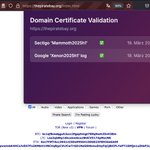


This project was a finalist of the recent global Mammothan, organized by @celestia and @encodeclub.
Without their help and the amazing support of the chads @prism_xyz, @spusch810, and @distractedm1nd none of this would be possible!
3
69
14/14
PrivaCT represents the future of web security: trust-minimized, user-centric, and transparent.
Don't just hope your connections are secure. KNOW they are.
Follow us on the path to production!
1
1
62
13/14
The implications are massive:
- Decreased reliance on central authorities
- Faster detection of compromised certificates
- More transparent web infrastructure
- Empowered users with real security tools
1
1
19
12/14
Think about it: Currently, you're trusting dozens of Certificate Authorities you've never heard of to secure your banking, healthcare, and private communications.
PrivaCT puts verification in YOUR hands instead of theirs.
1
1
16
11/14
Why does this matter?
Because it bridges the gap between Certificate Transparency and actual user trust.
For the first time, YOU can verify certificate inclusion without trusting CAs or log operators. Trust minimized, not trust required.
1
1
16
10/14
Finally, PrivaCT updates its browser icon to tell you the status:
🟢GREEN = Certificate is valid and properly logged
🔴 RED = Certificate fails check or is missing
Simple, visual security you can understand at a glance.

1
1
22
9/14
The extension then verifies the proof using an inclusion proof directly within your browser.
It validates BOTH the Merkle proof from the CA AND the proof from Prism. Double verification means double security.

1
1
18
8/14
Next, PrivaCT fetches the latest root hash from Prism to ensure it's working with the most current view of the transparency log.
This is crucial because it prevents time-based attacks that could exploit outdated data.

1
1
20
7/14 The extension then queries the Prism Full Node to retrieve a Merkle Proof for the certificate.
"What's a Merkle Proof?" It's cryptographic evidence that proves the certificate exists in the transparency log without trusting intermediaries.

1
1
21
6/14
Here's how PrivaCT's browser extension works:
When you visit a website, it triggers a background check that extracts the site's TLS certificate using Firefox's API.

1
1
30
5/14 PrivaCT is built on three powerful components:
Prism Network @prism_xyz : A distributed, transparent store for certificates
CT Service: Fetches certificates from logs and submits to Prism
Browser Extension: Verifies everything directly when you visit a site.
1
1
24
4/14
Enter PrivaCT: a browser extension that leverages Prism to deliver trust-minimized Certificate Transparency directly to YOU.
No more blind trust. No more empty promises. Real verification in your hands.

1
1
34
3/14
Your browser only verifies that a PROMISE of inclusion exists from the CA. The inclusion itself is NEVER enforced!
How do you know if that certificate is actually logged? You don't. 🤯
(credits to the OG post @distractedm1nd) teapawt.net/distractedm1nd/status/…

All of us recognize the little🔒 you get when visiting a website, telling you your connection is secure.
It's there to guarantee that the conversation between your device and the website is 🎀 end-to-end encrypted 🎀.
Except you're not as safe as you think.

1
1
45

