
Multibillionaire space pirate. CIO of Vader Capital LP. Activist engagements include Jeddha and Alderaan.
Des Moines, Iowa
Joined June 2019
- Tweets87.5K
- Following1.1K
- Followers72.8K
- Likes175K


Pythia Cap: Partially Conductive retweeted

*MICROSOFT TO OFFER BUYOUTS TO 60,000 WORKERS IN LATEST COST CUT
This is 27% of $MSFT's entire workforce


Pythia Cap: Partially Conductive retweeted

Someone made a site that tracks what people are talking about at public city council meetings across the US.
The only thing discussed more than data centers?
Pickleball courts.

Pythia Cap: Partially Conductive retweeted

This is what we have outlined in our AI economics model and enterprise software model. Pre-expansion IT services and IT software annually is currently ~$3 trillion dollars.
Each CIO/CTO survey we do, we see increases in net new budget also going to dedicated AI spend.

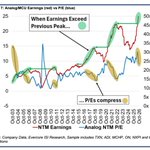
Chip P/E's compress when earnings exceed previous peaks (from Evercore). Lots of signs we are late cycle $SOXX


Hi Sharks, I'm looking to raise $100b at a $1.5 trillion valuation to bring about the end of humanity. Kevin, I know you're gonna be super interested in this one...

"Q3: 79% of revenue came from outside the top 5, up from 64% in Q1 Claude Enterprise users who also use Claude Code spend ~20x more than those who don’t"

1/Anthropic’s S-1 is out.
2/ Revenue, quarter by quarter ($M)
Q1'25: 376
Q2'25: 787
Q3'25: 1,382
Q4'25: 2,040
Q1'26: 4,731
Q2'26: 11,555
Q2'26 revenue was up 1,368% YoY. Compute & infra costs were up 300% over the same period.
Q2'26 was the first quarter with positive GAAP operating income: $974M.
3/ How “Run-Rate Revenue” is defined
Trailing-28-day consumption fees × 13
+ monthly subscription fees × 12
Three caveats from the S-1:
-It includes customers later found to be violating the usage policy
-It is seasonal: usage dips in summer and winter holidays
4/ Revenue is recognized gross
When Claude is sold through the AWS, GCP or Azure marketplaces, Anthropic is the principal. It books the full amount as revenue, and the cloud provider’s fee goes into Sales, marketing & partnerships.
The marketplace share of revenue has climbed fast:
11% (2023) → 32% (2024) → 47% (2025) → 48% (H1'26)
Adjust for this before comparing multiples with companies that report net.
5/ Distillation
The S-1 puts a number on it:
“we estimate that revenue from such customers represented approximately 5% to 7% of our revenue for the nine months ended September 30, 2026”
These are customers violating the usage policy or commercial terms. Applied to ~$33B of 9M revenue, that’s roughly $1.7–2.3B.
Enforcement was stepped up in Aug–Sep, and the company expects the share to decline. The S-1 says the estimate “requires judgment and may change.”
6/ Visibility is low
RPO at 6/30/26: $10.8B
~75% of that is recognized in the next 12 months, so cRPO ≈ $8.1B
Deferred revenue: $1.65B
Q2 annualized revenue is ~$46B, so cRPO covers less than 20% of it.
80% of revenue is consumption-based, and next year’s revenue depends almost entirely on usage.
7/ The compute bill
Disclosed commitments:
Broadcom TPU leases: ~$161B
SpaceXAI (NVIDIA GPUs): up to $121B, ~$3.1B a month from Dec’26
Google: ≥$115B, plus $125–150B more of TPU capacity in 2028–31
Amazon: ≥$110B
Microsoft: ≥$45B
Nscale: ~$45B
Lambda: ~$41B
AMD: >$20B
That adds up to roughly $780–810B.
8/ The mismatch to watch
Revenue is variable and consumption-driven. Compute costs are fixed, multi-year and take-or-pay.
On top of that, the Broadcom leases, the credit agreement and the convertible notes include cross-default provisions.
This is the single most important risk in the filing.
9/ Demand is real
NRR ~900% (ex-Pro/Max)
Customers paying more than $100K / $1M / $10M a year: 11,900+ / 1,900+ / ~250
No single customer was >10% of 9M’26 revenue
Top 5 customers ≈ 25% of 9M revenue
Q3: 79% of revenue came from outside the top 5, up from 64% in Q1
Claude Enterprise users who also use Claude Code spend ~20x more than those who don’t
10/ Dilution
$77B of convertible capacity: Google $20B, Amazon $15B, Broadcom $42B, settled in shares at a trailing VWAP
Google can buy up to $10B more stock at the IPO price
A Public Benefit Fund already holds 5% of fully diluted shares, and can get up to +2% more for every 50% rise in the share price
Pythia Cap: Partially Conductive retweeted

Seasonality impacting consumption trends... Love seeing this because it confirms our thinking regarding the timing decisions for increasing usage limits and also partly reason for the "slowdown" we saw during the summer months... $ANT
"Our customer usage patterns have also typically exhibited seasonality, particularly around holiday and vacation periods in the summer and winter, when certain workflows slow down and overall customer activity declines.
For example, developer commits and feature launches are typically slower during the code freezes that many companies schedule over holidays. Consistent with this pattern, for the two weeks ended January 2, 2026, total customer spend declined by approximately 20% compared to the prior two weeks ended December 19, 2025.
However, our historical growth rates may mask the impact of seasonal trends on our results. These dynamics are inherent aspects of a pay-for-intelligence revenue model and may be important determinants of our financial results in future periods."
Pythia Cap: Partially Conductive retweeted

25/ Reinvent, don't entrench
From the founders' letter in the S-1:
"We will be constantly seeking to reinvent our business, releasing new classes of products whose aim is to dwarf the economic value of our existing ones."
"Relative to a typical business, we will generally devote less effort to entrenching our current products and business models, and more effort to defining new ones, because that is where the technology's greatest possibilities lie."
26/ The viability timeline
"AI chatbots became viable around 2022, and AI coding agents around 2025; AI agents for general knowledge work and scientific discovery are gradually becoming viable in 2026."
The S-1 describes Claude Cowork as extending Claude Code's agentic architecture to knowledge workers broadly.
It also says model versions released in the six months to 9/30 accounted for over 80% of Q3 revenue.
27/ How big they think the market is
Knowledge work: >$40T of economic value globally in 2025 (company estimate, built from ILO / BLS wage data)
Knowledge workers: >1B by 2028 (IDC)
AI's cumulative economic impact: $22.5T by 2031 (IDC); Anthropic believes it could be even greater
Pharma spend alone: >$2T in 2026
28/ A country of geniuses in a data center
Anthropic believes "Powerful AI" will become widely available within a few years. Its definition:
- Matches or exceeds top human experts across most professional and scientific disciplines
- Uses any interface a human can, including direct computer control
- Works autonomously for hours, days or weeks
- Coordinates across many instances, with humans and with other AI systems
- Controls lab equipment, robots and other machines
The founders describe millions of virtual agents able to transform software, physics, math, biology, medicine, finance and more.
29/ Why the compute bets look so large
The founders say Anthropic will often make forward investments, especially in compute, that may look irresponsibly large at first glance. The reasoning: based on the scaling laws, AI's economic value is on an exponential curve, so near-future value will be much larger than current value.
Their analogy is pharma: very large upfront R&D that only makes sense in light of later returns. At Anthropic the same process runs much faster and at much larger scale.
The hedge: give up some upside for downside protection, e.g. offloading excess compute if demand is overestimated, improving efficiency, or raising capital to ride out temporary slowdowns.
30/ The growth caveats sit right next to the vision
The company expects AI capabilities to keep advancing for many years, with demand concentrated at the frontier.
It also expects the revenue growth rate to decline, possibly significantly and faster than anticipated, and seasonality to become more visible as growth slows.
31/ Revenue they choose not to take
- No ads in Claude, even though the founders acknowledge ads would likely be a large source of revenue
- Claude Mythos Preview was not made generally available over cybersecurity risk, and its capabilities were released later as Claude Fable 5. The delay meant forgoing substantial revenue, and they gave away ~$100M in Claude credits to cyber defenders
- There may be times they choose to advance more slowly than they could, to make systems safer, even at a competitive disadvantage
32/ The historical analog they chose
2000-2025: global GDP ~$34T -> $118T+ (more than tripling)
Top 10 public tech companies' revenue: $68B -> $2.5T+ (~38x, ~11x the rate of global GDP growth)
IT spend: ~$1.2T (2006) -> $4.3T (2025), as cloud went from 0 to $1.9T
The founders believe the impact of an exponential in machine cognition will be vastly greater than the exponential in computer chips (Moore's law).
33/ On investor expectations
Before the IPO, the founders spoke with many leaders who had been through one. The advice they heard from several of them: "never let your company be worth a dollar more than it is actually worth"
Their own principle: underpromise and overdeliver.
They compare it to how they recruit: an "anti-sell" pitch, designed to put off candidates who aren't a good fit.
17/ Gross margin is in the footnotes
The P&L no longer shows gross profit. Since 2025, expenses are grouped by nature instead of by function.
But Note 8 still gives a functional breakdown, including cost of revenue ("substantially all... compute and infrastructure costs associated with customer-serving workloads").
Implied GPM:
2024: -95%
2025: 40%
H1'25: 12%
H1'26: 85%
SBC inside cost of revenue isn't broken out, so non-GAAP GPM is likely slightly higher.
Two caveats: CSP fees (48% of revenue sold via marketplaces) sit in S&M, and free-tier inference sits in S&M too. Both flatter the 85%.
R&D (training + research compute) was 60% of H1'26 revenue.
18/ Q2'26 cost structure ex-SBC (% of revenue)
Compute & infra: 48% (serving + training + research + internal use)
Personnel ex-SBC: ~5%
S&M & partnerships: 18% (includes CSP fees)
Other: ~9%
SBC: $1.26B, ~11% of revenue, excluded from everything above.
19/ Non-GAAP operating margin
2023: -1,273%
2024: -722%
2025: -106%
H1'25: -159%
H1'26: +10% ($1.6B)
Quarterly (my est., adding back SBC): Q1'26 ~-14% -> Q2'26 ~+20%
(GAAP: H1'26 -4%; Q2'26 +8.4%)
20/ Non-GAAP net margin
2023: -1,115%
2024: -695%
2025: -97%
H1'25: -150%
H1'26: +16% ($2.7B)
Adjusted net income excludes SBC ($2.2B in H1'26), the change in fair value of convertible notes, derivatives & SAFEs ($72.4B), other mark-to-market items ($8.7B), non-cash charitable contributions and the Bartz settlement.
The $80.7B GAAP net loss is almost entirely financing-instrument noise.
21/ FCF turned positive
Operating cash flow: 2025 -$2.6B -> H1'26 +$3.9B
Capex: H1'26 $0.5B
Simple FCF (OCF - capex): H1'26 ~+$3.4B, ~21% of revenue (2025: ~-$2.8B)
The S-1 credits part of this to working capital, "timing of payments to vendors and cash receipts from customers."
SBC is non-cash, so a ~21% FCF margin vs. a ~10% non-GAAP OPM is mostly working capital timing.
22/ But watch what FCF leaves out
The Broadcom TPU deal (~$161B) is structured as finance leases. Lease principal sits in financing cash flow, not in OCF or capex. Payments so far: $4M.
Once that capacity comes online in 2026-27, OCF - capex will look better than the real cash cost of compute.
Cash on hand at 6/30: $112B + $19B short-term investments.
23/ Lock-ups are drip-fed, not a single cliff
Ticker: ANT (Nasdaq).
Some shares held by non-founder directors, officers and employees unlock on the first trading day. More unlock on days 27, 48, 62 and 76.
Then roughly every two weeks after FY26 earnings, then on Q1'27 earnings or day 180.
The 365-day group, which includes all 7 co-founders, unlocks in tranches through Q3'27 earnings.
Share counts and % for each tranche are still blank.
24/ Founders' 80% pledge
Each co-founder has pledged 80% of their personal equity to philanthropy. The S-1 says the pledge is "voluntary, revocable" and not legally binding.
Donated shares sold later could add to supply once lock-ups expire.
Pythia Cap: Partially Conductive retweeted
11/ Q3 revenue is blank in the S-1, but you can back it out
“Revenue for the three months ended September 30, 2026 was 86 times our revenue for the three months ended December 31, 2024”
Q4'24 revenue = $197M, so Q3'26 ≈ $16.9B.
That lines up with the $16.8B shared at the investor day.
12/ New models drive almost all revenue
Model versions released in the six months to 9/30 made up over 80% of Q3 revenue.
Old models fall out of use fast. Both the release cadence and the risk of a model being restricted now directly affect revenue.
13/ Christmas matters for the exit ARR
Customer spend in the two weeks ended Jan 2, 2026 was ~20% below the two weeks before.
A run-rate measured over the last 7 days of the year will be heavily affected by the holidays, so be careful with the Dec’26 “exit ARR”.
14/ The October run-rate is left blank on purpose
“Our Run-Rate Revenue was $ as of October 31, 2026”
Q3 revenue, liquidity and total compute commitments are also blank.
Expect them in the S-1/A, together with the price range.
15/ Anthropic runs on Claude
Over 90% of code written by Claude (Sep’26)
Code per engineer is 45x 2024 levels
The value of internal Claude usage grew 250x+ from Jan to Sep, and since April it has exceeded monthly personnel cost (ex-SBC)
TTM revenue per employee went from $1.4M to $6.6M+
16/ Margins will compress before they expand
Compute is bought 12–18 months ahead, and costs hit the P&L before the revenue that capacity will generate. The company expects margins may compress when big new capacity comes online.
SpaceXAI alone is ~$3.1B a month from Dec’26.
1/Anthropic’s S-1 is out.
2/ Revenue, quarter by quarter ($M)
Q1'25: 376
Q2'25: 787
Q3'25: 1,382
Q4'25: 2,040
Q1'26: 4,731
Q2'26: 11,555
Q2'26 revenue was up 1,368% YoY. Compute & infra costs were up 300% over the same period.
Q2'26 was the first quarter with positive GAAP operating income: $974M.
3/ How “Run-Rate Revenue” is defined
Trailing-28-day consumption fees × 13
+ monthly subscription fees × 12
Three caveats from the S-1:
-It includes customers later found to be violating the usage policy
-It is seasonal: usage dips in summer and winter holidays
4/ Revenue is recognized gross
When Claude is sold through the AWS, GCP or Azure marketplaces, Anthropic is the principal. It books the full amount as revenue, and the cloud provider’s fee goes into Sales, marketing & partnerships.
The marketplace share of revenue has climbed fast:
11% (2023) → 32% (2024) → 47% (2025) → 48% (H1'26)
Adjust for this before comparing multiples with companies that report net.
5/ Distillation
The S-1 puts a number on it:
“we estimate that revenue from such customers represented approximately 5% to 7% of our revenue for the nine months ended September 30, 2026”
These are customers violating the usage policy or commercial terms. Applied to ~$33B of 9M revenue, that’s roughly $1.7–2.3B.
Enforcement was stepped up in Aug–Sep, and the company expects the share to decline. The S-1 says the estimate “requires judgment and may change.”
6/ Visibility is low
RPO at 6/30/26: $10.8B
~75% of that is recognized in the next 12 months, so cRPO ≈ $8.1B
Deferred revenue: $1.65B
Q2 annualized revenue is ~$46B, so cRPO covers less than 20% of it.
80% of revenue is consumption-based, and next year’s revenue depends almost entirely on usage.
7/ The compute bill
Disclosed commitments:
Broadcom TPU leases: ~$161B
SpaceXAI (NVIDIA GPUs): up to $121B, ~$3.1B a month from Dec’26
Google: ≥$115B, plus $125–150B more of TPU capacity in 2028–31
Amazon: ≥$110B
Microsoft: ≥$45B
Nscale: ~$45B
Lambda: ~$41B
AMD: >$20B
That adds up to roughly $780–810B.
8/ The mismatch to watch
Revenue is variable and consumption-driven. Compute costs are fixed, multi-year and take-or-pay.
On top of that, the Broadcom leases, the credit agreement and the convertible notes include cross-default provisions.
This is the single most important risk in the filing.
9/ Demand is real
NRR ~900% (ex-Pro/Max)
Customers paying more than $100K / $1M / $10M a year: 11,900+ / 1,900+ / ~250
No single customer was >10% of 9M’26 revenue
Top 5 customers ≈ 25% of 9M revenue
Q3: 79% of revenue came from outside the top 5, up from 64% in Q1
Claude Enterprise users who also use Claude Code spend ~20x more than those who don’t
10/ Dilution
$77B of convertible capacity: Google $20B, Amazon $15B, Broadcom $42B, settled in shares at a trailing VWAP
Google can buy up to $10B more stock at the IPO price
A Public Benefit Fund already holds 5% of fully diluted shares, and can get up to +2% more for every 50% rise in the share price
$ANT So, both convertible notes & other expense totalling ~$67b look to be fair value related, so the company is profitable today on both operating and an adjusted net income basis.
CFO - SBC - capex is positive, $130b in cash/ST investments.


Ant giving us the "anti sell" sec.gov/Archives/edgar/data/…


Pythia Cap: Partially Conductive retweeted

ANTHROPIC JUST PUBLISHED ITS S-1 FOR A U.S. IPO
Here's everything you need to know:
The Listing:
• Nasdaq Global Select Market, ticker $ANT
• Leads: Goldman Sachs, Morgan Stanley, J.P. Morgan
• Price range and share count: not disclosed yet
The Growth:
• H1'26 revenue: $16.3B vs. $1.16B in H1'25
• 2025 revenue: $4.59B vs. $386M in 2024
• $100K+ customers: 11,900+ vs. 950+ a year ago
• $1M+ customers: 1,900+
• $10M+ customers: ~250
• Consumption-based: $13.1B, 80% of H1 revenue
• Subscriptions: $3.2B, 20% of H1 revenue
The Losses:
• H1'26 operating loss: $693M vs. $2.14B
• H1'26 net loss: $80.7B
• $72.4B fair-value charge on convertible notes
• That charge tracks its rising valuation
• 2025 included a $1.5B Bartz copyright settlement
The Compute Bill:
• H1'26 compute & infrastructure: $8.9B
• Google: at least $114.5B through July 2033
• Amazon: at least $110.0B through April 2036
• Microsoft: at least $44.9B through May 2033
• ~$265.6B in total minimum commitments
• Owed regardless of actual usage
The Cash:
• $131.7B in cash & short-term investments
• Up to $77B more in note facilities:
- Google: $20B
- Amazon: $15B
- Broadcom: $42B
Who Controls It:
• Public benefit corporation
• Class F (Founder LLC): 50.1% of the vote
• Members: Dario & Daniela Amodei + 5 co-founders
• Long-Term Benefit Trust picks board majority
• Class A: 1 vote per share
• Class N (strategic partners): no vote
• Ownership caps: Amazon 12%, Google 14.99%
• 5% of shares to Anthropic Public Benefit Fund
The Risks They Flagged:
• Warns advanced AI could pose
"catastrophic or existential risks to humanity"
• Training-data copyright suits could hurt it
The Team:
• ~5,300 employees as of Sept. 30
Use of proceeds: compute, hiring, general purposes


Pythia Cap: Partially Conductive retweeted

George W. and Laura Bush are backing James Talarico against Trump's terrible candidate Ken Paxton


