
Theoretical quantum physicist / The posts are just notes or my personal opinion, RP & Like do not imply my endorsement
- Tweets9.3K
- Following587
- Followers1.5K
- Likes5.8K


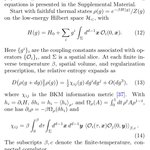



ALT In this work, we extend the equilibrium-evolution duality between stochastic quantization and Wilsonian renormalization to non-abelian gauge theories in anti-de Sitter space, for which the radial coordinate of AdS plays the role of the stochastic time. We show, to all orders in the fields for bulk theories without explicit radial dependence, that the Langevin distribution at time t is the product of the ultraviolet and infrared radial wavefunctions at the cutoff ε=t. We therefore identify this Langevin process as the ground-state (Doob) transform of the radial evolution. By explicit calculation, we also extend the existing dictionary in the stochastic-renormalization duality: the radial component of the bulk field is Zwanziger's stochastic gauge-fixing function; radial gauge is Parisi-Wu quantization; and the bulk gauge Az=α⁻¹∂ᵢAᵢ is Zwanziger's gauge. We also obtain the expressions for the triple-trace and quadruple-trace couplings of the holographic Wilsonian action at finite cutoff


ALT In quantum error correction (QEC), the goal is to engineer an encoding that protects logical information against the erasure of a physical subsystem. In local many-body quantum systems, by contrast, nature provides a subsystem inclusion \mN⊂ \mM in a fixed reference state \ketΩ. Asking whether the inclusion admits a reference-preserving code that protects subsystem \mN against erasure of the complement is equivalent to asking whether \mN is preserved under the modular dynamics of \mM in this state (modular autonomy). We define the subsystem flow, which measures the departure from this error correction regime. Away from autonomy, the infinitesimal flow quantifies relative-entropy loss, while the history algebra and persistent core describe which observables the modular orbit generates and retains. We call an inclusion ergodic when modular orbits generate everything and retain nothing. Analytic continuation of subsystem flow yields Petz recovery maps and a family of positive inclusion pa

ALT The Lorentzian gravitational path integral over homogeneous and isotropic metrics in a closed universe with positive cosmological constant is dominated by complex saddle points, such as the Hartle-Hawking saddles. We ask how to compute cosmological correlators on such complex backgrounds, and how they respond to the shifts of the kinematic variables—the kinematic flow—without tracking the bulk time evolution explicitly. We, specifically, study a conformally coupled scalar test field with a cubic interaction around these saddles. We find that the wave function coefficients can be written as discrete spectral sums with the summands containing the corresponding coefficients in the Einstein static universe, which are obtainable in analogy with the polytopes program for flat spacetime. Whereas the wave function coefficients of the flat FLRW case are given by integrals over shifted kinematics, the discrete spectrum on the three-sphere for Hartle-Hawking saddles produces sums. We identify the

ALT We study holographic entanglement entropy in the flat limit of AdS₃/CFT₂, and clarify the relation between Ryu-Takayanagi surfaces and the swing surfaces proposed for flat-space holography. We show that the ordinary RT formula does not admit a well-defined flat-space limit and connect this to subtleties of the state-operator map in the flat limit. We then construct an AdS₃ uplift of the swing prescription and develop its corresponding information-theoretic interpretation through two complementary approaches. First, we show that the swing surface length computes the mutual information between suitably chosen nearly null boundary intervals in a special class of pure CFT states. The gravity interpretation of this result involves scattering processes which take place deep inside of the AdS₃ bulk. Second, we reduce the problem of finding an information-theoretic interpretation for swing surfaces to the more general problem of finding an information-theoretic interpretation of black hole inn


ALT We complete a proof of the quantum null energy condition (QNEC) in the mathematical framework of Half-Sided Translations and Modular Inclusions (HST/HSMI) removing an assumption that applied to previous proofs. Here we establish a theorem, which when translated to a physical setting implies that the relative entropy comparing the state of fields outside a stationary black hole with a Hartle-Hawking (HH) state is always a convex function of the horizon cut. Previous proofs only applied when a purification with finite null energy was available. We also obtain a QNEC generalization in which the HH Hilbert space is replaced with one based on a weight which is plausibly of relevance to evaporating black holes in flat space.


