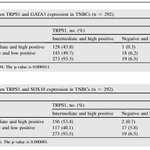
doi.org/10.1016/j.humpath.20…
Check TRPS1 in normal breast duct, at the appropriate condition, it stains luminal cell weakly to moderately , not myoepithelial cell and stromal cells, just like ER, and check the full paper, we compared multiple TRPS1 antibodies and different protocols.
New in #HumPathol: Updates on Utility of Immunohistochemistry in Diagnosis of Metastatic Breast Cancer. sciencedirect.com/science/ar… #pathology #PathTwitter #PathX #breastpath #IHCpath
TRPS1 in huge number of tumor by Dr. Lennartz et al. High expression in breast and some sarcoma (synovial, osteo/chondro), weak to moderate in some SqCC (most organ), salivary gland and GYN tumors, rare in others. This study shows the balance of sensitivity and specificity nicely
Qing Ding, MD/PHD retweeted
The March 2024 issue of #HumPathol is available online! sciencedirect.com/journal/hu… #pathology #PathTwitter #PathX
Qing Ding, MD/PHD retweeted
Very excited to share our paper (comparative Evaluation of TRPS1 and GATA3 in salivary gland tumor) just published in @humpathol
#pathology #PathTwitter #breastpath #ENTpath #pathresidents #BreastPatholog1
@ColumbiaPath @Columbia @MDAndersonNews @TheISBP
sciencedirect.com/science/ar…

ALT Representative cases of breast AdCC and basaloid TNBC with TRPS1 and GATA3 immunostains. Cribriform AdCC with negative expression of TRPS1 and GATA3. Mixed AdCC with positive expression of TRPS1 and negative GATA3. Solid AdCC with high expression of TRPS1 and negative GATA3. Basaloid triple-negative breast carcinoma with high expression of TRPS1 and negative GATA3.
Qing Ding, MD/PHD retweeted
New in #HumPathol: A Comparative Evaluation of TRPS1 and GATA3 in adenoid cystic, secretory, and acinic cell carcinomas of the breast and salivary gland. sciencedirect.com/science/ar… #pathology #PathTwitter #breastpath #ENTpath
It is my greatest honor to have this, and I am very glad that our findings (TRPS1 and SOX17) have been implemented in clinical diagnosis and benefit patient care. Thanks so much for the support from Andrew Sabin Family Foundation, my mentors, colleagues, and fellows.
Congratulations to the 2023 class of Andrew Sabin Family Fellows. This fellowship program provides funding to 10 early career clinicians and scientists to deliver breakthroughs to #EndCancer.
bit.ly/44Vx2Ge @JosephArthurMD @QQingDing @RobJenqMD @pbachi @anilkorkut @SahniLab
Qing Ding, MD/PHD retweeted
New in #HumPathol: Trichorhinophalangeal Syndrome Type 1 (TRPS1) Expression in Male Breast Carcinoma. sciencedirect.com/science/ar… #pathology #PathTwitter #breastpath
Apocrine breast carcinoma is the only type of BC with positive GATA3 and negative TRPS1 we knew so far, and this immunoprofile may be associated with apocrine morphology, but not androgen receptor. ???
More about TRPS1.
Cutaneous apocrine ducts express GATA3 (not TRPS1), eccrine ducts express TRPS1(not GATA3). Similarly, breast carcinomas with apocrine differentiation don’t express TRPS1. doi.org/10.5858/arpa.2022-02…
For the mammary paget, TRPS1 only may be enough for IHC.
Just sharing our photogenic, nerdy moment. This image from our recent study has been featured on the front cover of Journal of Cutaneous Pathology! It’s a great way of starting Monday I guess. 😆🔬
onlinelibrary.wiley.com/doi/…
#dermpath #IHCpath #TRPS1
1
2
739
Qing Ding, MD/PHD retweeted
New episode of ModPath CHAT discussing SOX17 as a marker for gynecological neoplasms @TheUSCAP @ModernPathology podcasts.google.com?feed=aHR…
Qing Ding, MD/PHD retweeted
TRPS1 expression is sensitive and specific for primary extramammary Paget disease @MichelleDunno17 #gynpath onlinelibrary.wiley.com/doi/…
It is believed that breast duct developed from skin sweat gland ( possible modified apocrine duct?). Apocrine ducts express GATA3 (not TRPS1), eccrine ducts express TRPS1(not GATA3), but breast ducts express both, what caused this difference?
#dermpath #breastpath @DrAldehyde
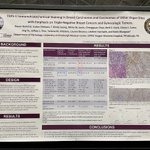
Many colleagues talked about this poster to me after USCAP, TRPS1 expressed in 71% endometrial Ca, but look at the expression H score of breast and endometrial Ca, ~200 (all cases >100 in breast) vs 25.
@BreastPathology @GynPath @TheISBP @Aysegul33508077 @LiZaibo
Part 4: For the TRPS1 Ab, I recommend use polyclonal PA5-84874 (Epitope retrieval #1 20min, 1:500 25min), the problem for this Ab is sometime out of stock, I believe many labs use this Ab based on our recommendation.
1
2
227
Part 1: Many colleagues talked about this poster to me after USCAP, TRPS1 expressed in 71% endometrial Ca, but look at the expression H score of breast and endometrial Ca, ~200 (all cases >100 in breast) vs 25.
@BreastPathology @GynPath @TheISBP @Aysegul33508077 @LiZaibo
Part 5: Another Ab we also use is abcam monoclonal EPR16171 (epitope retrieval #2, 1:2000), this antibody is very sensitive, but not that specific, it stains red blood cell, stromal cell and many more serous carcinomas ( this is the direct reason we identify GYN marker SOX 17)
1
194
Part 3: In addition, we need to set a criteria for positive stain. In my first TRPS1 paper, H-score:negative <10/weak<50/moderate <100/strong>100, in my second paper, grouping weak with negative, and moderate with strong. As it is very rare to see weak stain in the breast cancer.
155
Part 2: For commonly used IHC markers in all kinds of tumor, the expression is not just yes or no, but weak and strong. we need to optimize the condition to balance sensitivity and specificity. Decreasing the titration and incubation time can minimize the background weak stain.
146
Qing Ding, MD/PHD retweeted
This mother and son dream team both matched today! #MatchDay #MCWMatch23