

Researching #Qfever amplification & #epidemiology in Australia. Partners include @FVASunimelb @UQscience @UniofAdelaide @goatvet @MeredithDairy @CharlesSturtUni
Joined September 2018
- Tweets506
- Following395
- Followers281
- Likes220







Pinned Tweet
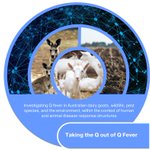
Our research - industry partnership aims to reduce #Qfever spread in Australian livestock enterprises. Please visit our website to learn more about project aims and how you can get involved: fvas.unimelb.edu.au/research… #epidemiology #zoonosis #emerginginfectiousdisease

***NEW PAPER***
Low prevalence of the agent responsible for #Qfever found in wild #deer at multiple sites in eastern #Australia. Unlikely to presently play a major role in maintenance in the environment - check out the research at Open Access early view: onlinelibrary.wiley.com/doi/…

Cross-sectional survey of risk factors helps identify C.burnetii positive dairy goat herds. Check out the research from the @UniMelb and @Qfever_Group team. onlinelibrary.wiley.com/doi/… #Qfever @Alexhou9 @simon_firestone @mstevenson888 @charlescaraguel

Congrats to RHD student @ATolpinrud on the publication of the paper "Validation of an indirect immunofluorescence assay and commercial Q fever ELISA for use in macropods" in J of Clinical Microbiology journals.asm.org/doi/10.1128…
@mstevenson888 @simon_firestone @JohnStenos @UniMelb

1
Want to better understand the true prevalence & distribution of #QFever in #beef cattle in Northern Australia? sciencedirect.com/science/ar…
@simon_firestone @UniMelb
People's experience with #Qfever diagnosis isn't always straight forward. Hear #CharlesSturtUni researcher @JaneHeller11 speak about the findings from a survey of patient experiences.
abc.net.au/.../breakfast/bre…
Hot tip: Jump to 49 minutes to go directly to Jane's interview.
1
1
Check out the latest research from the research team. Identifying scenarios & risk factors for #Qfever outbreaks using qualitative analysis of expert opinion. doi.org/10.1111/zph.12923 @tabitatan @JaneHeller11 @CharlesSturtUni @simon_firestone @mstevenson888 @UniMelb

2
By developing a better understanding of the drivers of #Qfever spread in farmed livestock, the project’s research will help direct #biosecurity resources to reduce the risk of #disease in livestock and humans. Find out more blogs.unimelb.edu.au/q-fever…

We want to hear from you! there's still time to complete the #Qfever questionnaire and register for the #Qfever workshop next week.

Please contribute to Taking the Query out of Q Fever @UniMelb study buff.ly/3ib6dYt.
SURVEY: buff.ly/3J9WYDL
REGISTER for @ASIDANZ webinar 'Where to next with Q Fever research?' 31 March 2022 7.00PM: buff.ly/3MPnqVD
#QFever @Qfever_Group @JaneHeller11

Check out the latest research investigating whether pig-hunting dogs above the Tropic of Capricorn in QLD had similar rates of #Qfever exposure to previous serosurveys of companion dogs in rural north-west NSW onlinelibrary.wiley.com/doi/…
4
Curious about #Qfever? Check out our website for resources and project updates blogs.unimelb.edu.au/q-fever…
#epidemiology #zoonosis #emerginginfectiousdisease
Do you know how to prevent the spread of #Qfever?
Here's a few handy hints that everyone can follow to help reduce the spread.
(Image credit: @ConversationEDU)


#Qfever can affect anyone, of any age, at any time. Spread from animals to humans by inhaling infected particles in the air, many other routes of infection exist including direct contact with infected animals, animal products & contaminated materials. blogs.unimelb.edu.au/q-fever…

What do deer & rabbits have in common? Other than Bambi & outdoor figurines (shorturl.at/bdCPW)
We're studying them both as part of our research into #QFever & its transmission between animal species.
Stay tuned for results of our cross-sectional surveys next year!

5
Does aerosol transmission of C.burnetii occur from farms with positive #Qfever herds? @Qfever_group @UniMelb researchers soil sampling to find answers. Also building a risk profile & identifying transmission risk factors where aerosol transmission has or is occurring.


Great to see reported human #Qfever cases reduced compared with this time last year - the cause still up for debate... abc.net.au/news/rural/2020-0…
"Our results demonstrated that the risk of [#QFever] exposure in dairy cattle varied across the landscape ...and was associated with environmental risk factors." Yet more evidence of the need for #OneHealth approaches! Big 👏 to all the authors, including @Qfever_Group members!
This post is from an account that no longer exists. Learn more
@Qfever_Group research collaborator meetings #COVID style! @FVASunimelb @mstevenson888 @simon_firestone @tabitatan @csuwebgroup @charlescaraguel @tatiproboste

2
Check out PhD student Tabita Tan talking about what led her to her exciting work on #Qfever
agrifutures.com.au/news/rura…
@FVASunimelb @UQscience @UniofAdelaide @goatvet @MeredithDairy @CharlesSturtUni
5