

Adaptative Recursive AI Systems - #NvidiaInception @msft4startups #DatabricksGrow
Paris
Joined June 2023
- Tweets355
- Following5
- Followers126
- Likes339
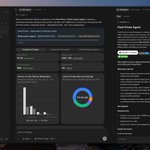






Qredence Fleet retweeted

Jev from @typesafeai is good at deterministic situation, but has this real potential to expand furthermore, by having uncertainty as focus rather than certainty
Which is something possible with Jev
I would say that a major usecase/ solution upon it would be the ability to set a prior, run an update, and hand you a posterior on a given situation
Bayesian way

Qredence Fleet retweeted
An subtle feature in the web UI for prime-agent :
You can customize the interface as you wish and make it your own.
👇
Qredence Fleet retweeted
A web UI for Prime-Agent updates :
- Prime-Agent 0.9.3
- Better integrations of subgents in tabs for a clear interactions
- Performance improved
Add your custom model/provider from the frontend
it uses your prime-agent, no need to resetup anything
install :
`npm install -g @qredence/fleet `
then simply run anywhere
`fleet-agent`

Qredence Fleet retweeted
Prime Agent 0.9 is out from @PrimeIntellect 🎉
Want to use it through a UI?
Fleet (@AgenticFleet) web UI runs the new 0.9 as-is, no config, no tweaks.
Install:
npm install -g @qredence/fleet
fleet-agent
Qredence Fleet retweeted
Fleet Prime Agent v0.3.0 released !
Use the native prime-agent from @PrimeIntellect accross your local project through an user interface
Updates
> Switch project directly from the sidebar
> UI elements more reactive with proper events
> Richer InputComposer
> Settings more inline with prime-agent
> sidepanels WIP progress

Prime Agent from @PrimeIntellect , now with a UI.
Prime Agent with all its capabilities, while adding a UI around it:
• Project selection + file tree
• Streaming agent activity & tool calls
• OpenUI (@thesysdev ) for dynamic, interactive outputs
• A proper web interface for working with your agent
Same agent. A much richer way to use it.
Open source 👇
github.com/qredence/fleet-pr…
Qredence Fleet retweeted
I made a frontend interface made for @PrimeIntellect Prime-Agent !
Just few polish and I will share it asap if interested !
( include a touch of OpenUI @thesysdev )
Qredence Fleet retweeted
Experience Fleet Pi, an UI first experience Pi coding agent, beyond TUI
Beyond rigid frameworks.
Native natural generative UI.
It adapt to you, not the other way around and evolutive.
No technical skills needed.
A UI-first workspace for everyone. Built on Pi.
100% OSS.

Qredence Fleet retweeted
Fleet RLM 0.4.4 - Release note :
- Implementation of persistent memory in @Modal Volume
- Recursive delegation improvements
- PDF ingestion added
- Adding tools run code inside the Modal sandbox or delegate to RLM sub-agents
- No RAG, no database
Qredence Fleet retweeted
Qredence Fleet retweeted
Interesting, wondering @AgenticFleet is tackling and focuses on.. 🧐

First large-scale study of AI agents actually running in production.
The hype says agents are transforming everything. The data tells a different story.
Researchers surveyed 306 practitioners and conducted 20 in-depth case studies across 26 domains. What they found challenges common assumptions about how production agents are built.
The reality: production agents are deliberately simple and tightly constrained.
1) Patterns & Reliability
- 68% execute at most 10 steps before requiring human intervention.
- 47% complete fewer than 5 steps.
- 70% rely on prompting off-the-shelf models without any fine-tuning.
- 74% depend primarily on human evaluation.
Teams intentionally trade autonomy for reliability.
Why the constraints? Reliability remains the top unsolved challenge. Practitioners can't verify agent correctness at scale. Public benchmarks rarely apply to domain-specific production tasks. 75% of interviewed teams evaluate without formal benchmarks, relying on A/B testing and direct user feedback instead.
2) Model Selection
The model selection pattern surprised researchers. 17 of 20 case studies use closed-source frontier models like Claude Sonnet 4, Claude Opus 4.1, and GPT o3. Open-source adoption is rare and driven by specific constraints: high-volume workloads where inference costs become prohibitive, or regulatory requirements preventing data sharing with external providers. For most teams, runtime costs are negligible compared to the human experts the agent augments.
3) Agent Frameworks
Framework adoption shows a striking divergence. 61% of survey respondents use third-party frameworks like LangChain/LangGraph. But 85% of interviewed teams with production deployments build custom implementations from scratch. The reason: core agent loops are straightforward to implement with direct API calls. Teams prefer minimal, purpose-built scaffolds over dependency bloat and abstraction layers.
4) Agent Control Flow
Production architectures favor predefined static workflows over open-ended autonomy. 80% of case studies use structured control flow. Agents operate within well-scoped action spaces rather than freely exploring environments. Only one case allowed unconstrained exploration, and that system runs exclusively in sandboxed environments with rigorous CI/CD verification.
5) Agent Adoption
What drives agent adoption? It's simply the productivity gains. 73% deploy agents primarily to increase efficiency and reduce time on manual tasks. Organizations tolerate agents taking minutes to respond because that still outperforms human baselines by 10x or more. 66% allow response times of minutes or longer.
6) Agent Evaluation
The evaluation challenge runs deeper than expected. Agent behavior breaks traditional software testing. Three case study teams report attempting but struggling to integrate agents into existing CI/CD pipelines.
The challenge: nondeterminism and the difficulty of judging outputs programmatically. Creating benchmarks from scratch took one team six months to reach roughly 100 examples.
7) Human-in-the-loop
Human-in-the-loop evaluation dominates at 74%. LLM-as-a-judge follows at 52%, but every interviewed team using LLM judges also employs human verification. The pattern: LLM judges assess confidence on every response, automatically accepting high-confidence outputs while routing uncertain cases to human experts. Teams also sample 5% of production runs even when the judge expresses high confidence.
In summary, production agents succeed through deliberate simplicity, not sophisticated autonomy. Teams constrain agent behavior, rely on human oversight, and prioritize controllability over capability. The gap between research prototypes and production deployments reveals where the field actually stands.
Paper: arxiv.org/abs/2512.04123
Learn design patterns and how to build real-world AI agents in our academy: dair-ai.thinkific.com/

Qredence Fleet retweeted

5/
@AgenticFleet based on @pyautogen & @chainlit_io
Now continuous ship toward the extensive features, open-source!
teapawt.net/AgenticFleet/status/18…

Beta release of #AgenticFleet based on @pyautogen & @chainlit_io
Now continious ship toward the extentive features, open-source, no bullsh*t.
Few surprise too soon.
Qredence Fleet retweeted
I just published Rethinking Interaction: An Adaptive, AI-Native UI Approach Exemplified by AgenticUI medium.com/p/rethinking-inte…
Qredence Fleet retweeted
Little small sneak peak of one element being worked on for #AgenticFabric from @AgenticFleet 👀
(Not just visual but will most likely be dynamic !)
AI Agents System, from start to bottom 🚀
Qredence Fleet retweeted
Here are some updates about @AgenticFleet testing minimal reasoning in a few scenarios. The alpha phase will leverage Magentic-One from @pyautogen both on Azure Cloud and locally, incorporating a touch of a probabilistic agent 👀.
Next steps include setting up @AgentOpsAI locally. While AgenticUI undergoes some polishing, there will be an update of #GraphFleet with the full GraphRAG 1.0. This will be followed by open access to selected features for AgenticFleet Cloud and broader access to services/models in the cloud, including a free tier.
Everything will be open-sourced on @GithubProjects.

Qredence Fleet retweeted
youtube.com/watch?v=YtUg8hes…
Good video, agree as previous post i could have made already
A need to go further is needed !
@AgenticFleet is aware and working toward these aspect.
(Limited registration are open btw, just was made in a stealthy manner and more broadly this monday
Qredence Fleet retweeted
After a fun hangout with friends yesterday, I whipped up a quick, playful tool to manage debate time with pals. 😂
1. Nail down the discussion topic.
2. Add participants, set speaking limits.
3. Engage in an uninterrupted, timed debate!
It's free no signup👇
Built with @stackblitz & @onlookdev

Qredence Fleet retweeted
More than 7k downloads ! 🚀
Not even the true beginning of the journey for @AgenticFleet
#buildinpublic
We've released GraphFleet Alpha 0.2.0! Enjoy a smoother, more interactive data indexing workflow. #GraphFleet #RAG
✨ New Jupyter Notebook integration! Upload PDFs, set output directories, and run the GraphFleet indexing pipeline seamlessly.
github.com/Qredence/GraphFle…
Qredence Fleet retweeted
For those using @cursor_ai (❤️), here a small example of a system prompt for their #Copilot that is meant to its self-reflection and attribute a score on its probability it's true , link of the prompts below 👇