






ALT Conceptual 16:9 diagram titled "Two classical paths in a quantum-centric system," per IBM's 12 March 2026 reference architecture, a published blueprint. A "Quantum processor" box at top center has a high-bandwidth arrow left to an "Error mitigation" panel and a low-latency arrow right to an "Error correction" panel. The mitigation panel lists high-throughput CPUs and GPUs, a high-bandwidth path, scale-out classical resources, and pre- and post-processing. The correction panel lists low-latency classical systems, more closely integrated, closer to the qubits, and decoding and mid-circuit decisions. A footer says it is a conceptual diagram drawn from ibm.com/quantum/blog/qcsc-reference-architecture, not a facility photo or an official IBM graphic, and that the source reports no measured result on a named machine. A CONCEPTUAL DIAGRAM badge sits at top left.


ALT Conceptual 16:9 chart titled "Company targets per alice-bob.com/roadmap." A subtitle states that this is the Alice & Bob public roadmap, read 18 November 2026, from 2028 Beryllium through 2034 Neon. The left panel, "Logical qubit targets," shows 6 in 2028 (Beryllium), 200 in 2030 (Carbon), 1,024 in 2032 (Oxygen), and 2,048 in 2034 (Neon). The right panel, "Physical qubit targets," shows 400, 3,600, 40,000, and 89,600 in those same years. A footer states that these figures are company targets from the public roadmap, that the page does not report a completed Carbon or Neon machine, and that this is a conceptual chart drawn from alice-bob.com/roadmap, not a device photo and not an official company graphic. A CONCEPTUAL DIAGRAM badge appears at the top left.


ALT Conceptual 16:9 diagram titled "A hardware path for lattice-surgery magic states." A subtitle states that this is Q-CTRL cultivation on a public IBM Nighthawk processor, per arXiv 2611.22035, into a distance-5 surface code after escape. Three linked panels read: "1. CULTIVATE," "Prepare a T state in a small color code"; "2. ESCAPE," "Move it by lattice surgery into a surface code"; and "3. HOLD 10 ROUNDS," "T-state fidelity 0.991 with 4.6% of shots kept." A note says this was a hardware experiment on ibm_phoenix, a public IBM Nighthawk processor, that most shots were discarded, and that decoding was offline. A CONCEPTUAL DIAGRAM badge and a footer mark this as a conceptual graphic of a measured protocol, not a photograph of a processor, not a fabricated chip, and not a reconstructed source figure.


ALT Conceptual 16:9 diagram titled "Higher-rate codes for stacked superconducting wiring." A subtitle states that this compares Armillary codes with the Gross code at the same distances, per arXiv 2611.20410, from circuit-level layouts and simulations. The left panel, labeled GROSS CODE, shows a short bar on a 0-to-1 scale at rate 1/12, with the caption "1 logical qubit per 12 data qubits." The middle panel, labeled ARMILLARY CODES, shows a taller bar just above the half mark, labeled "rate above 1/2," with the captions "More than 1 logical qubit per 2 data qubits" and "About 6 times the Gross-code rate." The right panel, labeled WIRING TIERS, shows six abstract stacked layers and the caption "5 or 6 tiers, schematic only." A CONCEPTUAL DIAGRAM badge and a footer mark this as a conceptual graphic of circuit-level layouts and simulations, not a fabricated multi-tier chip, not a device photo, and not a reconstructed source figure.

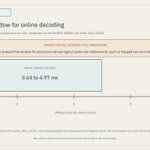
ALT Conceptual 16:9 diagram titled "A millisecond window for online decoding." A subtitle states that this is mean memory-shot latency at a 0.2% physical error rate, measured on one NVIDIA GB200, per arXiv 2611.21321. A framed note headed "FRAMED FOR MILLISECOND-CYCLE PROCESSORS" says the authors present this window for processors whose logical cycles last milliseconds, such as trapped ions and neutral atoms. A teal band on a 0-to-8 millisecond axis, labeled "Milliseconds per memory shot," reads "MEAN LATENCY AT 0.2%" and "0.64 to 4.97 ms." A CONCEPTUAL DIAGRAM badge and a footer mark this as a conceptual graphic of a measured mean-latency band, not a hardware run on an ion or atom clock, not a device photo, and not a reconstructed source figure. No vendor logos.

ALT Conceptual 16:9 diagram titled "A proved distance for a 360-qubit bicycle code." A subtitle states that this is one of IBM's bivariate-bicycle codes, formally checked in the Lean proof assistant (QECLean), per arXiv 2611.21236. The left panel, labeled Reported, reads "Upper bound of 24" and says the code was reported as having distance at most 24 because constraint solvers timed out before a matching lower bound. The right panel, labeled Proved, reads "Distance 24" and says a machine-checked proof shows the distance is 24 and that the lower bound now matches the published upper bound. A CONCEPTUAL DIAGRAM badge and a footer mark this as a conceptual formal-proof graphic, not a device photo or a reconstructed source figure.

ALT Conceptual 16:9 two-bar diagram titled "Simulated qLDPC decoder latency." A subtitle states that the bars show input-to-result latency from a 250 MHz register-transfer-level functional simulation. The left bar is labeled Mean, 173.8 ns. The right bar is labeled 99th percentile, 732 ns. A footer states that these figures come from 4,096 samples from a circuit-level noise model at a 0.5% physical error rate; that they are a 250 MHz register-transfer-level functional simulation of a two-arm decoder core, not a chip measurement; and that the labeled figures are from arXiv 2611.19130. A badge reads CONCEPTUAL DIAGRAM.

ALT Conceptual 16:9 diagram titled "Temporal errors on Willow." Three labeled cards describe a surface-code stability experiment on a 105-qubit Willow processor: the experiment scales patches from 3×3 to 7×7; the measured timelike block suppression is μT = 1.47 ± 0.25 as the patch grows from 3×3 to 7×7; and a 3×3 walking circuit reaches a logical error probability floor of ≤ 3.20×10^{-8} at 60 cycles, about 100 times below the standard 3×3 circuit, limited by ionizing radiation bursts. A footer states that data-qubit heating to |3> is the temporally correlated error the walking circuit targets, and that walking is worse than the standard circuit at low cycle counts. Caption: labeled facts from arXiv 2611.21578; conceptual graphic.