

Faster chip design at GDSFactory. FDTD at https://xitter.cf/t.co/NNeMNJdrMA. Previously designing photonic ICs @Fraunhofer.
The grid.
Joined March 2014
- Tweets2.7K
- Following776
- Followers1.9K
- Likes17.2K


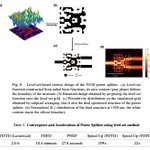

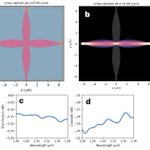

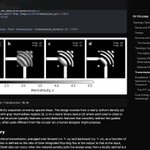
I have been using my FDTD solver BeamZ beamz.tech/ for this partial reproduction of the work in nature.com/articles/s41467-0… . I was actually playing around with various other inverse design ideas to help in the implementation of neural nets within integrated photonics this weekend when I remembered that article again.
Note though that an autoencoder first reduces the dimensionality of the already very simple problem dramatically. Nonetheless, this is an impressive and inspiring paper.


Quentin retweeted

What a charming little ecosystem!
Tiny swimmers switch direction when they grow big enough, sprouting long streamers that trail behind them.
When a swimmer runs into a pellet it repeatedly 'pecks' at it, losing streamer length until finally being absorbed.
Quentin retweeted

can we start calling things human slop. i'm so sick of people acting like their code or math proof is inherently more valuable because they slaved away making it themselves. especially when the field is so fucking deterministic and we can actually check whether the result works.
what gets me even more angry is when it's a thankless effort like oss. someone spends their valuable time making something for you, for free, and you think it's okay to criticize how they go about it
and half the time, if they hadn't found an easier way to make it, the thing wouldn't exist at all. there isn't some "lovingly handcrafted" alternative waiting in the wings
there's just nothing.
each person being able to do way more means problems that wouldn't even have been given a thought can finally get solutions. somebody with a one-off bug in a game can go ahead and patch it themselves. somebody with a rare genetic condition could get together with a small group of people and have a real shot at contributing to research that nobody was prioritizing, without needing billions of dollars behind them just to get started.
people can finally do things they couldn't do before, including things nobody else was ever going to bother doing for them, and your first instinct is to get mad about how they did it.
i think that's so self-serving. when you'd rather something useful never existed than accept that somebody had an easier time making it than you would have, there's something genuinely ugly about that

Introducing Diorama: an OSS Minecraft minimap that shows your world in 3D, updating live as you build
Huge shoutout to @8Blits, this is heavily inspired by his map for @HallowPrison 🙏
Out now on CurseForge for Fabric, Minecraft 26.3 & 1.21.11


Just 9 lines of code.

Signals: ☑️
Point and mode sources: ☑️
Rasterization with sub-pixel smoothing: ☑️
I am pretty sick though and have other duties so I'll continue on the weekend. 🧟♂️
It's quite fun and a nice learning experience to work on a larger project like this where there are so many features.
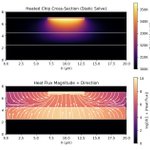
I have implemented FDTD sims and adjoint solvers before. You can do it very quickly and easily for specific problems. But you pay with time as soon as you are trying to do something more complex or want to set up a new design. So now, I am taking the time to really develop the individual modules and workflow so that simulating photonic devices becomes a sprint rather than a debugging marathon.
Interesting problem to improve sometime: The rasterization is very slow for large collections of structures. Scattering makes it impossibly slow. Basically the same reason for why regions are chunked for ray tracing. Or why regions are chunked for collision detection. But since it is pretty much instant as long as we don't scatter hundreds of particles, it is fine for now.


Quentin retweeted

Constant communication is what makes autonomy like this safe. Early contact lets us take maneuvering responsibility, publish ephemeris faster than ground radar can catalog the object, and deorbit and keep commanding through demise if needed
We treat early communications as a requirement, not a nice-to-have
