

The System only cares about you being a Product on their shelf. You’re better than that.
Lake Zurich, IL
Joined October 2016
- Tweets1.9K
- Following867
- Followers246
- Likes6.5K




JBell retweeted

THEY DIDN’T GIVE RIPPLE THE KEYS TO THE BANK.
THEY APPROVED THE BANK THAT CAN HOLD THE KEYS.
And if you think those are the same thing, you’re about to miss the entire story.
October 26, 2026.
The OCC grants FINAL approval to charter Ripple National Trust Bank.
Not conditional.
Not another application.
FINAL.
Days after the OCC finalized new stablecoin capital rules.
And right before Ripple Swell.
Coincidence? Maybe.
Let’s follow the plumbing.
1. WHAT DID RIPPLE ACTUALLY GET?
A commercial bank takes deposits, makes loans, and creates credit.
A national trust bank does something different.
It safeguards assets, administers property, manages collateral, and acts as a fiduciary under federal OCC supervision.
Ripple didn’t receive a license to become JPMorgan.
It received approval for federally supervised trust infrastructure.
2. THREE AUTHORIZED ACTIVITIES.
• Managing segregated RLUSD reserves.
• Acting as collateral trustee for RLUSD holders.
• Providing fiduciary digital asset custody.
Read that second one again.
COLLATERAL TRUSTEE.
That’s a legal responsibility, not a marketing slogan.
Institutions need to know who controls collateral, who benefits, and what happens when something fails.
3. THE THREE-LAYER STRUCTURE.
Standard Custody & Trust Company remains RLUSD’s NYDFS-regulated issuer.
Ripple National Trust Bank adds federal OCC supervision over reserve administration and fiduciary activities.
BNY remains the primary reserve custodian.
Issuance. Custody. Fiduciary oversight.
Separate responsibilities. Different regulatory relationships.
4. NOW LOOK AT OCTOBER 23.
Three days earlier, the OCC finalized stablecoin capital regulations.
The framework allows qualifying uninsured national trust banks to elect an alternative capital treatment, subject to approval.
That doesn’t mean Ripple automatically qualifies.
But the regulatory architecture is taking shape.
Capital requirements.
Federal supervision.
Reserve management.
Institutional custody.
The charter isn’t the finish line.
It’s the legal foundation for what comes next.
PART 2: How this connects to Treasuries, Ripple Prime, collateral markets, and potentially XRP.
JBell retweeted

Dear Secretary Bessent @SecScottBessent,
My name is Everett Stern. In 2010 I was a compliance officer at @HSBC. From a back office in New Castle, Delaware, I watched billions of dollars move to drug cartels, sanctioned regimes, and terrorist organizations. The enemies of the United States. I documented it, I escalated it, and when the bank would not act, I took it to the @FBI, the @CIA, and eventually the @SECGov.
The result was a $1.92 billion settlement. At the time, it was one of the largest in American history. It was also about five weeks of the bank’s profit. Not one banker was charged. Not one went to prison.
I paid a different price. I lost my career, my savings, and my place in the industry I had trained for. I was blacklisted. Every door in American finance closed at once. I slept on a camping cot in a 300 square foot apartment because I could not afford a bed, and I waited tables at @PFChangs to eat. I tell you this not for sympathy, but so you understand that I know exactly what it costs to do the right thing in American finance, and exactly how little the system does in return.
I made that sacrifice because I believed it would change something.
Yesterday, your department fined @BankofAmerica $1.2 billion for failing to report more than $5 billion in suspicious transactions, some of it tied by your own findings to Chinese laundering networks, narcotics, and the southwest border, alongside 475 apparent sanctions violations touching Russia, Iran, and global terrorism. The bank admitted it willfully violated the Bank Secrecy Act.
Fourteen years after HSBC. A bank with “America” in its name. And once again, not one individual charged.
Secretary Bessent, I want to say plainly what I believe you already know. The fines are not working.
A fine is paid by shareholders, absorbed by the balance sheet, and forgotten by the next earnings call. Bank of America reported earnings this morning. Nobody who set the alert thresholds, nobody who decided the 2024 cease and desist could wait, nobody who chose the backlog over the law will lose a single thing they value. Their lives are untouched. That is the entire reason the behavior repeats.
This is money laundering. This is blood money. Money that reaches a cartel buys fentanyl that kills Americans. Money that reaches a terrorist organization buys the next attack. This country has fought a war on drugs and a war on terror for decades, at enormous cost in lives and treasure, and all the while we have allowed the financing to flow through institutions we charter and regulate. Cut off the money and we win. We have never seriously tried.
There is also a question of equal justice that I cannot let go.
Before I walked into the FBI building to report HSBC, I stopped in front of the Great Seal on the wall and read the words engraved beneath it: “Justice is the defense of our liberty.” I believed that. I still want to. But every day in this country, people go to prison for crimes that are nothing next to moving money for the people who want Americans dead. A suit, a title, and a corporate badge should not be a shield from the consequences that apply to everyone else. If a street dealer goes to prison for what he sells, the banker who moved the cartel’s money should be standing next to him.
I also want to raise something that is rarely said in these conversations. Why has no one inside Bank of America come forward the way I did? The answer is that everyone in American banking knows what happened to me, and to the whistleblowers who came after. The last person who spoke up is the only policy anyone believes. That is a culture problem, and it starts with leadership, in the banks and in the agencies that regulate them.
This is not a political issue. It has spanned administrations of both parties. It is a national security issue, and I am asking you to treat it as one.
Three things would change the math overnight.
Refer individuals for criminal prosecution. Not the analyst in the queue. The executives who set the thresholds and chose the risk. One banker in handcuffs would do more than every fine in Treasury’s history combined.
End “too big to jail.” An institution cannot be too big to fail and too big to jail at the same time. If it is the first, it must be held to a higher standard, not a lower one.
And if Bank of America will not act as America’s bank, review its charter. A national charter is a privilege granted on behalf of the American people. It should be conditioned on not moving money for the people trying to kill them.
Secretary Bessent, you said yesterday that these actions send a clear message that even the biggest institutions are not above the law. With respect, the institution was never the problem. The people inside it are above the law, and they know it. Until that changes, I will keep writing letters like this one, and the next bank will keep paying the next fine.
I gave up everything I had to stop this. I am asking you to use the power you have to finish it.
Respectfully,
Everett A. Stern
HSBC Whistleblower
Founder and Intelligence Director, Tactical Rabbit
ethereum:0x4a220e6096b25eadb88358cb44068a3248254675


China PDF patentimages.storage.googlea…
China overview
patents.google.com/patent/CN…
Japan PDF
patentimages.storage.googlea…
Japan overview
patents.google.com/patent/JP…
US PDF
patentimages.storage.googlea…
US overview
patents.google.com/patent/US…
EU PDF
patentimages.storage.googlea…
EU overview
patents.google.com/patent/EP…
1
4
93
JBell retweeted

$FIGR Figure's stock is on a massive losing streak, but the company is on a massive winning streak.
Their consumer loan marketplace, which doesn't include Kiavi #'s from September, are up 107% Y/Y and 20% from the prior quarter.
As @mcagney said, they can't keep doubling forever, but for now they sure are.

JBell retweeted

If you’re holding $QNT, here’s my prediction: The Clearing House was the first domino.
I’m watching seven major infrastructure moves next.
People are celebrating the price move.
I’m watching the architecture.
The Clearing House sits underneath a huge part of U.S. banking.
It selected Quant around tokenized deposits and connected that architecture into RTP and CHIPS.
To me, the important part is what that proves.
Quant can sit between:
traditional payment rails
tokenized bank money
different ledgers
settlement systems
and the banks themselves.
That is exactly the problem almost every major financial market is now creating.
So here are the next places on my radar.
1. Zengin / BOJ-NET in Japan
Quant already has Dentsu Soken.
Dentsu Soken already works around BOJ-NET, SWIFT and CLS.
The partnership is already aimed at tokenized deposits, bank-issued stablecoins and programmable settlement.
Japan has the ingredients.
My prediction is the orchestration layer becomes the next battle.
2. Payments Canada
BMO, CIBC, National Bank, RBC, Scotiabank and TD are already working toward shared CAD tokenized deposits.
Canada has Lynx.
Once multiple banks create digital commercial-bank money, somebody has to make those liabilities settle together.
The U.S. now has a live reference case.
3. EBA Clearing + ECB infrastructure
Europe has RT1, STEP2, TARGET, TIPS and Pontes.
Tokenized euro deposits will need to interact with those systems.
Quant already has the digital-euro connection described in this thesis.
Europe eventually needs coordination more than another private bank silo.
4. Pay UK + Bank of England Synchronisation
Quant already proved the UK side through Great British Tokenised Deposits with:
Barclays
HSBC UK
Lloyds
Monzo
Nationwide
NatWest
Santander
So I’m looking beyond another pilot.
I’m watching whether the same logic gets closer to Faster Payments, Bacs, CHAPS and RTGS Synchronisation.
5. HKMA Ensemble / EnsembleTX
Hong Kong already has HSBC, Standard Chartered and Bank of China (Hong Kong) working around tokenized deposits and wholesale CBDC settlement.
Multiple forms of money.
Multiple institutions.
One shared settlement problem.
That is Quant territory in my thesis.
Then come the two monsters.
6. SWIFT
If tokenized deposits start moving globally, SWIFT needs programmable connectivity between digital bank money and existing ISO 20022 infrastructure.
7. CLS
Once tokenized USD, GBP and other major currencies become real institutional settlement assets, FX needs PvP.
CLS sits right in that path.
Now zoom out.
Project Rosalind.
BIS.
Bank of England.
UK Regulated Liability Network.
Great British Tokenised Deposits.
ECB.
Murex.
Dentsu Soken.
The Clearing House.
None of these names appeared overnight.
Quant spent a decade building around the same problem:
banks will tokenize money, but somebody still has to make all that money work together.
The Clearing House showed what happens when that problem becomes real infrastructure.
My prediction is simple:
Japan, Canada, Europe, the UK and Hong Kong now have versions of the same problem. SWIFT and CLS complete the cross-border picture.
I’m watching who calls Quant next.
You ready?


I bought $ZEC around $47.
I publicly announced that I sold all of it around $1,500.
Then I rotated those profits into $QNT around $60.
A few days later, $QNT exploded to around $374.
I took profits there too, but I’m still holding a long-term $QNT bag because I believe there’s a lot more ahead.
Then yesterday, I added more hedera-hashgraph:native.
Today, hedera-hashgraph:native started pumping hard.
And I believe hedera-hashgraph:native and $QNT are still just getting started.
My subscribers who joined months ago watched these calls happen in real time.
$ZEC at $47.
$QNT around $60.
Now hedera-hashgraph:native.
The receipts are all there.
We’re preparing for what I believe could be a massive institutional bull market, and I’m already looking for the next long-term setups before everyone else starts talking about them.
If you don’t want to miss the next one, you can subscribe now and see the setups, deep dives, entry zones and long-term plays I’m watching.
I’m telling you now, you do not want to sleep through this part of the market.
You’re still early.


JBell retweeted

Its confirmed: Capgemini partnering with ethereum:0x4a220e6096b25eadb88358cb44068a3248254675 for agentic payments and liquidity management 🔥🔥🔥
Capgemini:
✅420.000 employees
✅servicing more than 50% of the world largest companies


Suprise demo and partner (?), nice👀👀
$QNT and @Capgemini (420.000 employees globally and one of the worlds largest IT consultancy firms).
Save to Capgemini will be promoting Quant to their clients (they serve >50% of the Global 500 🔥🔥)
JBell retweeted

DCENT CUSTOMERS — IT'S TIME TO DEMAND ANSWERS.
We have asked questions. We have reported incidents. We have documented transactions.
And we're still waiting for meaningful transparency.
DCENT is operated by IoTrust Co., Ltd. Its CEO is Baek Sang Su.
If you've been affected—or you're a DCENT customer concerned about what is happening—contact the company directly and respectfully demand:
• A public statement from the CEO
• The known scope of the incident
• The number of affected wallets
• The identified attack vector/root cause
• What is being done to protect customers
• Whether affected customers will be reimbursed
📧 [email protected]
☎️ Customer Service: +82-2-1833-4022
☎️ DCENT Support: +82-2-6959-3559
🏢 IoTrust Co., Ltd.
7th Floor, Samsungdang Building
747 Seolleung-ro, Gangnam-gu
Seoul 06056, Republic of Korea
CEO: Baek Sang Su
Business Registration: 219-86-00705
Keep it professional. Keep it factual. But keep asking.
Hundreds of customers asking the same legitimate questions are much harder to ignore than one person asking them alone.
DCENT/IoTrust: your customers deserve answers.
#DCENT #IoTrust #CryptoSecurity #CryptoWallet #XRP #Transparency #Accountability
JBell retweeted
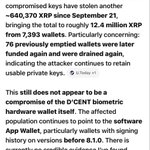
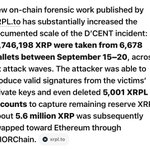
UPDATE: 12,533 XRP — I’m still following the trail.
Since the unauthorized transfer from my D’CENT wallet, I’ve continued documenting and tracing every piece of information available.
🔹 D’CENT has been notified and a case opened.
🔹 XRPScan identified an address in the transaction trail as ChangeNOW.
🔹 ChangeNOW responded directly and asked for the transaction hash and supporting information so their team can investigate from their side.
🔹 A formal report has now been filed with the FBI Internet Crime Complaint Center (IC3), including the transaction hash, wallet addresses and blockchain trail.
I don’t know where this investigation will ultimately lead, but I’m not stopping at “your crypto is gone.”
Document everything. Follow the blockchain. Contact the companies involved. File the reports. Keep asking questions.
You are your own best advocate.
The blockchain keeps receipts. 🔎


JBell retweeted

XRP… “Price before Law”. That’s what the Riddlers have always said would happen.
Based on history, I think the Clarity Act could very well be a smokescreen for the 1%.. to catch retail complacent/sleeping, while the real price appreciation event takes place before. 👀
JBell retweeted
Here’s a key part Swift left out from their announcement on their super ledger where they conveniently did not name the distinction of innovation, new tech, or 3rd party provider utility:
HSBC token = HSBC's liability.
Citi token = Citi's liability.
They are NOT interchangeable. They don't net against each other.
It is THE REASON the banking system is set up the way it is currently.
To move value between between the two, you need one of two things:
1. Bilateral trust lines: every bank pre-funding accounts with every other bank. That's the nostro/vostro problem.
Recreated on-chain.
2. A neutral bridge asset: something no single bank issues, that All (of them) can settle through.
Swift built the room…
where the banks TALK.
Swift didn’t build…
the thing they settle down with…
the person they go home with
$XRP

Let’s cut through all the trees to view the entire landscape, here it is without fluff, bullshit, and
NDA’s…broken down to easily understand—
What’s happening:
• Swift built a blockchain ledger so 17 banks can move their own tokenized deposits 24/7, overnight, weekends included
• Each bank’s token = that bank’s promise (HSBC token = HSBC’s liability, Citi token = Citi’s liability)
• Banks can now shuffle promises instantly across borders without waiting for Monday morning settlement
• The infrastructure is live, the pilots are running, the pressure is institutional-grade
What’s not happening:
• This is NOT settlement
• These promises don’t automatically NET against each other
• Swift built the messaging layer and stopped
• FINAL SETTLEMENT still runs through EXISTING systems — the same ones that have been moving money for 40 + years
Why it matters:
Tokenization WITHOUT SETTLEMENT is IOU-shuffling. Fast IOUs are INDEED BETTER than slow IOUs, but they’re still promises someone else needs to keep.
Swift just proved the messaging can work at scale. Swift didn’t prove the settlement problem goes away. They just deferred it.
That’s the open door.
If you’d like me to break this down further today — let me know by crushing the heart button and dropping a comment or line on the most interesting aspect, confusing part, or specific sub-topic you’d like to drill down further on.
JBell retweeted
**By December 31, 2026, every US Treasury trade in America must clear through DTCC’s FICC**
No exceptions. No opt-out. Regulatory mandate.
$28 trillion in annual volume. Forced into one pipeline.
DTCC’s clearing subsidiary — **FICC — is mandating that every single US Treasury trade route through it by December 31, 2026.
Every. Single. One.
That’s not a pilot. Not a proposal. Not a working group.
It’s a regulatory deadline. From DTCC’s own website.
$28 trillion in annual Treasury volume forced into a single clearing pipeline in 6 months.
DTCC acquired Securrency — rebranded as DTCC Digital Assets — whose protocol natively supports the XRP Ledger.
Nobody is talking about this.
Because it just happened**
The infrastructure clearing every US Treasury trade by year-end already has XRPL in its stack.
Most people will find out later.
You just found out now.

JBell retweeted

Ripple Treasury Connected to 13,000 Banks.✅


Introducing the first native onchain capabilities in an enterprise treasury management system – today @Ripple Treasury is adding Digital Asset Accounts and Unified Treasury to give CFOs the ability to view, hold, receive and manage fiat and digital liquidity in their existing dashboard.
No separate interface, no new workflows and no need to navigate crypto on your own. Corporates, your starting point into digital assets is at treasury.ripple.com.
ripple.com/ripple-press/ripp…

JBell retweeted
Regulation doesn’t always make markets go up.
It makes them honest.
Every major sector shows the same pattern:
Uncertainty drops → capital shows up
Standards rise → weak players disappear
Multiples compress → infrastructure wins
Semiconductors didn’t run because of hype.
They ran because policy made them necessary.
Banking didn’t explode after SOX/Dodd-Frank.
It consolidated. Got heavier. More controlled.
Let’s apply that to crypto…
MiCA. U.S. clarity.
Global alignment forming.
⸻
Bear Case (relative):
Regulation compresses the space.
• Fewer tokens survive
• Issuance gets harder
• Leverage gets reduced
• Compliance costs concentrate power
• Speculation cools off
Most assets don’t make it through that filter.
⸻
Bull case (structural):
Crypto isn’t just a sector.
It’s settlement infrastructure.
It’s our future.
If it becomes:
• permissible
• integratable
• collateralizable
…it stops competing with tech.
It integrates with finance.
⸻
That’s the movement taking place.
From tradable → usable
From usable → required
And when that happens, performance won’t look like prior cycles. Prior cycle patterns are dead.
⸻
The question isn’t “does crypto go up?”
It’s:
Which assets survive regulation? (We’ve already been told to a large extent)
And which will get embedded into the system for the next 100-500 years?
Everything else is just elective liquidity passing through for a moment in time.
The market will sort out what’s honest and useful.
JBell retweeted
Interesting.

🚨BREAKING: Hong Kong Names XRP as CORE Infrastructure — 77% of Financial Institutions Are Moving Into Crypto 🤯🔥
A new @Ripple + Quinlan report says 77% of Hong Kong financial institutions have ALREAY started USING CRYPTO or plan to start SOON. 👀
That means crypto is moving beyond speculation in Hong Kong and into REAL banking and finance use cases like payments, custody, tokenization, and investment products. 😳
Even bigger, the report highlights $XRP as part of the CORE INFRASTRUCTURE layer helping power those digital asset systems. 🔥
@Ripple Custody is featured as part of the setup banks can use for security, compliance, and interoperability as finance moves on-chain. ✅
HONG KONG IS GOING ALL-IN INTO $XRP 🚀🤑

JBell retweeted
Active addresses are quietly rising on the new settlement rails.
Meanwhile…
Oil just doubled in three months.
Japan’s markets are cracking.
The yen carry trade is starting to crack.
That combination is rarely random.
Here’s what’s actually happening under the surface:
⸻
According to RWA.xyz, Ripple’s stablecoin RLUSD now shows:
• 47,167 holders
• 5,437 monthly active addresses
• $4.9B monthly transfer volume
But the number that matters most isn’t the dollars.
It’s the active addresses.
Because active addresses mean something very specific:
New participants.
New systems.
New integrations.
⸻
Infrastructure adoption always begins the same way.
Not with massive flows.
With more entities connecting to the rails.
Treasury desks
Liquidity providers
Market makers
Settlement systems
Payment corridors
Every new participant increases the surface area of the network.
⸻
Now look at the macro backdrop.
Oil has doubled in roughly three months.
Oil priced in yen just surged +36% in a single session.
Japan’s markets are reacting.
The carry trade is under pressure.
When global liquidity shifts like this, financial institutions start prioritizing two things:
Speed of settlement.
Mobility of collateral.
That’s when infrastructure suddenly matters.
⸻
Every network matures through the same structural sequence:
Experimentation.
Participation.
Integration.
Dependency.
Most people only notice the last stage.
But the important shift is earlier.
Participation.
⸻
You can see it in the RWA.xyz active address curve.
That’s not speculation.
That’s systems connecting.
APIs linking.
Liquidity providers onboarding.
Settlement pathways forming.
⸻
History shows the same pattern everywhere.
In 1984, Dan Marino signed the first $1M NFL contract.
People thought it was ridiculous.
Twenty years later in 2004, Peyton Manning signed the first $100M contract.
Today there are dozens of $100M+ deals across the league.
What once looked impossible became routine once the structure matured.
⸻
Financial networks behave the same way.
At first:
Few users.
Small flows.
Constant skepticism.
Then participation grows.
Systems integrate.
And eventually the network becomes non-optional infrastructure.
⸻
That’s when price discovery changes.
Not because of speculation.
Because the system now needs the rails to function.
⸻
Watch the macro stress.
Watch the oil charts.
Watch Japan.
But also watch the quiet signals.
The addresses.
The participants.
The systems connecting.
That’s where the real transition starts.
— The Settlement Conductor
⸻


JBell retweeted
I don’t know who this man is but I love this guy.
Some people would say it’s “not professional”
Ya know what, we are done with trying to be professional with these commies.
JBell retweeted

How do I know a financial reset is coming, and why Ripple (XRP) is positioned to play a central role alongside gold? Because we’re at the end of multiple measurable cycles simultaneously.
We’re at the end of a 100-year global debt cycle. Governments are buried in debt, interest costs are exploding, and the old tools don’t work anymore.
We’re also at the breaking point of a 60-year monetary system built on dollar dominance and an oversized derivatives market that keeps needing more leverage just to survive.
At the same time, central banks are quietly doing what they always do before major transitions. They’re buying gold. Not for speculation. For stability. Gold still anchors trust when paper systems stretch too far, and that hasn’t changed.
But this reset isn’t just about storing value. It’s about moving it. And that’s where the system starts to crack.
The world is shifting from a unipolar order into a multipolar one.
Trade is fragmenting. Sanctions are weaponized. Globalization is being restructured in real time. No single nation can credibly sit at the center of settlement anymore. That creates a vacuum.
Gold preserves value. It doesn’t settle modern markets at scale.
XRP was built for that gap. Fast settlement. Liquidity efficiency. Interoperability across currencies and jurisdictions. A neutral bridge when trust between nations is thin. Where gold anchors balance sheets, XRP moves value between them.
This is why XRP is so hard to explain to people. You can’t look at it in isolation. You have to see the debt cycle, the monetary shift, the geopolitical realignment, and the breakdown of legacy rails all at once. Miss any one of those, and you miss the point entirely.
Gold and XRP aren’t competing. They’re doing different jobs in the same transition.
This is not a prediction. It’s an observation. I’ve been shouting this for 8 years, still not wrong, just early.