

mRNA translation and degradation group leader in Bern, viral proteins vs human translation - Nanopore seq-curious and very much into teaching - 🏳️🌈
Bern, Switzerland
Joined May 2014
- Tweets823
- Following484
- Followers709
- Likes3.5K






Karousis Lab retweeted

Our latest work is out in @Nature today! Using smFRET, we directly visualized recruitment of the eIF4F complex to the 5' cap of eukaryotic mRNAs and formation of an activated mRNA. Our findings reveal new and surprising roles for each eIF4F component. 1/3 nature.com/articles/s41586-0…


Karousis Lab retweeted

Please RT: Are you a highly skilled, top-motivated biochemist looking for an exciting postdoc project? We are looking for you. For details, check here: ohws.prospective.ch/public/v…
Karousis Lab retweeted

Today we report in @natBME the eePASSIGE system, which uses evolved and engineered recombinases and prime editing to integrate large gene-sized DNA cargoes into the mammalian genome in an efficient, precise, and targeted manner. (1/13)
drive.google.com/file/d/1WDM…

Karousis Lab retweeted

We’re excited to share our study in @CellCellPress on the role of the MAP3 kinase ZAK in UV-induced apoptosis led by @2primehydroxyl! We studied cell signaling kinetics following UV-damage and found that ZAK drives apoptosis via ribosome collisions. cell.com/cell/fulltext/S0092…

Karousis Lab retweeted

Check out our two new papers! We delevoped a method to follow individual translating ribosomes for hours in living cells, and discovered that ribosomes are great friends and help each other in problematic situations


Two new lab papers: In the first paper we develop Stopless-ORF circRNAs (socRNAs), a technique to measure translation by individual ribosomes with incredible precision. Amazing work jointly led by @MadernMax and @_SoraY.
biorxiv.org/content/10.1101/…

Karousis Lab retweeted

Our work on translation-dependent mRNA decay during T CD4+ lymphocyte activation is out! @genomeresearch genome.cshlp.org/cgi/content…
Karousis Lab retweeted

Mendelian inheritance revisited: dominance and recessiveness in medical genetics go.nature.com/3IgKyKW #Review by Johannes Zschocke, Peter H. Byers & @Wilkie_Lab
@imed_tweets @UWMedicine @MRC_WIMM @UniofOxford
Karousis Lab retweeted

This is a scary, yet amazing discovery. Cancer can arise without mutations following transient loss of epigenetic gene silencing.
nature.com/articles/s41586-0…

Karousis Lab retweeted

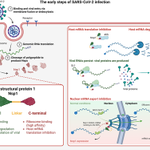
Review by @The_Ban_Lab (@ETH_DBIOL, @ETH_en) & Karousis Lab (@RNAkook, @DCBPunibern, @unibern on "#Coronavirus takeover of #host cell #translation and intracellular antiviral response: a molecular perspective" @embojournal @KathaSchubert
bit.ly/3VEZwCS
Karousis Lab retweeted

UZH has decided to withdraw from the Times Higher Education World University Ranking. The ranking is not able to reflect the wide range of activities in teaching and research undertaken by universities. news.uzh.ch/en/articles/news…

ALT UZH main building
Karousis Lab retweeted

I am impressed: "Uni. Zurich @UZH_en No Longer Provide Data for THE Ranking @THEworldunirank" because "UZH is committed to an academic culture that prioritises quality over quantity".
This is forward-looking!
#BetterScience #Dora
news.uzh.ch/en/articles/news…

Karousis Lab retweeted

📢 #RibosomeProfiling has revolutionized our understanding of #ProteinSynthesis deregulation, offering fresh perspectives on targeting diseases. Discover the potential in therapeutic strategies. Well done to all involved in Kangdong Liu lab. #riboseq
🔗 doi.org/10.1038/s41392-024-0…

Karousis Lab retweeted

This is pretty amazing: a single hominoid-specific genetic change leads to loss of the tail. What an incredible phenotype!


How did we lose our tail? A simple question.. but it wasn't really asked before! We discovered a plausible scenario for the genetic mechanism that led to tail loss. Amazing that such a big change may have been caused by such a small genetic event. nature.com/articles/s41586-0… @BoXia7

Karousis Lab retweeted

Do you love #RNA and #neuroscience? Are you looking for a #postdocposition on #ALS and gene therapy? Join @RueppLab @UKDRI @KingsIoPPN and @FrattaLab @UCLIoN for a collaborative pre-clinical project on a novel gene therapy approach for ALS. More info here: tinyurl.com/2cpcbsp3
Karousis Lab retweeted

Four largely ignored coronaviruses circulate in humans without causing great harm and may portend the future for #SARSCoV2.
Learn more in this @NewsfromScience feature: scim.ag/5J3

Karousis Lab retweeted
Although translational selection to favour codons that match the most abundant tRNAs is not readily observed in humans, there is nonetheless selection in humans on synonymous mutations

Karousis Lab retweeted

Now online! Cell surface RNAs control neutrophil recruitment dlvr.it/T1sDxL

Karousis Lab retweeted

Jan. 7, 1924: George Gershwin begins writing “Rhapsody in Blue.” The 25-year-old has only five weeks to compose this revolutionary classical piece with jazz rhythms before it’s scheduled to be played at New York’s Aeolian Hall as part of a concert organized by Paul Whiteman. 1/4


