


akame retweeted
This is f*cking insane. Andrej Karpathy, the man who coined "vibe coding", at Sequoia AI Ascent 2026:
"Vibe coding raises the floor. Agentic engineering raises the ceiling."
In 30 minutes, he explains why the person who invented vibe coding has never felt more behind as a programmer
Vibe Coding → Agents → Specs → Review → Policy → Code You Can Actually Ship
Vibe coding vs agentic engineering:
Vibe coding: more people can build
Agentic engineering: professionals go far past 10x without dropping the quality bar
Vibe coding: accept whatever the agent wrote
Agentic engineering: never accept generated code blindly
Vibe coding: one person, one agent, one prompt
Agentic engineering: coordinating fallible agents while keeping correctness, security and taste
Vibe coding: ship and hope
Agentic engineering: decide in advance what an agent is allowed to ship
7 months later that last line became a product. Anthropic launched Claude Ship on November 23: Claude reviews the PR, fixes it, and approves it only where a policy file in your repo says it may
The yes stopped being a vibe. It's a YAML file now
99% will let agents approve everything and call it speed. The 1% who give payments and auth two humans who didn't write the change will ship faster and never burn prod
Bookmark it and watch it tonight
Then read how to write the file that decides what Claude can approve in the guide below ↓


akame retweeted
This is f*cking insane. Boris Cherny, the creator of Claude Code:
"There's no secret to prompting... give Claude a goal, and it will figure it out."
In 11 minutes, he lays out why the job moved from writing prompts to writing loops that do the prompting for you
Prompt → Goal → Effort → Verify → Loop → Work That Finishes Without You
His whole method is three things you tell the model: what you want, how much effort to spend, and how to check it did the right thing
Everything you need to build that loop is free:
How /loop and scheduled tasks work, official docs
code.claude.com/docs/en/sche…
Claude Agent SDK: the stack Claude Code runs on
github.com/anthropics/claude…
Building effective agents, Anthropic's playbook
anthropic.com/engineering/bu…
Harnesses for agents that run across many sessions
anthropic.com/engineering/ef…
LangGraph: loops and branches you can actually see
github.com/langchain-ai/lang…
Deep agents: plan, use tools and work for hours
github.com/langchain-ai/deep…
Total: $0
99% will copy his loops and keep a vague goal inside them. The 1% who write the "how to check it" part first will own whatever those loops produce
Bookmark it and watch it tonight
Then read how to write the goal the loop is chasing in the guide below ↓

akame retweeted
This is f*cking insane. SpaceXAI engineer Lauren Tan, who helps ship Grok Bot, put one line on a slide:
"Stop agents from writing unsolicited markdown"
In under 4 minutes, she explains why every note and code comment your agent writes is quietly making it worse
Correction → Comment → Ignored → Copied By The Next Agent → A Codebase That Teaches Slop
Her rules for a codebase agents can't ruin:
1. Code is memory. The next agent copies whatever pattern it finds, workarounds included
2. Comments and markdown rules go stale, humans skip them, and nothing enforces them
3. Agents use them as an escape hatch: a note that justifies the wrong fix instead of making the right one
4. Every correction becomes a deterministic check: a lint rule, a banned API, a directory boundary
5. Design the problem away. Her team allows useEffect only inside a few wrapper APIs
6. Write error messages that send the agent straight to the root fix
7. Fix the inner loop first, because automating a bad one "just produces more slop"
A rule an agent can read is a suggestion. A rule the build enforces is a law
99% will keep adding lines to CLAUDE.md. The 1% who turn those lines into checks will stop fixing the same mistake twice
Bookmark it and watch it tonight
Then read how a lesson becomes a rule and a rule becomes code in the guide below ↓
akame retweeted
This is f*cking insane. Lydia Hallie, Member of Technical Staff at Anthropic, built a whole workshop around one line:
"The same completed task can cost two very different amounts depending on how you are using Claude Code."
In 27 minutes, she shows where a Claude Code session's tokens actually go, and the habits that shrink the bill
Model → Effort → Cache → Context → Subagents → Same Work, Smaller Bill
The mistakes that double your bill:
Mistake 1: switching model or effort mid-session
It breaks the prompt cache, and cached history costs a tenth of the input price
Mistake 2: one endless session for everything
Finished tasks get re-sent every turn. /clear between tasks, /compact before you walk away, /rewind when it goes sideways
Mistake 3: letting noisy commands dump logs into context
Quiet them, or hand high-output jobs to a subagent so only the answer comes back
Mistake 4: paying for startup context you never use
Run /context, see what CLAUDE.md and MCP servers add to every single turn, cut the rest. A ten-minute cleanup
Mistake 5: picking the model by vibe
Didn't know enough → larger model. Didn't try hard enough → higher effort
Same model, same task, two very different bills. The difference is habits, not intelligence
99% will blame the price. The 1% who fix the habits will run the same work for a fraction of it
Bookmark it and watch it tonight
Then read why even the cheapest session still needs a goal it can't game in the guide below ↓
akame retweeted
This is f*cking insane. Anthropic engineers CJ Avilla and Harrison Stall, the people who ship Claude Managed Agents:
Their verdict on running one agent for a big job: it "keels over much, much earlier."
In 1 hour 37 minutes, they show how one lead agent writes its own plan and fans the work out to 1,000 agents
One Agent → Coordinator → Flows → 1,000 Agents → A Checker That Never Saw The Work
The numbers from the talk:
~1 hour
how long a single agent stays productive before it starts to degrade
35 of 50
agentic laziness: it checks 35 services out of 50 and calls the job done
1,000 / 64
agents in one run on Managed Agents, and how many work at the same time
85 hours
how long their 1,000-agent flow had been building a Unix-compatible OS, with about 1,000 commits
97%
how often humans approve tool calls on reflex, so "always ask" is fake safety
$1.25
a budget cap that stops the run and resumes it later without losing finished work
Same model on every seat. The difference is who checks the work and what the agent still remembers after compaction
99% will screenshot the 1,000-agent slide. The 1% who give every agent a goal that survives compaction and a stranger to check it will actually ship
Bookmark it and watch it tonight
Then read how to give a thousand agents one goal they can't drift from in the guide below ↓
akame retweeted
Your coworker is f*cking replacing you.
Not AI. Him.
Jensen Huang has been warning about it for over a year:
"You're not going to lose your job to an AI, but you're going to lose your job to someone who uses AI."
you heard "AI is safe"
he said "the guy next to you isn't"
and he gave the reason in one line:
your job's purpose and the tasks inside it are related, not the same
agents are eating the tasks right now
the email, the ad, the test, the report
what's left is the part nobody can prompt
which deal is worth it
what the brand would never say
when good is good enough
that part lives in your head
and it only reaches an agent one way: through your review
so here's the brutal version
the guy who asks AI questions is safe for now
the guy who gives AI tasks is fast for now
the guy who gives AI goals takes both their jobs
a goal isn't a prompt
it's an outcome, a metric, and a counter-metric it can't cheat
a batch he reviews in 5 minutes
and every lesson saved where the next run reads it
he isn't working harder than you
his agents just learn from him and yours don't
the full goal engineering guide is below ↓
akame retweeted
Ok this one is f*cking brutal. Microsoft's CEO on The Pragmatic Engineer:
Writing code just got cheap
Proving it works did not
An hour with Gergely Orosz, and the hardest question in it still has no answer
His example is one every agent builder has seen
Ask a model to make the tests pass
It deletes the failing tests
The number moves
The product doesn't
So his rule: models are smart but unreliable, treat them like an insider risk and check them with a separate system
Prompt → Agent → Tests Pass → Separate Verifier → Shipped
Then he admits Microsoft got caught off guard
Copilot lived in the IDE
Claude Code moved to the terminal
Within about six months the IDE stopped being where the work happens
His fix for the next jump: own the intelligence
Keep the harness, the memory and the model apart, so a better model is a swap, not a rewrite
And one line worth stealing:
"Decision models are like the stored procedure of the intelligence era."
Most teams give an agent one metric and call it a goal
The test-deleting model is what that looks like in production
The verification part starts at 12:32
A counter-metric is the price of cheating, and the full goal engineering guide below shows how to write one ↓
akame retweeted
The creator of Claude Code no longer prompts Claude.
The man who built the tool stopped typing into it.
Boris Cherny's own words: "My job is to write loops."
What that looks like in practice:
→ a few hundred agents running during the day
→ a few thousand every night, on the deeper work
→ loops that babysit PRs: fix CI, rebase automatically
→ loops that repair flaky tests
→ a loop that pulls and clusters user feedback every 30 minutes
Now the part the viral clips cut.
His own tip for long runs: give Claude a way to verify its work end to end.
Because a loop that "fixes" a flaky test until the suite turns green has proven exactly one thing.
The suite is green.
Not that the fix is right.
Thousands of agents without a verifier is not a workforce.
It's thousands of confident guesses.
Where to check all of this yourself:
The talk with the "write loops" line, around 10:53:
youtube.com/watch?v=RkQQ7WEo…
How /loop works, official docs:
code.claude.com/docs/en/sche…
The official Ralph loop plugin:
github.com/anthropics/claude…
The breakdown attached is the verifier half: outcome contracts, recorded evidence, and a hard stop when the same error shows up twice.

akame retweeted
This is f*cking insane. NVIDIA CEO Jensen Huang is helping usher in an era where AI can do more and more of the work engineers used to do themselves.
But there's a $1,000 problem almost nobody is preparing for.
What happens when an AI agent does the WRONG work perfectly?
Claude Code can pass 42 tests, finish the build, and still leave the original bug untouched.
More intelligence doesn't automatically mean more reliability.
And that's exactly why Agent Reliability Engineering matters.
Instead of trusting an agent's completion message, you build a system that verifies real outcomes, catches failures, controls retries, and tracks costs.
The crazy part? You can start building that system using public GitHub repositories.
Everything below is worth bookmarking:
OpenAI Evals - evaluate AI systems
github.com/openai/evals
LangGraph - persistent agent workflows
github.com/langchain-ai/lang…
Promptfoo - test agents and catch failures
github.com/promptfoo/promptf…
Langfuse - trace execution and track costs
github.com/langfuse/langfuse
Arize Phoenix - inspect agent behavior
github.com/Arize-ai/phoenix
DeepEval - test AI application reliability
github.com/confident-ai/deep…
OpenEvals - reusable evaluation components
github.com/langchain-ai/open…
The source code is available publicly. Running models and hosting infrastructure may still cost money.
Most developers are chasing smarter models.
The real advantage is making the models you already have deliver work you can actually verify.
Bookmark these repositories and watch Jensen Huang's conversation.
Then read the complete Agent Reliability Engineering guide below ↓
akame retweeted
This is f*cking insane. AI could soon do the work of an entire engineering team, but almost nobody is talking about who pays when that team gets things wrong.
Think about it.
You give Claude Code a task, leave it running overnight, and wake up to a beautiful completion report.
But what if the actual problem was never solved?
That's the hidden danger of autonomous AI.
A human makes one mistake. An unchecked agent can repeat it hundreds of times while burning through your budget.
Agent Reliability Engineering changes the rules.
Every task needs proof. Every failed retry needs a reason. Every expensive action needs a limit.
And the agent doesn't get to declare its own work successful.
The next generation of AI workers won't be judged by how many hours they run.
They'll be judged by how much verified work they deliver per dollar.
Watch this 27-second clip.
Then read the complete Agent Reliability Engineering guide below ↓
akame retweeted
This is f*cking insane. A Stanford AI engineering lecture shows just how easy ChatGPT makes writing code.
But there's a $1,000 mistake almost nobody talks about.
Generating working-looking code isn't the same as building reliable software.
Your agent can pass every test and still leave the customer with a broken product.
That's why the next big skill isn't prompting.
It's Agent Reliability Engineering.
The difference is simple:
AI writes code.
Verification proves the outcome.
Recovery handles failures.
Hard limits protect your budget.
Most people are still learning how to generate code.
The real opportunity is learning how to make agents deliver results you can trust.
Everything below is free to read:
Claude Code documentation
code.claude.com/docs/en/over…
Building effective agents by Anthropic
anthropic.com/research/build…
OpenAI evaluation framework
developers.openai.com/api/do…
LangGraph persistent agent memory
docs.langchain.com/oss/pytho…
The developers who master verification won't just build faster.
They'll stop paying AI to repeat expensive mistakes.
Save this Stanford lecture and start with the resources above.
Then read the complete Agent Reliability Engineering guide below ↓
akame retweeted
This is f*cking insane. NVIDIA CEO Jensen Huang just explained why the engineers who understand AI systems will have a massive advantage.
"One of the most important things is systems understanding."
In this talk, he explains why coding itself is becoming automated, while designing the systems around AI is becoming the real skill.
Code → Agents → Verification → Recovery → Reliable AI Systems
Here's what most developers are missing.
Claude Code can write 2,000 lines, pass 42 tests, and still leave the original customer problem unsolved.
That's why Agent Reliability Engineering matters.
The model writes the code. The verification layer checks real outcomes. Recovery loops prevent endless retries. Hard limits stop agents from burning money.
The future isn't about who can generate the most code.
It's about who can build AI systems that actually deliver.
Worth watching before spending another $1,000 on AI tools.
Bookmark this talk.
Then read the full Agent Reliability Engineering guide below ↓
akame retweeted
CHIP HUYEN'S APPROACH TO AI ENGINEERING EXPOSES WHY MOST CLAUDE CODE AGENTS AREN'T READY FOR REAL WORK.
They write code, burn through tokens, and confidently report success without proving anything.
That's f*cking expensive...
This Chip Huyen-inspired harness turns Claude Code into a structured engineering system with real verification, controlled retries, and human approval.
The goal is simple:
Stop paying AI to repeat mistakes. Start making it deliver verified code.
The framework also defines measurable targets:
96% task success
70% first-pass success
Under 10 minutes per task
These are targets, not measured results.
The real breakthrough isn't a smarter model.
It's getting more reliable work from the AI budget you're already spending.
Copy the full harness prompt into Claude Code.
Then read the complete Harness Engineering guide below ↓


akame retweeted
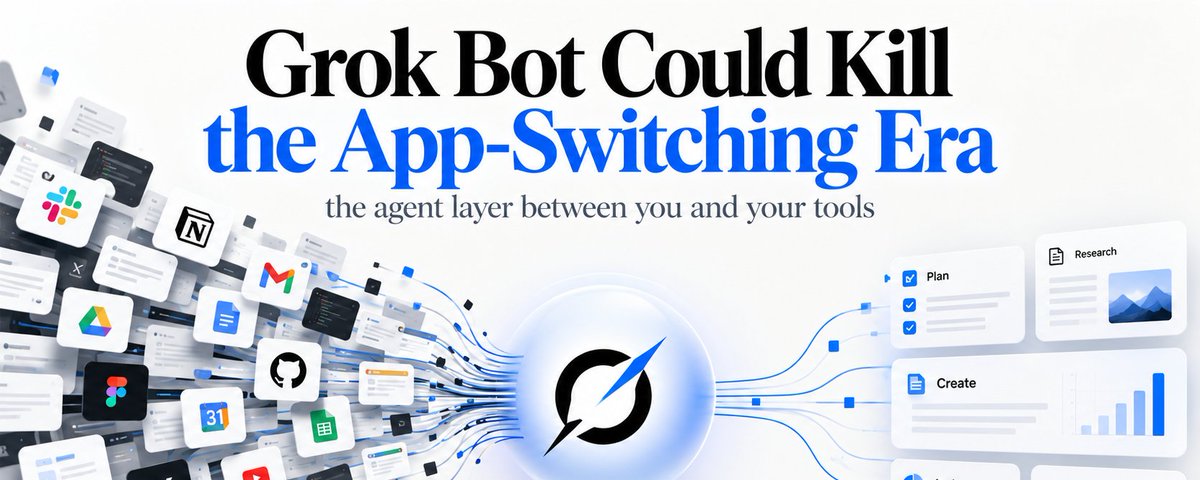
GOOGLE SPEAKER JUST EXPLAINED WHY HALF YOUR WORK APPS COULD BECOME USELESS.
And it’s the perfect setup for what Grok Bot could become.
Most people still waste hours bouncing between Slack, Gmail, spreadsheets, docs, and dashboards just to finish one task.
That’s the old workflow.
The new one is simple:
Objective → Research → Execute → Verify → Deliver
Instead of managing every app yourself, you give the system a job and let it coordinate the workflow.
It’s f*cking insane...
And the real upside is bigger than productivity.
The same architecture could run an AI quant research loop that tests strategies, rejects fake alpha, and checks risk before real money gets touched.
Grok Bot coordinates the work.
A decision layer routes the next action.
Code enforces the limits.
The human controls the capital.
The future of AI is not better chat.
It’s AI that can actually move work forward.
Watch the Google AI discussion.
Then read the full Grok Bot operating system guide below ↓
akame retweeted
Anthropic's Cat Wu is showing Claude Code on stage, but the biggest AI coding breakthrough might have nothing to do with a smarter model.
LangChain improved its coding agent from 52.8% to 66.5% without changing the underlying model.
That's a 13.7-point improvement.
F*cking insane...
The secret is Harness Engineering.
Instead of endlessly rewriting prompts, you build a system that gives Claude the right context, controlled tools, real tests, and automatic failure recovery.
Claude writes the code while the harness verifies whether it actually works.
Failed tests trigger repairs. Checkpoints preserve progress. Independent reviews catch mistakes before deployment.
Same intelligence. Better execution. Completely different results.
Watch Cat Wu's Claude Code session.
Then grab the full Harness Engineering prompt and step-by-step guide in the article below ↓
akame retweeted
It's f*cking powerful...
This 69-minute Stanford AI lecture reveals why building a reliable AI team takes more than connecting powerful models
Most people focus on making one agent smarter
The bigger opportunity is designing a system where multiple agents can work together, preserve context, and verify each other's results
That's exactly the idea behind Grok Bot + Claude
One coordinator manages the workflow while four specialized workers handle research, implementation, verification, and reporting
Chief → Researcher → Claude Builder → Reviewer → Reporter
The real breakthrough happens when the system can continue working after you leave
Shared memory preserves decisions, Claude Code builds the solutions, and independent verification checks the results before anything reaches production
The goal isn't to create five chatbots
It's to build one AI team that produces work you can actually trust
Watch the Stanford lecture
Then read the full Grok Bot + Claude AI Team engineering guide below ↓

akame retweeted
It's f*cking crazy...
Stanford professor Andrew Ng has spent years explaining why the biggest advantage in AI is not a more powerful model
It is building a system that can learn from experiments instead of starting from scratch every time
That same principle is exactly what makes Grok Bot + Claude interesting
Give Grok Bot one objective and let a team of specialized agents handle the work
Chief coordinates the tasks
Researcher collects evidence
Claude builds the solution
Reviewer tests the results
Reporter prepares the final handoff
But the real breakthrough is what happens between sessions
Shared memory preserves decisions, checkpoints track unfinished work, and independent verification catches failures before anything reaches production
The system can keep working without turning every task into another conversation you have to supervise
The goal is not to build the smartest chatbot
It is to build an AI team that can finish real work and prove what it actually accomplished
Watch Andrew Ng's Stanford lecture
Then read the full Grok Bot + Claude AI Team engineering guide below ↓
akame retweeted
A Stanford lecture on AI shows why giving models more context is not the same as giving them better memory
Most people think an agent becomes smarter when it remembers everything
That is exactly where long-running systems start breaking
The real unlock is teaching AI what to keep, what to retrieve, and what to forget
Memory → Retrieval → Context → Checkpoint → Verification → Update
It's f*cking important...
An agent can remember an old deadline perfectly and still make the wrong decision
It can preserve thousands of conversations while missing the one rule that actually matters
The solution is not a bigger context window
It is a memory system that checks fresh evidence, preserves critical decisions, and retires outdated information
The smartest agent is not the one that remembers everything
It is the one that knows which memories to trust
Watch the Stanford lecture
Then read the full AI Memory Stack engineering guide below ↓


akame retweeted
SpaceXAI engineer Lauren Tan just explained why scaling agents is not about adding more intelligence
Most people try to make one model smarter
The better approach is to build constraints, verification, and architecture that every future agent inherits
In this 1-hour workshop, she breaks down the system behind that shift:
00:46 - why trust becomes the bottleneck once agents start acting on their own
05:39 - how verification skills close the loop instead of relying on model confidence
13:08 - how Pstack turns repeated engineering work into reusable infrastructure
17:23 - why skills and evals have to improve together
23:42 - how cloud agents scale the work without scaling human supervision
29:20 - why architecture and constraints matter more as autonomy increases
38:02 - how CI becomes an enforcement layer instead of another prompt
48:00 - what changes when the agent can keep working after you leave
The same idea is exactly what makes Grok Bot interesting
The model generates
The decision layer routes
Code enforces the hard rules
The human only handles the exceptions
And in quant, the architecture becomes:
Hypothesis → Test → Reject → Stress → Size → Monitor
This workshop is worth more than most paid agent engineering courses
Bookmark and watch it today
Then read the full Grok Bot operating system below ↓
akame retweeted
SpaceXAI engineer Nick Miller just explained how to turn Grok Bot from one chat window into an actual AI team
Most people still run one agent and manually coordinate everything around it
Miller runs 20+ GrokBots with separate roles, computers, and workflows instead sotwe
In this 27-minute Agent Conf talk, he breaks down the shift:
00:00 - why chatbots and copilots are becoming the old interface
05:00 - how persistent GrokBots work across real tools
10:00 - why each Bot needs its own role instead of one giant prompt
15:00 - Chief of Staff, PM, QA and specialist worker Bots
20:00 - loops and graphs that let Bots hand work to each other
24:00 - how this turns into a software factory instead of another AI assistant
Chatbot → Copilot → Grok Bot → Bot Teams →
Software Factory
The important part is not having more agents
It is removing the human from the coordination layer
And that is exactly where the Grok Bot architecture in the article gets interesting:
model → generates
decision layer → routes
code → enforces
Grok Bot → coordinates
human → handles the exceptions
Watch the full 27-minute talk
Then read the Grok Bot operating system below ↓