
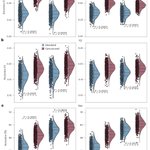


There is still much to learn about caricatured FC, but we conclude that dominant task-like patterns are not the only useful signals. What the caricatured data represents and how it can be optimized for downstream applications are exciting questions ready for future exploration.
We then created predictive models using the caricatured connectomes and benchmarked the performance versus standard model accuracy. Caricatured models predicted most behaviors tested and sometimes outperformed standard models, suggesting a useful and unique source of information.


We first ensured the method truly caricatures the data according to the definition proposed by Finn et al., 2017 (NeuroImage). By demonstrating decreased between-individual similarity and increased fingerprinting accuracy, we showed that the caricaturing definition is satisfied.


Resting-state FC has long been a source of debate. Recent evidence suggests that task-like patterns dominate its signal. To study less dominant components, we introduced a caricaturing method to project the data to a subspace orthogonal to these patterns.
rdcu.be/eN1gJ
Raimundo Rodriguez retweeted

Use machine learning in🧠research or for other high-dimensional data?
Curious about its robustness to data manipulations ("trustworthiness")?
Check out our new article in @Patterns_CP and thread ⬇️ cell.com/patterns/fulltext/S…

Raimundo Rodriguez retweeted

Curious about how frailty may be an indicator of other health outcomes? We present new work that suggests a link between frailty and >300 health-related outcomes, especially those relating to mental health, which may be mediated by brain structure. Now out in @LancetDigitalH

5/5 @sNeuroble, @LinkTejavibulya, @DScheinost, @YaleRadiology, @Yale_INP, @YaleMRRCneuro, @NeuroImage_EiC
4/5 Here, we introduced a statistical application of the edge-centric framework popularized by @joshfasky, @richardfbetzel, and others. We still have much to learn about edge-centric networks, but as edge-centric research progresses, we anticipate power will continue to increase.
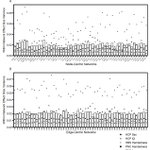
3/5 So is edge-centric *better* than node-centric? It’s relative: Node-centric networks had lower mean within-network effect size variance, but edge-centric networks varied less in this measure across networks implying they are more fair to the underlying effects.

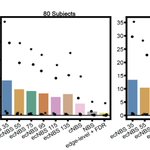
2/5 Using edge-centric partitions in the network-level inferential procedure, we observed up to a ~3.5-fold average increase in power compared to the complementary node-centric approach. An even larger increase in power was seen compared to edge-level FDR correction and NBS.

1/5 Remember when @sNeuroble went Super Saiyan?
teapawt.net/sNeuroble/status/15552…
We made it edgier, addressing a question that arises from her cNBS work–how to pool edges? In our new work, we explore the use of edge-centric, rather than node-centric, networks.
doi.org/10.1016/j.neuroimage…

Do you use cluster-level inference to pinpoint effects? 🧠🎯
Are you concerned about power? 🔍
Then we have a simple message for you:
Level Up 💪🏾
pnas.org/doi/10.1073/pnas.22…
w/ @DScheinost @mandyfmejia @AndrewZalesky
@PNASNews
1/6
Raimundo Rodriguez retweeted
Very excited for this - thanks for the opportunity @riotscienceclub!

Super excited to welcome @DScheinost and @RosenblattMatt speaking (virtually) for RIOTS all the way from across the pond @Yale. Make sure not to miss it!

Raimundo Rodriguez retweeted
Excited to share our latest work investigating associations between grip strength, mental health, and brain structure. Thanks to all excellent coauthors @maggieeastfire @sNeuroble @RosenblattMatt @WeiDai1 @kittysj @vdcalhoun @DScheinost bmcmedicine.biomedcentral.co…

Raimundo Rodriguez retweeted
Are you in a neuroscience-related field? We are seeking online survey participants for the study: “Opinions on self-citation rates in neuroscience research”. It will only take about 10 mins if you are interested in participating: yalesurvey.ca1.qualtrics.com…