

Race Reflections is a U.K. based social enterprise tackling inequality, injustice & oppression — join us in our quest to make society fairer & safer for all.
England, United Kingdom
Joined November 2020
- Tweets2.3K
- Following18
- Followers3.1K
- Likes771

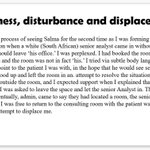

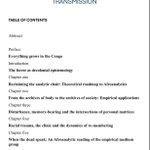



I have just remembered 5-6 years ago, I did do a Twitter survey on people experience’s of scapegoating.
I was interested in the link between people saying they had a propensity to be entrusted with secrets, had repeated experiences of strangers confiding in them and scapegoating.
And it was a reasonably large sample N > 150, to my recollection and it seems, as expected, there was a statistically significant correlation.
Not a robust study of course a hand that appears to support the same axis sensitivity-disturbance and also holding in some sense.
I will try to dig this, because perhaps I made sense of this differently, I cannot remember the questions I asked, it was well before my current scholarship

The metaphisics of sensitivity
My good people, I have accepted an invite to speak at the Tavistock again, on the Doctoral Programme in social work/care this February — I will share details as soon as I can.
Today I have been thinking about sharing some Afroanalytic thoughts on intuition, before I got the invite actually so I think I’ll turn the thoughts below onto that talk.
Here is the direction of the possible abstract.
What if sensitivity were not simply a quality or disposition inherent to the subject, but a communal resource, designated and bestowed upon particular members, and through which collective life is organised?
What if it were through sensitivity that a group’s knowing and unknowing are structured, that the memory of the unsaid and the unsayable is sustained? That discarded knowledge or knowledge at risk of being discarded is transmitted across time and space? What if sensitivity allowed for contested understandings of reality to be
preserved?
Those links above would imply those most likely to become sites of communal archives are also perceptively gifted. And those who are perceptively gifted are also most likely to become the location of disturbance as it is understood in groups.
This is an Afroanalytic line of interrogation and thinking, I have shared through various angles.
It mlinks sensitivity to inheritance, memory-bearing, and storytelling. It seeks to deprivatise and deindividualise sensitivity by emphasising its communal functions and its relationship to the immaterial.
Drawing on African metaphysics, this approach to sensitivity expands our understanding of disturbance, embodiment, and the relationship between groups, knowing and memory.
Although this formulation appears to be opposed to classic analytic understanding of disturbance, it is like much of Afroanalytic ideas, which push and expend the boundaries of the conceptually legitimate beyond so called scientific realism, and used alternative exploitations for phenomena both scholarly orientations note.
I think I will make this the focus on my talk… what do you think? sensitivity as a collective, historical, metaphysical and epistemic resource, basically.
88
I wanted to share another slip I made live. When I wrote…´Today I have been thinking about sharing some Afroanalytic thoughts on intuition’ I meant ‘Today I have been thinking about sharing some Afroanalytic thoughts on sensitivity’
Isn’t it the most useful of slips, like heart and art I shared last month, the slip is forcing to me to explore the relationship between sensitivity and intuition and although I do not think the two constructs are interchangeable at all, and can exist independently I think they often overlap?There is an interesting question from an Afroanalytic perspective;
Could sensitivity, understood as astute attunement to phenomena, dynamics, patterns, and experience that do not easily reach the threshold of perception for most,
be one of the ways through which forms of knowing become which are discarded/disavowed or repressed become available to intuitive understanding?
The metaphisics of sensitivity
My good people, I have accepted an invite to speak at the Tavistock again, on the Doctoral Programme in social work/care this February — I will share details as soon as I can.
Today I have been thinking about sharing some Afroanalytic thoughts on intuition, before I got the invite actually so I think I’ll turn the thoughts below onto that talk.
Here is the direction of the possible abstract.
What if sensitivity were not simply a quality or disposition inherent to the subject, but a communal resource, designated and bestowed upon particular members, and through which collective life is organised?
What if it were through sensitivity that a group’s knowing and unknowing are structured, that the memory of the unsaid and the unsayable is sustained? That discarded knowledge or knowledge at risk of being discarded is transmitted across time and space? What if sensitivity allowed for contested understandings of reality to be
preserved?
Those links above would imply those most likely to become sites of communal archives are also perceptively gifted. And those who are perceptively gifted are also most likely to become the location of disturbance as it is understood in groups.
This is an Afroanalytic line of interrogation and thinking, I have shared through various angles.
It mlinks sensitivity to inheritance, memory-bearing, and storytelling. It seeks to deprivatise and deindividualise sensitivity by emphasising its communal functions and its relationship to the immaterial.
Drawing on African metaphysics, this approach to sensitivity expands our understanding of disturbance, embodiment, and the relationship between groups, knowing and memory.
Although this formulation appears to be opposed to classic analytic understanding of disturbance, it is like much of Afroanalytic ideas, which push and expend the boundaries of the conceptually legitimate beyond so called scientific realism, and used alternative exploitations for phenomena both scholarly orientations note.
I think I will make this the focus on my talk… what do you think? sensitivity as a collective, historical, metaphysical and epistemic resource, basically.
Race Reflections retweeted
The metaphisics of sensitivity
My good people, I have accepted an invite to speak at the Tavistock again, on the Doctoral Programme in social work/care this February — I will share details as soon as I can.
Today I have been thinking about sharing some Afroanalytic thoughts on intuition, before I got the invite actually so I think I’ll turn the thoughts below onto that talk.
Here is the direction of the possible abstract.
What if sensitivity were not simply a quality or disposition inherent to the subject, but a communal resource, designated and bestowed upon particular members, and through which collective life is organised?
What if it were through sensitivity that a group’s knowing and unknowing are structured, that the memory of the unsaid and the unsayable is sustained? That discarded knowledge or knowledge at risk of being discarded is transmitted across time and space? What if sensitivity allowed for contested understandings of reality to be
preserved?
Those links above would imply those most likely to become sites of communal archives are also perceptively gifted. And those who are perceptively gifted are also most likely to become the location of disturbance as it is understood in groups.
This is an Afroanalytic line of interrogation and thinking, I have shared through various angles.
It mlinks sensitivity to inheritance, memory-bearing, and storytelling. It seeks to deprivatise and deindividualise sensitivity by emphasising its communal functions and its relationship to the immaterial.
Drawing on African metaphysics, this approach to sensitivity expands our understanding of disturbance, embodiment, and the relationship between groups, knowing and memory.
Although this formulation appears to be opposed to classic analytic understanding of disturbance, it is like much of Afroanalytic ideas, which push and expend the boundaries of the conceptually legitimate beyond so called scientific realism, and used alternative exploitations for phenomena both scholarly orientations note.
I think I will make this the focus on my talk… what do you think? sensitivity as a collective, historical, metaphysical and epistemic resource, basically.
The role of gender in displacement
I have been asked a question about the place of gender in the displacement…
This is my response more or less verbatim.
Yes. Gender is operative for sure, the people involved, the patient, the supervisor and indeed all the reception staff were women…
BUT I was also the only black body in the space.
So to decide the significance and intersection of these variables, let’s ask ourselves, could this have happened to a white woman? It is possible but less likely I feel that amongst an all-white women bystanders crowd, the interaction would have enfolded as it did.
Of course the context would have been different and lead to different interpretations equally worth exploration.
Now, how much more likely is it that it could have happened to a black male clinician, much more likely than to a white woman.
I’m not convinced that the intersection of gender and race here in particular led to increase in the risk of displacement. However, I’m willing to concede that there was some intersection.
So for me that is the first clue that whiteness is the most significant operative factor. This is supported by my sole blackness first of all and most importantly by the blanket denial to explore the coloniality of the racial dynamic, evidence of disturbance in and of itself.
I always say if in doubt about the racialised nature of an incident observe closely the responses that follow — here denial and lack of containment, they will be part of the frame.
I doubt very much that I would have faced such fierce resistance, if gender was the main or only factor at play, if I wanted to discuss gender oppression, supporting my interpretative proposition.
But even then when we are talking about intersection basically interactions in statical thinking, we need to accept that in some context one axis of oppression may have a greater influence on a particular outcome. This should not be controversial to say.
We can of course never be sure and the point is not to reach certainty the point is to reach reflexivity, humility and depth and therefore to settle, if only provisionally on that hypothesis which holds the most explanatory power — while holding competing explanations in mind, if they cannot be dismissed.
Thank you for the question and I hope my answer helps.
Good morning!
This morning I want to return to the body.
I suggested yesterday that embodiment required attention — I invited you in the same way I invited the students to reflect on the dizziness, disorientation, and vertigo I experienced following the supervisor’s words.
These physical responses are entirely consistent with the kind of enactment of racialised power I experienced.
This enactment was bound to space; it was spatial violence. I was displaced from space: from a room I had legitimately occupied as a clinician; thus from my role and professional identity; I was displaced from the safety of the analytic frame; and I was displaced from my capacity to think.
Epistemically, I was rendered homeless — remember when I say the capacity to know is dependent on the capacity to have a home…? If only momentarily, I lost that capacity because I lost that home.
A further reminder that racism often attacks the racialised subject’s capacity to think. So, for a few seconds I lost my bearings physically and epistemically.
So we can see that my body reacting with dizziness — almost as though the rug was pulled from under my feet — is entirely consistent with the symbolic and literal actions in the hospital.
I was destabilised in space, and I felt destabilised. Even if one argues, I responded with this vertigo and dizziness because I was having an acute stress response and became autonomically activated, there is a wide repertoire of bodily responses that can be triggered under stress or under duress.
Stress is involved but alone is not precise enough as an explanatory frame. It does not account for why my body responded in the specific way that it did. We can be more attuned to the links between the body’s responses and the form of violence, it is subjected to.
Again we are only formulating, not trying to make truth claims, only exploring these relationships.
I would say the attack on my capacity to think, the symbolic blow to my head we could say, is something also reflected in students’ comments.
Many noted the irrationality of the senior analyst’s actions, with a student stating it was as though ‘he was possessed by some kind of colonial archetype’ — a very vivid imagery, particularly useful if we return to scripts, repetitions, and equivalence.
So we could say, analytically, at least two things. In the moment that I was experiencing the dizziness and vertigo, I was not formulating in my head that I had been displaced from space, that there were strong colonial echoes, or that I recognised that script as heavily loaded historically and ancestrally.
I was simply attempting to keep grasp of was happening. But my body, we could say, recognised the spatial violence and responded in a spatialised manner — pointing to the specific disturbance. Therefore, the possibility that my body registered the violence before it could be fully symbolised, is viable.
If like Bion we speak of containment as the transformation of inarticulate or pre-verbal emotional experience into thought and meaning, containment was triply disrupted: first, by the senior analyst - who could be said to represent authority, if not a parental figure - then by my quasi-maternal figure, the supervisor, who also did not provide containment; and then by peers and colleagues in the broader profession who simply refused to allow any kind of meaningful racialised meaning-making, so that was left to contain the experience without support.
So we could say the supervisory then structural refusal to contain repeats the initial displacement.
Finally, my body responding as though I had been hit at the back of the head makes the violence of mundane racialised exchanges hard to ignore. It makes it impossible to deny in good faith that such racialised enactments have significant implications for our health, I add here the connection between hypertension and race discrimination. Core symptoms of hypertension are dizziness and head spinning…
Thoughts welcome
Race Reflections retweeted
Good morning!
This morning I want to return to the body.
I suggested yesterday that embodiment required attention — I invited you in the same way I invited the students to reflect on the dizziness, disorientation, and vertigo I experienced following the supervisor’s words.
These physical responses are entirely consistent with the kind of enactment of racialised power I experienced.
This enactment was bound to space; it was spatial violence. I was displaced from space: from a room I had legitimately occupied as a clinician; thus from my role and professional identity; I was displaced from the safety of the analytic frame; and I was displaced from my capacity to think.
Epistemically, I was rendered homeless — remember when I say the capacity to know is dependent on the capacity to have a home…? If only momentarily, I lost that capacity because I lost that home.
A further reminder that racism often attacks the racialised subject’s capacity to think. So, for a few seconds I lost my bearings physically and epistemically.
So we can see that my body reacting with dizziness — almost as though the rug was pulled from under my feet — is entirely consistent with the symbolic and literal actions in the hospital.
I was destabilised in space, and I felt destabilised. Even if one argues, I responded with this vertigo and dizziness because I was having an acute stress response and became autonomically activated, there is a wide repertoire of bodily responses that can be triggered under stress or under duress.
Stress is involved but alone is not precise enough as an explanatory frame. It does not account for why my body responded in the specific way that it did. We can be more attuned to the links between the body’s responses and the form of violence, it is subjected to.
Again we are only formulating, not trying to make truth claims, only exploring these relationships.
I would say the attack on my capacity to think, the symbolic blow to my head we could say, is something also reflected in students’ comments.
Many noted the irrationality of the senior analyst’s actions, with a student stating it was as though ‘he was possessed by some kind of colonial archetype’ — a very vivid imagery, particularly useful if we return to scripts, repetitions, and equivalence.
So we could say, analytically, at least two things. In the moment that I was experiencing the dizziness and vertigo, I was not formulating in my head that I had been displaced from space, that there were strong colonial echoes, or that I recognised that script as heavily loaded historically and ancestrally.
I was simply attempting to keep grasp of was happening. But my body, we could say, recognised the spatial violence and responded in a spatialised manner — pointing to the specific disturbance. Therefore, the possibility that my body registered the violence before it could be fully symbolised, is viable.
If like Bion we speak of containment as the transformation of inarticulate or pre-verbal emotional experience into thought and meaning, containment was triply disrupted: first, by the senior analyst - who could be said to represent authority, if not a parental figure - then by my quasi-maternal figure, the supervisor, who also did not provide containment; and then by peers and colleagues in the broader profession who simply refused to allow any kind of meaningful racialised meaning-making, so that was left to contain the experience without support.
So we could say the supervisory then structural refusal to contain repeats the initial displacement.
Finally, my body responding as though I had been hit at the back of the head makes the violence of mundane racialised exchanges hard to ignore. It makes it impossible to deny in good faith that such racialised enactments have significant implications for our health, I add here the connection between hypertension and race discrimination. Core symptoms of hypertension are dizziness and head spinning…
Thoughts welcome
I did not put emphasis on this, but may I also invite you to consider the embodied response to the supervisor’s actions, some have called collusion?
Yesterday I did ask the students to reflect on this and return to the body. I felt disoriented, dizzy, vertigo… for a minute or so seconds. I’ll leave this here for you to consider.
I may share how we collectively formulated.
Race Reflections retweeted
My good people
Second Open Day — Foundation course in Group Analysis and racial trauma.
November 30th 16h00 to 18h00
A gentle reminder that we still have places to grab onto the certificate in working with racial trauma using the foundation of Group Analysis. Half the places have gone and we are now outside the early bird period but you can still join!
Race Reflections’ members, remember that your fees is fixed at £1250 — instead of the now £1800 for non-members (+ vat) — but I have more good news and I will be emailing you directly before going public.
And because I have received a couple of queries about Afroanalytics… yes, we cover the fundamentals as part of the programme as critique/alternative to understanding group forces, inheritance and transmission without Eurocentric sanitation.
So yes, excited people say they want to learn more.
Join us at the end of the month.
racereflections.co.uk/events…
Good morning!
This morning I want to return to the body.
I suggested yesterday that embodiment required attention — I invited you in the same way I invited the students to reflect on the dizziness, disorientation, and vertigo I experienced following the supervisor’s words.
These physical responses are entirely consistent with the kind of enactment of racialised power I experienced.
This enactment was bound to space; it was spatial violence. I was displaced from space: from a room I had legitimately occupied as a clinician; thus from my role and professional identity; I was displaced from the safety of the analytic frame; and I was displaced from my capacity to think.
Epistemically, I was rendered homeless — remember when I say the capacity to know is dependent on the capacity to have a home…? If only momentarily, I lost that capacity because I lost that home.
A further reminder that racism often attacks the racialised subject’s capacity to think. So, for a few seconds I lost my bearings physically and epistemically.
So we can see that my body reacting with dizziness — almost as though the rug was pulled from under my feet — is entirely consistent with the symbolic and literal actions in the hospital.
I was destabilised in space, and I felt destabilised. Even if one argues, I responded with this vertigo and dizziness because I was having an acute stress response and became autonomically activated, there is a wide repertoire of bodily responses that can be triggered under stress or under duress.
Stress is involved but alone is not precise enough as an explanatory frame. It does not account for why my body responded in the specific way that it did. We can be more attuned to the links between the body’s responses and the form of violence, it is subjected to.
Again we are only formulating, not trying to make truth claims, only exploring these relationships.
I would say the attack on my capacity to think, the symbolic blow to my head we could say, is something also reflected in students’ comments.
Many noted the irrationality of the senior analyst’s actions, with a student stating it was as though ‘he was possessed by some kind of colonial archetype’ — a very vivid imagery, particularly useful if we return to scripts, repetitions, and equivalence.
So we could say, analytically, at least two things. In the moment that I was experiencing the dizziness and vertigo, I was not formulating in my head that I had been displaced from space, that there were strong colonial echoes, or that I recognised that script as heavily loaded historically and ancestrally.
I was simply attempting to keep grasp of was happening. But my body, we could say, recognised the spatial violence and responded in a spatialised manner — pointing to the specific disturbance. Therefore, the possibility that my body registered the violence before it could be fully symbolised, is viable.
If like Bion we speak of containment as the transformation of inarticulate or pre-verbal emotional experience into thought and meaning, containment was triply disrupted: first, by the senior analyst - who could be said to represent authority, if not a parental figure - then by my quasi-maternal figure, the supervisor, who also did not provide containment; and then by peers and colleagues in the broader profession who simply refused to allow any kind of meaningful racialised meaning-making, so that was left to contain the experience without support.
So we could say the supervisory then structural refusal to contain repeats the initial displacement.
Finally, my body responding as though I had been hit at the back of the head makes the violence of mundane racialised exchanges hard to ignore. It makes it impossible to deny in good faith that such racialised enactments have significant implications for our health, I add here the connection between hypertension and race discrimination. Core symptoms of hypertension are dizziness and head spinning…
Thoughts welcome
I did not put emphasis on this, but may I also invite you to consider the embodied response to the supervisor’s actions, some have called collusion?
Yesterday I did ask the students to reflect on this and return to the body. I felt disoriented, dizzy, vertigo… for a minute or so seconds. I’ll leave this here for you to consider.
I may share how we collectively formulated.
Reflections on analytic defenses…
I want to share a few reflections based on the vignette I shared yesterday, which we discussed as part of our seminar on dynamic administration.
I think it’s very easy to get comfortable when we’re speaking to people who get it — people invested in equality, justice, and liberation. We can forget that this understanding is not the norm — particularly within professional fields, and within the psychotherapy and psychology world at large.
So I wanted to share some reflections on discussing that vignette with analysts more broadly, and the kinds of defensive responses I have encountered.
The most common reaction is to see the intrusion into the space simply as a concrete boundary violation; one that has nothing to do with race, or gender — and to refuse to make/attack those links (see Bion).
This is striking, isn’t it? Because the bread and butter of group and analytic practitioners is precisely to think deeply about the matrix — to consider what *communication* may be unfolding at personal, dynamic, and institutional levels.
It is fascinating that people trained to think deeply about the unconscious, to attune to its communications and its enactments, both relationally and within groups would refuse to consider, if only hypothetically, that there might be something significant here when it comes to the repetition of particular racialised histories.
On this point — and as we discussed yesterday — there is a tendency, when thinking about repetition compulsion, to look at an individual’s history and ask whether they might have invited violations due to unresolved trauma.
Following that line of thought, people may zero in on my history of displacement. And of course I have such a history: I have a history of migration, I am the child of migrants, descended from people carrying ancestrally inherited histories of displacement. That is absolutely part of the formulation. But stopping there is part of how dysfunction and disturbance get located in those with less social power — and how our understanding of social reality becomes skewed.
This white man also has a history of migration. As a white South African in Britain — that history of displacement, and indeed of *displacing*, is not distant from him either.
This takes us to the repetition of the broader history of colonialism — the ways Black and Brown bodies have been positioned in space, how whiteness has been made to feel at home and prioritised, and the violence of white expectations of comfort, priority, and entitlement.
These are scripts, narratives, and discourses are echoed and repeated in that interaction too.
So I find myself genuinely flabbergasted that so many colleagues have resisted engaging with these reflections, insisting instead on reading the situation through racially and power-neutral lenses: “It’s all because he was senior,” “I am white, I’ve also had a similar experience,” “How do you know race was at play?” — Not only refusing to consider the unconscious and symbolic communication, but discarding the very concepts group analysis puts at our disposal that speak directly to such processes.
I’m thinking especially of Hopper’s concept of equivalence; the idea that groups and social structures can and do repeat historical trauma. Isn’t colonialism a profound historical trauma? — asking rhetorically, for a friend.
I’m sharing this because our conversation yesterday felt clear and easy — I was speaking with students who already grasp these ideas if only viscerally, and there was no resistance, even among those racialised as white.
But we must remember: most people do resist. My invitation to you is this: before reaching for the impulse to find an individualised explanation for what happened — pause. Consider the symbolic. Consider the unconscious. Consider group forces. Consider history. Consider what is discomforting, that is where the deeper understanding lies.
racereflections.co.uk/workin…