ceo @ValsAI | solve evals, solve intelligence prev @stanford @PalantirTech
Joined April 2019
- Tweets531
- Following454
- Followers3K
- Likes1.5K






it’s not immediately clear what that gap between open and closed source will actually close.
egalitarian platforms like x have a tendency to become echo chambers to developments that are philosophically consistent.
unfortunately we’re approaching a world in which relative differences of models are indistinguishable to normal people.


Rayan Krishnan retweeted
Does it matter where you run an open-weight model?
Today we are releasing the Inference Provider Index. It compares first and third-party open-weight models for quality on agentic tasks in finance, coding, and legal industries.
Unlike other inference benchmarks, we rerun it every two weeks to catch quality degradation, and we use agentic tasks, not single-turn multiple-choice questions. It covers over 650 hours of model runtime.

Richard has been thinking deeply about the limits of intelligence (not just imitating human intelligence). Excited for this one

Introducing Flint, @Recursive_SI’s first model: a fast local coding model built with our automated research system, the Eureka Machine.
• Best-in-class fast local coding
• Up to 2x faster than comparable models: 125+ tokens/sec on a MacBook Pro, 150+ on RTX Spark
• Built from scratch in under 4 months
Private, unmetered intelligence on your own machine. Open weights available now on @huggingface, run it locally on your favorite framework or try it for free on @opencode or @pidotdev.
Rayan Krishnan retweeted

Excited to launch Before They Break Out, where I’ll spotlight promising startups before the rest of the world catches on.
Kicking off with Vals AI, a startup building critical evaluation infrastructure for the future of AI. @ValsAI @RayanKrishnan

Introducing Before They Break Out, where we explore promising startups and why they’re worth joining early. First up: Vals AI, a company building the measurement layer for artificial intelligence. @ValsAI @RayanKrishnan
beforetheybreakout.substack.…
The latest DeepSeek model makes powerful offensive cyber capabilities accessible to a much wider range of actors. The increase in risk is enormous.
We found DeepSeek V4.1 Flash 1017 beats GPT 6 Sol on our multi-step offensive cybersecurity task. Sol was tested via the Daybreak trusted access program.
We have been building a cybersecurity benchmark based on simulated corporate networks. This is a valuable indicator for the cyber-risk a model poses if in the hands of a bad actor. We plan to make the full evaluation public in the coming weeks but wanted to share our first immediate finding here.

people like indices because they represent intelligence unidimensionally. but a model's ability to do knowledge work (vals index) doesn't predict whether it can do scientific research.
this is an important step for us toward measuring a model's propensity for novel scientific breakthroughs.
Science reshuffles the leaderboard: GPT-6 Astra ranks first here but seventh on the Vals index.
GPT-6 Astra costs $8.03 per test run, while GPT-6.1 Sol is 5.6 points behind at just $1.36, the cheapest of the top three. Claude Sonnet 5.5 is the most expensive of the three at $13.24, more than 9x the cost of GPT-6.1 Sol for a 0.5 point lower score.

not a secret, our external rsi index has predicted the same timeline


Dwarkesh Patel reveals an Anthropic employee told him two days ago they expect AIs to match humans at AI research within nine months based on inside information they can’t share, and says labs should make that evidence public
“I think there’s a very frustrating element to the current situation right now, where people inside the AI labs claim to have evidence that makes them more worried. And they are not allowed to talk about it. And this makes it a very difficult situation on the outside to evaluate how worried we should be."
"So for example, just the other day, maybe two days ago, I was talking to somebody at Anthropic and they were like, look, I expect AIs to be humans at AI research within nine months."
"And I’m like, why do you believe that? Well, they’re like, it’s not just vibes, but I have information on the inside. Like, what is it? Is it a new model? Is it some evaluation you ran? It’s like, I can’t talk about it."
"I think it’s a terrible state of affairs. If they really believe this, if they think that we’re in a situation where we’re less than a year away from automating AI research and radically speeding it up, they should make this evidence public.”
Rayan Krishnan retweeted

Our RSI index perfectly predicts this btw

Dwarkesh Patel reveals an Anthropic employee told him two days ago they expect AIs to match humans at AI research within nine months based on inside information they can’t share, and says labs should make that evidence public
“I think there’s a very frustrating element to the current situation right now, where people inside the AI labs claim to have evidence that makes them more worried. And they are not allowed to talk about it. And this makes it a very difficult situation on the outside to evaluate how worried we should be."
"So for example, just the other day, maybe two days ago, I was talking to somebody at Anthropic and they were like, look, I expect AIs to be humans at AI research within nine months."
"And I’m like, why do you believe that? Well, they’re like, it’s not just vibes, but I have information on the inside. Like, what is it? Is it a new model? Is it some evaluation you ran? It’s like, I can’t talk about it."
"I think it’s a terrible state of affairs. If they really believe this, if they think that we’re in a situation where we’re less than a year away from automating AI research and radically speeding it up, they should make this evidence public.”
An oracle router on our Vals Index would score ~13pp higher than the best model and be 37% cheaper.
Routers have emerged as a new primitive in the AI stack, we're excited to partner across the major providers to develop a methodology for consistent evaluation.
Models are shipping faster than ever. In this past month alone, Vals tested 16 new LLMs and no single model leads on everything. That is why routers have become a core primitive in the AI stack.
We partnered with @OpenRouter, @tryramp, @FireworksAI_HQ and @notdiamond_ai to share what’s missing in how routers get evaluated.
Check out our latest blog:

Some thoughts on the new Meta release today:
- The models from MSL have improved quickly. They’re not just competing for Pareto optimal anymore, but driving for the frontier.
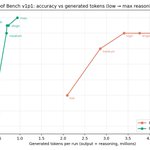
- To me, the biggest unlock of these models is their token efficiency. They’re able to see significant performance increases while reasoning less and spending fewer tokens / turns. In Vibe Code Bench ,WF gets the same performance as MS 1.3 in half the number of steps. Smarter models think more efficiently.
- Today, Muse Wonder Full is only available in in-app experiences (not via API). It may be that we see an even tighter coupling between models and first party applications. Or that this gating prevents nefarious actors from misusing the most capable intelligence. Not yet clear what the plan is.
- MSL is making some serious progress on alignment. We’ll have more to share publicly here soon. Meta hasn’t been as vocal about safety, but to service Muse so widely they have needed to solve some fundamental alignment challenges.
- Relatedly, we saw 0 refusals and Wonder did better than Wonder Full on our cyber capabilities benchmarks. This is itself very good! People should not expect their hard economically valuable work to be inhibited by these models.
- The models have room for improvement on scientific discovery. They are strong executors, especially in code, but don’t have the intuition for which experiments to try. We’re still running our RSI Index, sharing results soon. If they aren’t able to maintain the frontier, this would be why.
- META went up 3% today. I’ve said it before and I’ll say it again. As AI underpins a larger part of our economy, third party benchmarks will be the best value predictor of AI labs. The market for intelligence is rationalizing.

The diffusion of personal agents (Grok bot, Muse, Dots, Instinct, etc) may cause a rapid increase in socioeconomic inequality that we are not prepared for. This follows from a rough first-principles argument:
1. Life is a set of negotiations.
2. As personal agents get better, we will delegate more of our negotiations to them.
3. Negotiations will increasingly happen directly agent-to-agent.
4. In general, agent performance scales with model intelligence and inference-time compute.
5. Personal agents that consume more frontier intelligence will win more negotiations, in expectation.
6. People with more resources will pay for more expensive personal agents.
7. Winning more negotiations begets more resources.
Therefore - people with more resources will use better agents, win more negotiations, and acquire more resources.
Consider a situation where my roommate and I are deciding how to split our rent. If we delegate the decision to our agents, with mine running Fable 5.1 and his running Luna 6, I should expect a more favorable split than if our agents were equally intelligent.
The most important junctures in life are negotiations (jobs, promotions, purchases, housing, lawsuits, etc.), so people who can afford the best agents should expect to do better in these situations, compounding their initial material advantage.
This already happens to some extent (people with more resources hire better lawyers), but it may be amplified if 1) the gap between frontier and free intelligence is wider than the status quo gap (Big Law attorney vs. public defender), or 2) delegation to agents means more negotiations occur in total, so differences compound.
Personal agents may instead reduce inequality if 1) the gap between everyday and frontier intelligence is smaller than the human equivalent, 2) agents are more neutral/rational than humans and converge on an independent truth rather than acting at the behest of their operators, or 3) superintelligence frees everyone from resource constraints entirely.
If this form of inequality emerges, possible solutions include 1) taxing tokens and 2) subsidizing intelligence for the masses.
Auditing RL environments and reward models is one of the highest-leverage tasks evaluators can do in service of building aligned models (embedded or otherwise).

Pushing the bounds on evals leads you to some interesting discoveries about language models and sometimes about the world.
For decades, researchers have sought materials that sort electrons by spin while their magnetism cancels.
In 3 days, 90+ Opus 5.5 agents helped us uncover two room-temperature magnetic semiconductor candidates in simulations: YBaMnFeO₅ and KV[Cr(CN)₆].
KV[Cr(CN)₆] was synthesized back in 1999. Its predicted ability to sort electrons by spin appears to have been hiding in plain sight for 27 years.

Bad evaluations actively harm the all parties in the industry: providers spend time/effort improving on the wrong direction, buyers don't see capability show up in practice. This has been especially true in search where existing benchmarks have been so lacking that every major search provider has built their own first party benchmark.
We developed our own methodology from first principles for evaluating search, inviting feedback from all the major search providers. Today we shared a fuller write up explaining this approach.
We realized that web search wasn’t being measured correctly and we weren’t alone. Other companies have created their own benchmarks to tackle this problem, but kept running into the same issue: data contamination, realism, and answer leakage. When benchmarks measure the wrong thing, customers can't tell which search tool is best.
We believe the teams building these tools deserve to have a third-party benchmark that measures the work their users actually need done. We’re excited to share that @ExaAILabs, @KeenableAI, @p0, and @tavilyai are joining us as partners on the Vals Web Search Index: one benchmark, the same settings for everyone, run independently.
Check out our latest blog to learn more: 🧵

AI isn't just automating tasks, it's automating the substrate of labor itself.

Vals AI CEO @RayanKrishnan argues "Claude is the salesman for Claude," because the model can eventually find the inefficient parts of your life and insert itself into them:
"I was staying with a friend's parents, and the dad is a doctor in a hospital. Every month he spends 12 hours making the schedule for the hospital. I sat down with him for an afternoon, used Claude Code and made him a little web app, and this app has saved him 12 hours every month."
"I was asking this friend of mine at Anthropic, does this mean the biggest bottleneck will actually be behavior? He said, 'No, because over time, Claude will figure out the places where you're spending time in an inefficient way and suggest how to use itself for those tasks.'"
"Claude is the salesman for Claude. It's not going to be a human bottleneck. The model is itself the solution to a lot of these problems."
@ValsAI