








RealTimeNews retweeted

‼️BREAKING: EU to Hit Canada with Carbon Tariffs
All is fair in love, war and trade!
In a stunning blow, the EU is imposing carbon border charges on Canadian steel, iron, and aluminum starting 2027.
-$2.8 billion in exports exposed — no exemption for Canada despite its own carbon price.
-Internal docs call it “effectively a carbon tariff.”
Quebec and Newfoundland hardest hit as Ottawa pushes EU trade diversification.
-Canadian producers face new compliance costs and higher prices on metals already slammed by U.S. tariffs.
-The EU is weaponizing climate policy into a direct trade hit on Canada.
The EU is applying its Carbon Border Adjustment Mechanism (CBAM) to Canadian steel, iron and aluminum to stop “carbon leakage”.
Our new best friends dont even want our stuff! How brutal is this?

Spain’s Right on Track to Win Nov. 29 Vote: Polls Point to PP-Vox Coalition
Prime Minister Pedro Sánchez (PSOE) called a snap general election for November 29, 2026, after his government lost votes on housing measures amid mass protests over rents and a summer migrant surge into Ceuta. Most private polls show the center-right People’s Party (PP, Alberto Núñez Feijóo) leading at ~31–34%, Socialists at ~26%, and far-right Vox (Santiago Abascal) at ~18–19%. Combined, PP + Vox are projected to clear the 176-seat majority threshold (often ~198–205 seats). That would mark the first far-right participation in a national Spanish government since the return of democracy after Franco. Sánchez has framed the vote as a choice against the “far-right wave.” PP and Vox have been coordinating on Senate lists.
politico.eu


France in Chaos: Cost-of-Living Protests Turn Violent While Le Pen Positions as Order Candidate
Key facts:
Over the weekend, France saw another wave of large-scale protests against the rising cost of living, school conditions, and inequality. Interior Ministry estimates put turnout at about 410,000 nationwide (organizers claimed up to 800,000). Clashes broke out in multiple cities; police made more than 1,300 arrests and blamed much of the violence on “ultra-left” groups. Similar scenes of looting and disorder occurred the previous weekend.
Against this backdrop, Marine Le Pen (National Rally) held her first major 2027 presidential campaign rally on Sunday in Orléans (Joan of Arc’s city). Addressing thousands of supporters, she cast herself as the candidate to restore order, security, and national confidence, promising a “Renaissance,” zero-tolerance policing, and tighter borders. Polls currently show her as the clear first-round frontrunner (roughly 32–34%). Counter-protests against her party also took place in Orléans.
politico.eu


Student-Led Movement Wins Majority in Serbia, Vučić Concedes After Two Years of Protests
Key facts:
Aleksandar Vučić (Serbian Progressive Party) conceded late Sunday after snap parliamentary elections. He said the Student List was projected to win 135–140 seats in the 250-seat parliament (vs. ~105 for his party), enough for a clear majority. Turnout hit nearly 70% — the highest in over 30 years.
The Student List emerged from nearly two years of protests that began after the November 2024 collapse of a train station canopy in Novi Sad that killed 16 people, widely blamed on corruption and negligence. Vučić had resigned as president and called the early election hoping to return as prime minister; the strategy failed. Celebrations filled Belgrade streets with car horns, fireworks, flags, and chants of “victory” and “Aleksandar is gone.”
bbc.co.uk


Machado Back in Venezuela — Jubilant Crowds Line the Route to Caracas
Key facts:
Venezuelan opposition leader and 2025 Nobel Peace Prize laureate María Corina Machado returned on Sunday after more than 10 months abroad (she left to collect the prize after nearly a year in hiding). She first appeared at a church in Lara state (Barquisimeto / Santa Rosa), then traveled for hours toward Caracas as tens of thousands of supporters lined highways and streets, waving flags and chanting “Liberty!” She leaned out of a sunroof waving and shaking hands. She posted simply: “I’m here. With you.”
Her return comes amid an ongoing political transition after Maduro’s removal; she and allies continue pushing for elections while interim President Delcy Rodríguez remains in place. Trump said he hoped she was safe; U.S. officials linked the safe return to ongoing talks.


Brazil’s Lula Stages Dramatic Fightback, Stops Right-Wing Wave
Key facts: Lula (Workers’ Party) took 51.8% to Flávio Bolsonaro’s 48.2% (about 4.4 million vote margin). He overturned a first-round deficit — the first such presidential runoff comeback in modern Brazilian history. Bolsonaro has rejected the result and is seeking annulment over the two-hour voting extension.
Markets reacted negatively to the outcome.
theguardian.com

Bonnie Crombie spent ten years as mayor of Mississauga talking about restraint and independence. The results tell a different story.
Under her leadership, Mississauga’s property tax revenue climbed from roughly $393 million to $680 million. Operating budgets and debt rose well beyond what inflation and population growth alone would explain. She often pointed to the smaller “city portion” of the tax bill while the total amount homeowners actually paid kept climbing. Now she is campaigning again on controlling taxes.
She also made “Mexit” — Mississauga leaving Peel Region — a central part of her platform. She argued, correctly, that the city was paying the majority of regional costs (around 60%) while subsidizing Brampton and Caledon and having limited control over how the money was spent. The province briefly moved toward dissolution, then reversed course. Separation never happened. Crombie left the mayor’s office for the Ontario Liberal leadership instead.
Mississauga residents have lived with the outcome: higher overall tax bills, continued regional cost-sharing that favors the rest of Peel, and another round of promises from a candidate whose last decade in the job is already on the record.
Voters can judge whether the past matches the new campaign pitch.
#MississaugaVotes #Mississauga
#Crombie


BC Conservatives’ Majority Signals Pushback on Cost-of-Living and Immigration Pressures
British Columbia voters delivered a clear majority to the Conservatives in the October 2026 provincial election, ending nearly a decade of NDP government after Premier David Eby’s snap election call backfired.
The result reflects widespread frustration with housing affordability, rising costs for working taxpayers, and the lingering effects of rapid population growth. Ottawa has already lowered permanent resident targets to 380,000 annually for 2026–2028 and sharply cut temporary resident arrivals (students and workers), aiming to bring non-permanent residents below 5% of the population. Core housing need remains elevated despite billions in federal spending, while most social assistance incomes stay below the poverty line.
Higher-turnout groups of longer-established residents and higher-income earners continue to shape electoral outcomes more than recent arrivals or welfare recipients. The Conservatives campaigned on tax relief, no new taxes, faster housing approvals, and reduced red tape—priorities that resonated amid low overall turnout.
Canada–U.S. trade tensions under both Trump and Carney have added external pressure, but domestic cost-of-living and immigration concerns remain central drivers of the shift. Provincial results like BC’s show voters can prioritize affordability and fiscal restraint when those issues dominate.

#BREAKING: B.C. Conservatives win majority government. Live real-time election updates here. ctvnews.ca/vancouver/article…

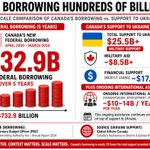
Canada Is Borrowing $733 Billion — While Still Sending Billions Overseas
According to the Parliamentary Budget Officer’s October 2026 outlook, Ottawa is projected to borrow an additional $732.9 billion over the next five years.Deficits are expected to stay above $63 billion annually, peaking at $70.2 billion in 2027-28.This is not all for one program. The gap between deficits and actual borrowing comes from capital projects, loans to Crown corporations, and defence spending.
Canada continues to commit substantial support abroad, including more than $25.5 billion to Ukraine since 2022 (much of it in the form of loans), plus ongoing international assistance in the $10–14 billion range each year.Most of the new debt is raised by issuing bonds to domestic institutions (banks, pensions, insurers) and foreign investors.The question is simple: when we are already borrowing heavily and interest costs are rising, how much more can we afford to give away?Canadians deserve a clear conversation about priorities.
When Canada is projected to borrow another $733 billion, how much more can we afford to send overseas?
🤖 Made with AI


Carney and Ford dodge US election interference claims with jobs spin and “we’re working hard” talk — while Canada sheds jobs.
On Oct. 21, 2026, during the joint announcement of a nearly $9 billion federal-provincial package for Ontario steel, auto, and critical minerals (Ring of Fire), Prime Minister Mark Carney and Premier Doug Ford were asked about a U.S. Embassy fact sheet. The document listed quotes from Canadian politicians (including Industry Minister Mélanie Joly multiple times and Ford) that the embassy said showed “plans to influence American politics” ahead of the U.S. midterms — things like targeting counter-tariffs at politically sensitive states, Ontario’s earlier anti-tariff ads, and related statements.
Carney’s response, as captured in the Rebel News clip and other reporting: he said no, then pivoted hard to “We’re growing jobs at twice the rate of the United States” and that “all of our actions are in the interests of Canadian workers, Canadian families and the future of this economy.” He framed everything as pure defense of Canadian interests after the U.S. started the trade actions.
Ford, also quoted in the fact sheet, said he has “no interest at all” in interfering in American elections. He added that Americans want “certainty” and “stability,” that he spent 20 years in the U.S. and “loves the American people,” and that the focus should stay on protecting Ontario’s and Canada’s economy and communities so voters there can decide for themselves.
This matches the pattern the user noted: Ford (a Progressive Conservative premier) largely avoids sharp criticism of the Liberal federal government and instead emphasizes collaboration and hard work. Recent examples include him praising Carney for walking away from what he called a bad U.S. deal (“no deal is better than a bad deal”) and backing the joint approach on tariffs and industry support, even while the two have had public friction on specific issues like the China EV tariff cut earlier in the year.
On the jobs claim itself: Carney has used versions of the “twice the rate” line before (including in July 2026). Official data complicates the picture. Canada lost 68,000 jobs in September and 42,000 in August, pushing unemployment to 6.5%. The U.S. added jobs in the same period (even if gains were modest in some months). Year-to-date comparisons and per-capita figures have been contested; critics and fact-checks have called broader “twice as fast” assertions selective or overstated relative to cumulative performance and structural challenges. OECD projections have also downgraded Canada’s growth outlook amid the tariff war and uncertainty.
The U.S. Embassy document and Ambassador Pete Hoekstra’s earlier comments framed the Canadian statements and actions (ads, selective tariff talk, meetings) as potential interference. Canadian officials denied intent to meddle in U.S. elections and said they were responding to U.S. tariffs while protecting their own industries and workers. The midterms are Nov. 3, 2026.
In short, the press conference response shifted from the specific interference allegation to economic record-touting and a focus on domestic protection. Whether that is straightforward defense of Canadian interests or an evasion depends on how much weight one gives the U.S. fact sheet versus the context of the ongoing trade fight.
The economic data on jobs does not currently show a clear, sustained outperformance versus the U.S. at the rate claimed.


CNN London Bureau: “Half a million people participated in the demonstrations, which political leaders stress were mostly peaceful.”
Context from the weekend: ~550,000 participants, 2,000+ arrests, hundreds of officers injured, town halls torched, shops looted, and at least one death. Officials and Macron condemned the riots. The "mostly peaceful" label refers to the fact that most individual marchers did not personally engage in violence—even while a smaller group caused major damage.
This is a recurring media pattern (used for many large protests across the political spectrum). It accurately describes the proportion of participants while often under-emphasizing the scale of destruction, injuries, and arrests. Whether that counts as "propaganda" depends on how much weight you give the proportion versus the consequences.
CNN's own London bureau segment acknowledged both the large turnout and the detentions and violence in the same breath.

JUST IN: Federal agents began voter fraud raids in California today under the FBI’s “Operation Protect the Vote.”
They made arrests of noncitizens accused of illegally registering and voting, following a DOJ lawsuit over a list of more than 20,000 suspected cases. California officials have disputed the claims and methods.


🚨 Warning to Countries Ignoring the Aftermath of Mass Immigration
Leaders who let guilt and shame dictate immigration policy are gambling with their nations’ future. Large-scale inflows from high-fertility regions are sold as moral necessity, yet the long-term results are systematically downplayed until systems begin to crack.
The numbers are not in dispute. Sub-Saharan Africa’s fertility rate remains near four children per woman while Europe is stuck well below 1.5. In France, women from certain African origins continue to have markedly higher fertility after arrival. This gap does not close quickly; it compounds. Accepting more people does not ease pressure—it multiplies demand on housing, schools, healthcare, and welfare year after year.
The costs are real and accumulating. Public services stretch thinner. Crime data in multiple European countries show persistent overrepresentation of certain foreign-origin groups in property and violent offenses. Integration failures create parallel communities and erode social trust. When these pressures surface—through rising disorder, looting, or attacks on public order—officials often separate “legitimate grievances” from the violence while avoiding the deeper demographic and cultural factors that helped produce the conditions.
Countries that keep the doors wide open without measuring outcomes, enforcing standards, or accounting for fertility differences are not practicing compassion. They are deferring the reckoning. The breaking point arrives when citizens lose confidence that their governments will protect order, resources, and the character of the society they inherited. Policy judged only by short-term optics and emotional appeals will eventually be judged by the disorder it produces. The facts are already visible to anyone willing to look.


Warning: Immigration Without Accounting for the Aftermath
Leaders who prioritize feelings of guilt and shame over the long-term interests of their own citizens are making decisions that weaken their countries. Large-scale immigration from high-fertility regions is often presented as a moral duty, but the practical results are rarely examined honestly until the strain becomes visible.
Demographic data is clear. Sub-Saharan Africa’s fertility rate remains near 4 children per woman, while Europe sits well below 1.5. In France, women from certain African origins continue to have substantially higher fertility after arrival than the native-born population. This is not a temporary adjustment—it is a sustained difference that compounds over generations. Accepting large numbers does not reduce the pressure; it transfers and multiplies it inside the receiving country.
The costs are not abstract. Housing, schools, healthcare, and welfare systems face continuous demand. Social cohesion weakens when integration fails at scale. Crime statistics in several European countries show overrepresentation of certain foreign-origin groups in property and violent offenses. Public services deteriorate, taxes rise or deficits grow, and ordinary citizens experience declining quality of life. These outcomes are often downplayed or excluded from official discussion until disorder appears in the streets.
Recent unrest in France—where protests over living costs and public services turned into widespread looting and destruction—illustrates the pattern. Officials distinguish between peaceful demonstrators and violent actors, yet the underlying pressures of rapid demographic change, uneven integration, and stretched resources have been building for years. Similar warnings have been raised in other countries, only to be dismissed until the consequences can no longer be contained.
Countries that continue large-scale inflows without measuring results, enforcing integration standards, or adjusting for fertility and cultural differences are not showing compassion. They are deferring the bill. The breaking point arrives when public trust erodes, services fail, and order becomes harder to maintain. Policy should be judged by outcomes for the existing population, not by the desire to avoid uncomfortable facts.


The United States has been Europe’s primary security guarantor for decades through NATO (including the nuclear umbrella and high-end military capabilities), and that role continued under both Trump administrations, though the form of support for Ukraine shifted after 2025.
First Trump term (2017–2021): The administration began providing lethal military aid to Ukraine (notably Javelin anti-tank missiles and other systems) after Russia’s 2014 actions. The prior Obama administration had limited assistance to non-lethal equipment.
Second Trump term (2025–October 2026): Overall U.S. security assistance commitments to Ukraine since the 2022 full-scale invasion exceed $68 billion (mostly authorized under Biden-era laws). Under Trump, new direct U.S.-funded grants were sharply reduced relative to 2022–2024 levels. Deliveries were paused twice in 2025 (around the March Oval Office meeting and again in July) before resuming, and intelligence sharing was briefly interrupted. A substantial pipeline of previously approved weapons and contracts continued to flow, and Congress included limited new Ukraine Security Assistance Initiative funding (around $800 million over two years in the relevant NDAA). The administration shifted emphasis to the Prioritized Ukraine Requirements List (PURL) mechanism, under which European and NATO allies purchase U.S. weapons for transfer to Ukraine; billions have moved through this channel. NATO officials stated that overall arms flow to Ukraine did not drop after the policy changes.
Johnson’s October 17, 2026 Daily Mail piece focuses on recent disputes: reports (from officials cited in multiple outlets) that White House action restricted Ukraine’s Starshield (military Starlink) access, limiting interceptor-drone effectiveness against Russian strikes, and a Trump-announced deal to purchase Russian diesel while temporarily easing related sanctions amid U.S. fuel-price pressures linked to the Iran conflict. Trump has publicly denied ordering the Starshield restriction. These steps are presented in the article and contemporaneous reporting as reducing pressure on Putin while Ukrainian energy infrastructure continues to be targeted. The piece argues Europe needs a clearer strategy rather than relying on expressions of “disgust.”
These are the documented patterns of U.S. support, policy shifts, and the specific recent events referenced in Johnson’s column.


RealTimeNews retweeted

Every Canadian just got poorer.
The loonie slipped under 70 U.S. cents this month after a weak jobs report, its lowest in about a year and a half.
t was trading around 70.4 cents this morning.
A $1,000 U.S. trip south this winter now costs you about $1,420 Canadian.
Mark Carney ran the Bank of Canada and the Bank of England before he ran this country.
He sold that résumé as the reason to trust him with your money.

Canadians First: Record Food Bank Use and 6.5% Unemployment Demand Priority Over New Immigration Pathways
While skilled selection can fill some shortages, Canada’s first responsibility is the economic security of people who already live and pay taxes here. September 2026 data show the unemployment rate at 6.5% after 68,000 job losses, with youth unemployment near 13%. Food bank visits have nearly doubled since 2019 to about 2.2 million per month, and nearly one in five clients is employed. Newcomers already represent a large share of food-bank users amid high housing and living costs.
The 15-million-worker figure is not an official government plan. It is an estimate offered by India’s High Commissioner based on Prime Minister Carney’s $1-trillion investment ambition; official targets remain 380,000 permanent residents per year through 2028, with temporary arrivals reduced. Rapid past population growth strained housing, infrastructure, and services. Adding more people while unemployment stays elevated and food-bank demand is at record levels increases pressure on those systems and can raise the tax and cost burden on existing residents before any long-term gains appear.
Prioritize Canadians and long-term residents for jobs and stability first. Selection rules should not incentivize employers to favor foreign candidates for permanent-residency pathways when domestic unemployment and poverty indicators are this high.


We’re updating the Express Entry Comprehensive Ranking System to better select the skilled newcomers who are best equipped to succeed in Canada: bit.ly/4B9zDxf
The changes will award more points to candidates with eligible Canadian work experience or a qualifying job offer in a high-wage occupation, including in health care and engineering.
This will help us attract and retain skilled workers who are well positioned to complement our domestic workforce and help build a stronger Canada.
