

History, politics and accounting graduate. 🏀🎥🎮🎭🎨🏛️🌮📚☀️🛸👽🧘♂️
- Tweets7.4K
- Following3.4K
- Followers526
- Likes16.5K






ALT Best Bethesda RPGs, Ranked


ALT Pawprint in brick (📸 Turkish Ministry of Culture and Tourism)


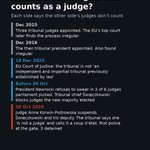
ALT Text card titled "Poland’s court fight: who counts as a judge?" Subtitle: each side says the other side’s judges don’t count. Five dated entries. Dec 2015: three tribunal judges appointed; the EU’s top court later finds the process irregular. Dec 2016: the then tribunal president appointed; also found irregular. 18 Dec 2025: EU Court of Justice says the tribunal is not "an independent and impartial tribunal previously established by law". Before 30 Oct: President Nawrocki refuses to swear in 3 of 6 judges parliament picked, and tribunal chief Święczkowski blocks judges the new majority elected. 30 Oct 2026, in red: Judge Anna Korwin-Piotrowska suspends Święczkowski and his deputy; the tribunal says she "is not a judge" and calls it a coup d’état; riot police at the gate, 3 detained. Footer: sources CJEU C-448/23, Reuters, AP, Euronews.

ALT Texas rock shelter (📸 Panhandle-Plains Historical Museum)


ALT The four members of NASA’s CHAPEA (Crew Health and Performance Exploration Analog) Mission 2 stand in their workspace after spending a year in their isolated and confined habitat. They are wearing black jumpsuits with patches on the arms and chest.


